By Netcomp Solutions | IT Support & Cyber Security Brisbane & Gold Coast
Picture this: your accounts manager gets an email from your “supplier.” Consequently, the email looks perfect — no typos, no weird formatting, and the tone sounds exactly right. So she pays the invoice. But unfortunately, that supplier never sent it. Your business is now $45,000 out of pocket.
This isn’t a hypothetical anymore. Instead, it’s happening right now to small businesses across Brisbane and South East Queensland every single week. Furthermore, in 2026, the old rule of “just look for spelling mistakes” is completely dead. Therefore, every Queensland business owner needs to understand what’s actually changed — and what to do about it.
The New Reality: Why 2026 Is Completely Different
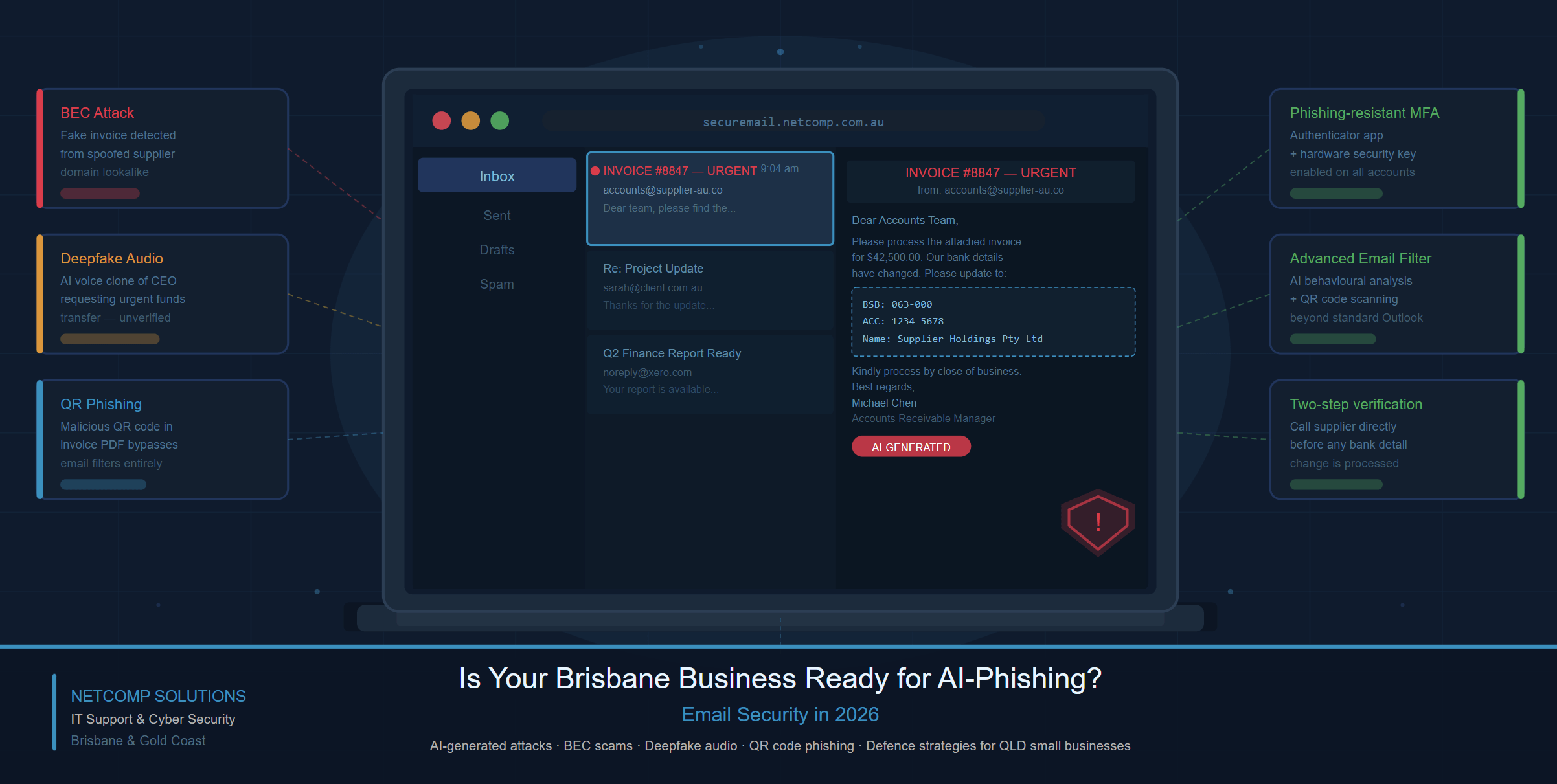
Generative AI has transformed the phishing playbook. Modern scammers use tools like large language models to automate every step of an attack, including language that is grammatically flawless and written in the exact tone of your real contacts.
In other words, the red flags you used to rely on simply no longer exist.
In 2026, today’s campaigns use AI to create highly personalised, grammatically flawless emails that mimic the tone, format, and timing of internal business communication. Additionally, they can be sent at massive scale, targeting dozens of businesses simultaneously.
And if you think this only happens to big corporations, think again.
What Happened to Noosa Council Should Terrify Every QLD Business Owner
Noosa Council was defrauded of $2.3 million in ratepayer funds. The scammers used “sophisticated social engineering AI techniques” to pull it off — and the council had dedicated processes and procedures specifically designed to prevent this type of event.
Mayor Frank Wilkie described the attackers’ methods as “unprecedented,” noting that the technology “enables skilled fraudsters to imitate personalities and individuals to a very high degree.”
Here’s the part that should genuinely concern you: Gold Coast City Council had already lost $2.78 million in a similar attack in November 2023, yet the security recommendations that followed went unimplemented before Noosa was hit in December 2024.
Consequently, Queensland now holds the unfortunate record of losing over $5 million across two local council scams in just over a year. Moreover, if international criminal gangs are targeting local councils with staff, processes, and audit oversight, then your small business in Brisbane or the Gold Coast is absolutely in their sights too.
The “Big Three” Threats Targeting QLD Small Teams Right Now
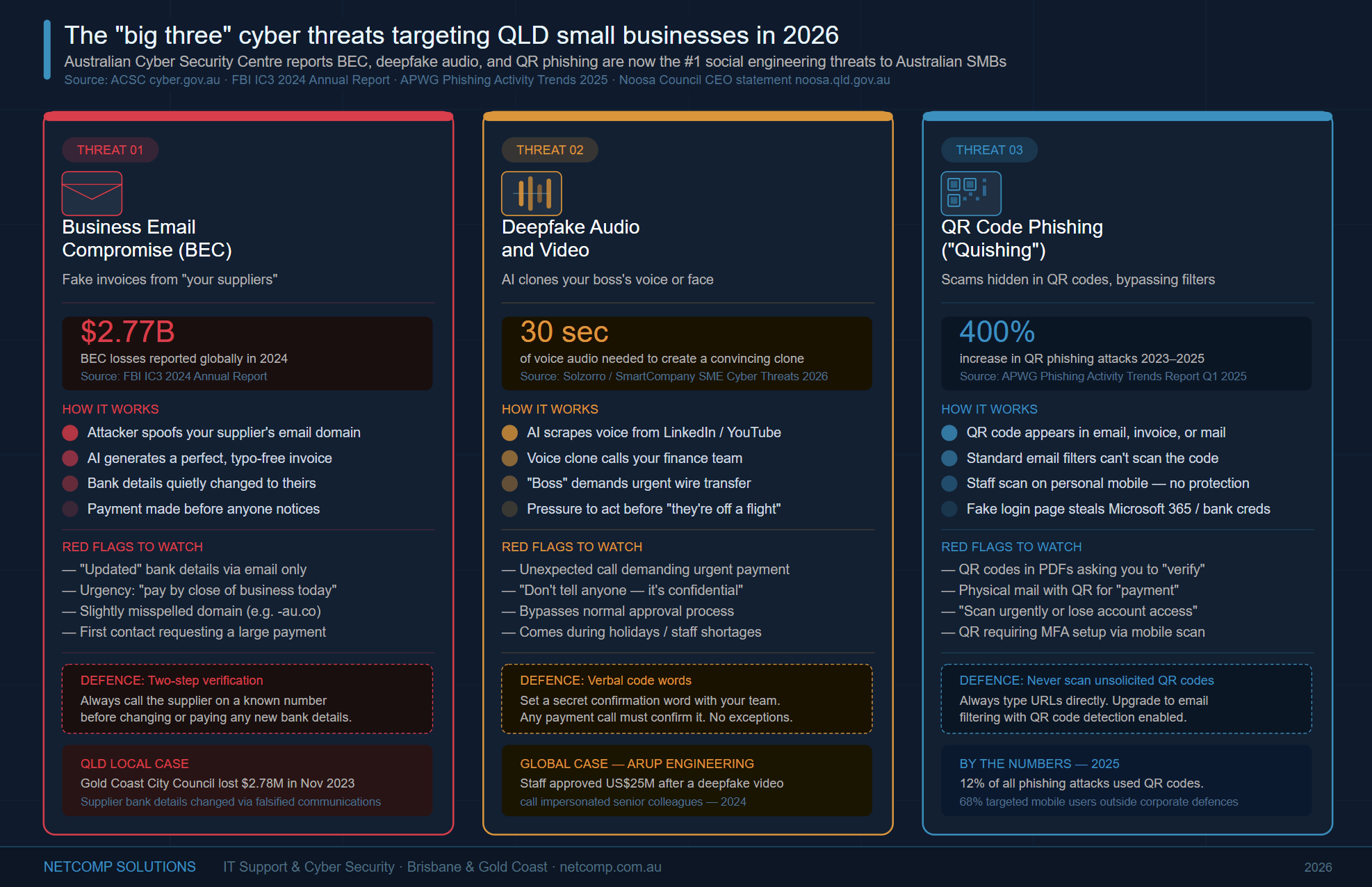
1. Business Email Compromise (BEC): The Fake Invoice Scam
Business Email Compromise is, quite simply, the most financially damaging cyber threat to Australian small businesses today.
In 2026, AI-powered BEC attacks continue to target finance and operations teams with urgent requests for confidential wire transfers or high-value transactions. Rather than relying on generic templates, attackers now use generative AI to replicate vendor branding, formatting, and communication history with remarkable accuracy.
Here’s how it typically plays out for a Brisbane small business:
- Step 1: A scammer monitors your email traffic (or guesses supplier names from your website).
- Step 2: Accordingly, they send a convincing email from a lookalike domain, like “accounts@your-supplier-au.com” instead of “accounts@your-supplier.com.au”
- Step 3: The email contains a real-looking invoice with updated bank details.
- Step 4: Your team pays it without calling to verify, because the email looks completely legitimate.
Australian cybercrime reporting shows BEC remains one of the highest-impact business fraud types, accounting for a significant share of financially damaging incidents in 2025.
2. Deepfake Audio and Video: When “The Boss” Calls
This threat is newer, and therefore it’s even more alarming than BEC.
With just a 30-second clip of a business owner’s voice from a YouTube video or a LinkedIn presentation, AI can create a perfect vocal clone. Furthermore, that clone can call your staff and instruct them to make an urgent payment — sounding exactly like you.
In 2024, an employee at global engineering firm Arup joined a video call with what looked like senior colleagues and approved transfers of approximately $US25 million. Every face and voice on the call was an AI deepfake built from real footage and information.
Similarly, Noosa Council’s mayor confirmed attackers used AI imitation techniques specifically to impersonate council executives and deceive staff into authorising transfers. This approach is now being used against everyday businesses — not just large organisations.
The takeaway? Even a phone call or video call from your boss needs to be verified independently if money is involved.
3. QR Code Phishing (Quishing): The Scam Hiding in Plain Sight
QR code phishing — or “quishing” — is the fastest-growing cyber threat most Brisbane small businesses have never heard of.
QR phishing attacks increased fivefold in 2025, marking one of the fastest-growing cyber threats. Furthermore, 12% of all phishing attacks contained a QR code in 2025, and 68% of quishing attacks specifically targeted mobile users.
Quishing is potent because scans happen on mobile, outside email defences, and URLs are harder to inspect. Attackers commonly place QR codes in invoices, parking notices, and delivery-related messages, as well as in emails, posters, and menus.
The reason this is so dangerous is specifically because your standard email security tools can’t see a malicious link hidden inside a QR code image. Therefore, the attack bypasses your filters entirely and lands directly on your employee’s personal phone.
Here’s what to watch for in your Brisbane business:
- QR codes in PDF attachments asking you to “verify your account”
- Physical mail or printed invoices with QR codes for payment
- Emails with QR codes claiming to set up Microsoft 365 MFA
- “Shared document” notifications requiring a QR scan to access
Approximately 90% of QR code attacks are credential phishing attacks, designed to steal your login details for Microsoft 365, Google Workspace, or your banking portal.
The Essential Email Security Defence Checklist for Brisbane Businesses
✅ Phishing-Resistant MFA: Go Beyond SMS Codes
Multi-factor authentication (MFA) is still one of the best defences available. However, not all MFA is equal in 2026.
SMS-based codes are increasingly bypassed by attackers using real-time interception techniques. Therefore, your Brisbane business needs to upgrade to phishing-resistant MFA:
- Authenticator apps (Microsoft Authenticator, Google Authenticator) are significantly stronger than SMS codes.
- Hardware security keys (like YubiKey) are the gold standard, especially for admin accounts and finance staff.
- FIDO2 hardware keys cryptographically verify the site’s domain. Unlike SMS or TOTP codes, they refuse to authenticate on a proxy site that spoofs a legitimate domain, making them the only fully effective protection against adversary-in-the-middle attacks.
Additionally, make sure MFA is enforced on every account — especially email, accounting software, and cloud storage.
✅ Advanced Email Filtering: Standard Outlook and Gmail Aren’t Enough
Here’s something your standard Microsoft 365 or Google Workspace subscription won’t tell you: the built-in email filters were simply not built for AI-generated threats.
Many small businesses still rely on older email security tools and awareness messages that tell users to look for spelling errors or watch for generic greetings. AI-generated phishing messages often contain no obvious mistakes, use industry-specific language, and match your organisation’s usual tone and formatting. Attackers also use AI to constantly tweak subject lines and wording, so static rules and signature-based filters catch fewer messages.
Consequently, businesses in Brisbane and the Gold Coast need to add a dedicated third-party email security layer on top of their existing platform. Look for solutions that offer:
- AI-powered behavioural analysis that detects unusual sender patterns
- Real-time link scanning at the moment of click, not just at delivery
- QR code detection inside attachments and email bodies
- Domain spoofing protection using DMARC, DKIM, and SPF enforcement
- Impersonation detection that flags emails pretending to be your CEO or key suppliers
This isn’t optional in 2026 — it’s foundational.
✅ The Human Firewall: Build a “Question Everything” Culture
Technology alone, however, will never be enough. Your team is simultaneously your greatest vulnerability and your strongest line of defence.
After one year of sustained security awareness training, ANZ organisations achieved an average phishing susceptibility rate of just 4.9% — a gold standard result. However, one-off workshops don’t work. Employees forget, and attackers evolve. Real-time coaching and simulations are necessary to keep employees alert to new tactics.
Practically speaking, here’s how to build a “Question Everything” culture in your Brisbane small business:
- Run regular phishing simulations — not to shame staff, but to build muscle memory.
- Make reporting easy and blame-free — if someone almost falls for a scam, you want to know.
- Brief your team monthly on new scam types circulating in Australia. The Australian Cyber Security Centre (ACSC) publishes regular alerts at cyber.gov.au.
- Create a “pause before you pay” rule — any payment or bank detail change gets a second look before action.
- Post a visible reminder near payment terminals or accounting workstations about verification procedures.
Government-backed initiatives like the Cyber Wardens program offer free baseline training for small businesses and give your team a starting framework. It’s a great free starting point for Queensland small businesses.
The “Two-Step” Verification Policy Every Brisbane Business Needs Today
This is arguably the single most important policy you can implement this week. Moreover, it costs you nothing but a few minutes of time.
The rule is simple: Any request to change bank details, make an urgent payment, or transfer funds must be verified via a second, completely separate communication channel — and that channel cannot be email.
Here’s how it works in practice:
- You receive an email from a supplier saying their bank details have changed.
- Before acting, you pick up the phone and call the supplier’s verified number (from your existing records, not from the email).
- You confirm verbally that the change is legitimate.
- Only then do you update the details or make the payment.
That’s it. Consequently, this one simple step would have prevented the Noosa Council fraud, the Gold Coast Council fraud, and thousands of BEC attacks on Australian small businesses each year.
Additionally, apply this rule to:
- New supplier registrations with bank details
- Payroll changes submitted via email
- “Urgent” payment requests from your director or CEO
- Any request that creates time pressure to skip normal approval steps
Document this policy, share it with your whole team, and review it every six months.
When to Call a Brisbane or Gold Coast MSP for a Cyber Security Audit
Sometimes, knowing where to start is the hardest part. Furthermore, most small business owners are running their business — not monitoring the latest cyber threat intelligence.
That’s precisely where a local Managed Service Provider (MSP) like Netcomp Solutions becomes genuinely valuable.
For SMEs with around 25 staff, a managed service can give you monitoring, incident response, and strategy without hiring a full-time security team.
Specifically, you should consider calling a Brisbane or Gold Coast IT security specialist if:
- You haven’t had a security audit in the past 12 months — your risk profile changes constantly.
- Your team uses standard Microsoft 365 or Google Workspace without added security layers — built-in filters are not enough in 2026.
- You don’t have a formal process for verifying supplier bank changes — this alone is a critical gap.
- You’ve grown your team recently — new staff are the highest-risk targets for social engineering.
- You handle sensitive client data or financial transactions — your risk exposure is significantly higher.
- You’re not sure if MFA is properly configured across all business accounts and systems.
A professional cyber security audit from a local Brisbane or Gold Coast MSP will typically assess:
- Your current email security configuration
- MFA implementation across all user accounts
- Staff phishing awareness levels (via safe simulation testing)
- Your incident response plan (or lack thereof)
- Your backup and recovery capability if ransomware hits
The cost of a security audit is a fraction of the cost of recovering from a single successful phishing attack. Additionally, the peace of mind alone is worth every dollar.
Quick Reference: Your 2026 AI-Phishing Defence Checklist
| Action | Priority | Who’s Responsible |
|---|---|---|
| Enable MFA on all accounts (upgrade from SMS) | 🔴 Urgent | IT / MSP |
| Add advanced email security filtering | 🔴 Urgent | IT / MSP |
| Implement Two-Step bank verification policy | 🔴 Urgent | Business Owner |
| Train staff on AI phishing + BEC threats | 🟡 High | Business Owner + IT |
| Set up DMARC, DKIM, SPF on your domain | 🟡 High | IT / MSP |
| Run a phishing simulation with your team | 🟡 High | IT / MSP |
| Book a full cyber security audit | 🟢 Recommended | MSP |
Protect Your Brisbane Business Before It’s Too Late
AI-phishing in 2026 is not a future problem. Rather, it’s happening right now to businesses just like yours across Brisbane and the Gold Coast. Furthermore, the attacks are more convincing, more targeted, and more damaging than ever before.
However, the good news is that most successful attacks exploit simple, fixable gaps. Therefore, a small number of practical steps — the Two-Step verification policy, phishing-resistant MFA, upgraded email filtering, and a well-briefed team — can dramatically reduce your risk.
Netcomp Solutions provides IT support and cyber security services to small and medium businesses across Brisbane and the Gold Coast. Additionally, our team stays ahead of emerging threats so your business doesn’t have to. Whether you need a full cyber security audit, help configuring advanced email protection, or staff awareness training tailored to your industry, we’re here to help.
👉 Contact Netcomp Solutions today to book your cyber security review before scammers make the decision for you.
Netcomp Solutions | IT Support & Cyber Security | Brisbane & Gold Coast | www.netcomp.com.au