By Netcomp Solutions | IT Support & Cyber Security | Brisbane & Gold Coast
Your Chatbot Is Yesterday’s News — Here’s What’s Really Running in 2026
Picture this: it’s 2:47am on a Tuesday. Your Fortitude Valley accounting firm is sleeping. Meanwhile, a sophisticated AI-generated phishing campaign is quietly probing your Microsoft 365 login page, crafted so perfectly it would fool even a seasoned IT professional.
There’s no human on your team awake to stop it. But there is something else — a multi-agent AI system, silently working. Additionally, it doesn’t just flag the threat; it isolates it, logs the evidence, and alerts your managed IT provider before a single credential is stolen.
Surprisingly, this isn’t science fiction. Consequently, for Brisbane small businesses that get this right in 2026, it’s the new competitive advantage. But for those still relying on yesterday’s tools, it’s the gap that attackers are already walking through.
This guide explains exactly what multi-agent AI systems are, why they matter locally, and how your South East Queensland business can start using them safely today.
What Exactly Is a Multi-Agent AI System?
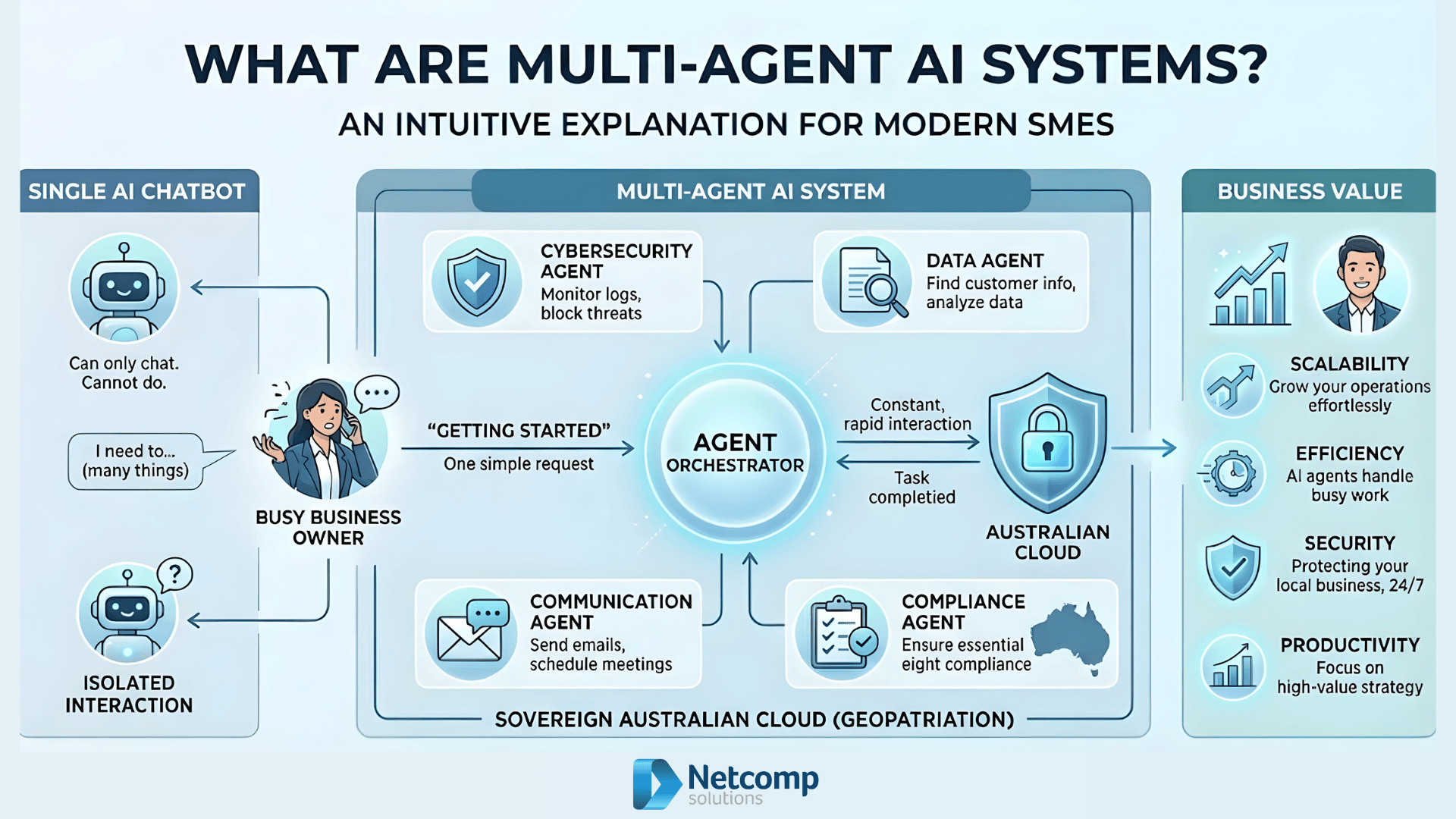
Most people have used a basic AI chatbot. However, a single chatbot is a bit like hiring one worker and expecting them to handle your accounts, answer phones, monitor your security cameras, and manage your inbox — simultaneously.
Multi-agent AI systems work differently. Instead, they deploy a coordinated team of specialised AI agents, each with a defined role, working together through a process called AI agent orchestration. Furthermore, an orchestrator agent acts as the team manager, directing tasks to the right specialist in real time.
In practical terms for a Brisbane SME, this could look like:
- A monitoring agent that watches your network traffic 24/7 for unusual patterns
- A triage agent that analyses whether a flagged event is a genuine threat or a false alarm
- A response agent that automatically isolates a compromised device from your network
- A compliance agent that logs the incident and generates an audit trail for your Essential Eight reporting
Together, these agents form an autonomous AI workflow — one that operates continuously, at machine speed, without human fatigue. Therefore, the result is a level of cyber defence that a small Brisbane business simply could not afford to hire in human form.
According to Palo Alto Networks’ 2026 cybersecurity predictions, enterprises are already deploying a massive wave of AI agents in 2026, and these systems are finally providing the “force multiplier” that security teams have desperately needed — triaging alerts to end alert fatigue and autonomously blocking threats in seconds.
The Real Threat: Why Brisbane SMEs Can No Longer Spot Phishing Alone
Here’s a number that should concern every Gold Coast and Brisbane business owner: a cybercrime is reported every 6 minutes across Australia, and the average self-reported cost of cybercrime for an Australian small business has climbed to $56,600 — a 14% rise on the previous year.
Even more alarming, the 2026 threat environment is dominated by “industrialised” cybercrime, where attackers deploy autonomous AI agents that work exponentially faster than human hackers. Phishing has evolved into “AI-Phishing 2.0,” which uses perfect grammar and deepfake technology to impersonate trusted vendors or even company directors.
Consequently, traditional cyber awareness training — the “look for spelling mistakes” approach — is becoming dangerously outdated. Furthermore, the sophistication of modern attacks and the speed at which they spread have both increased dramatically, making proactive cyber security investment far more cost effective than reactive recovery.
So, how do you fight an AI-powered attack? Logically, with AI-powered defence.
Digital Sentries: How Agentic AI Is Reshaping Cyber Defence
Think of multi-agent AI security systems as your business’s digital sentry team. Moreover, unlike a security guard who checks the door once an hour, these agents are always watching, always learning, and always ready to act.
These autonomous AI systems never sleep, but they act like privileged users at machine speed — constantly monitoring access, flagging anomalies, and responding to threats in real time.
For Brisbane and Gold Coast businesses, multi-agent system security operates across several critical layers:
Email and Phishing Defence Specifically, one agent monitors incoming email patterns for behavioural anomalies — not just keywords. Additionally, when an AI-generated phishing email lands that looks legitimate, the agent cross-references the sender’s domain history, the login time, and the geographic location of the request. Subsequently, within milliseconds, it makes a decision a human couldn’t confidently make in minutes.
Endpoint and Network Monitoring Meanwhile, another agent watches your staff laptops, servers, and cloud connections. Notably, agentic systems operate in “observe, orient, decide, act” loops, and when compromised, can execute unauthorised commands, exfiltrate data, and move laterally across systems — but properly configured defence agents do exactly the same thing to detect and contain such movements before damage occurs.
Automated Incident Response Furthermore, when a threat is confirmed, a response agent can immediately quarantine the affected device, revoke compromised credentials, and preserve forensic evidence — all before you’ve finished your morning coffee. Therefore, the speed advantage alone significantly reduces your exposure window.
According to Bessemer Venture Partners’ 2026 security briefing, agentic attacks traverse systems, exfiltrate data, and escalate privileges at machine speed — before a human analyst can respond. Consequently, the only viable defence is an equally fast automated response.
The Local Compliance Angle: Sovereign AI and the Essential Eight
Here’s something many Brisbane businesses don’t realise: where your AI agents run matters as much as what they do.
If your multi-agent AI system is processing sensitive business data through overseas cloud servers, you could be inadvertently breaching Australian privacy obligations — even if the tool itself is perfectly legal.
Geopatriation — the practice of keeping your data and AI workloads hosted within Australian borders — is therefore becoming a critical issue for South East Queensland businesses in 2026. Additionally, new national benchmarks from 2026 are standardising cybersecurity practices economy-wide, and the expanded Security of Critical Infrastructure Act has tightened obligations across essential services.
Locally-hosted, sovereign AI infrastructure ensures your agentic workflows comply with:
- The Essential Eight framework — Australia’s baseline cybersecurity standard developed by the Australian Signals Directorate (ASD). In 2026, the expectations around cyber security for Australian businesses have shifted from best-practice guidance to an expected baseline, with the Essential Eight framework at the centre of these expectations.
- The Privacy Act 1988 — including Notifiable Data Breach obligations that require you to know exactly where your data lives
- Cyber insurance requirements — many Australian insurers now refuse cover or hike premiums for businesses that cannot prove they meet baseline security standards.
Furthermore, cloud strategies in Australia are moving towards greater autonomy, with leaders wanting the ability to move workloads easily, enforce strong data controls, and run AI where it is most effective.
At Netcomp Solutions, we specifically architect agentic AI workflows for Brisbane and Gold Coast SMEs using Australian-hosted sovereign cloud infrastructure — ensuring you get the security benefits of automation without crossing compliance lines.
Automating Business Processes in 2026: Beyond Security
It’s worth noting that multi-agent AI systems aren’t just for cyber defence. Additionally, they’re quietly transforming how Brisbane small businesses run day-to-day operations — and the economic case is compelling.
Consider what autonomous AI workflows can handle:
- Customer service and ticket triage. One agent classifies incoming support requests; another routes them to the right staff member; a third follows up on unresolved issues automatically.
- Invoice and accounts processing. Agents cross-check supplier invoices against purchase orders and flag discrepancies before payment. It’s a particularly powerful defence against Business Email Compromise.
- IT helpdesk automation. Routine tasks like password resets, software installations, and system health checks are handled automatically, freeing your IT support team for higher-value work.
- Compliance reporting. Agents continuously log system activity and auto-generate Essential Eight audit reports, saving hours of manual documentation.
Consequently, for Brisbane SMEs already stretched on staffing and budget, this kind of managed IT automation represents a genuine competitive advantage — not a luxury reserved for large corporations.
McKinsey research confirms that over the next 12 months, companies expect the share of fully implemented agentic AI solutions to more than double. And therefore forward-thinking small businesses that move now will be significantly ahead of competitors still relying on manual processes.
The Risks You Need to Manage: AI Governance for Small Business
We’d be doing you a disservice if we only told you the benefits. So let’s be direct: multi-agent AI systems also introduce new risks that require careful management.
According to PwC research, 79% of organisations are already adopting AI agents. Yet most are still in early stages, and security governance is lagging well behind deployment speed. That gap is dangerous territory.
Specifically, Brisbane SMEs need to watch for:
- Prompt injection attacks. Malicious actors can craft inputs that “trick” an AI agent into taking unintended actions, such as exfiltrating data.
- Over-privileged agents. Agents should be given access only to the tools they need, with “Just-in-Time” permissions granted only for the required duration of a specific task, rather than broader system access.
- Cascading failures. In a multi-agent system, one compromised agent can mislead downstream agents. Therefore, cascading failures propagate through agent networks faster than traditional incident response can contain them.
- Shadow AI. Staff using unauthorised AI tools that process sensitive business data outside your governance framework
The solution is AI governance for small business — a clear, documented policy defining which AI tools are approved, what data they can access, and how they’re monitored. Furthermore, this isn’t optional anymore; it’s rapidly becoming a requirement for cyber insurance and government contracting in Queensland.
Getting Started: A Checklist for Brisbane SMEs Ready to Automate Safely
If you’re a Brisbane or Gold Coast small business considering your first agentic AI workflow, use this practical checklist to start safely:
✅ Step 1 — Identify Your First Automation Candidate. Start small and specific. Additionally, look for a repetitive, rule-based process that currently consumes significant staff time. For example, IT helpdesk ticketing, invoice matching, or email triage are ideal starting points.
✅ Step 2 — Audit Your Current Security Posture First. Before adding AI automation, ensure your foundational security is solid. Specifically, confirm you have Multi-Factor Authentication (MFA) enabled, software patching up to date, and backups verified — these are the first three pillars of Essential Eight compliance.
✅ Step 3 — Demand Australian Data Sovereignty. Ask your IT provider explicitly: where will this AI agent’s data be processed and stored? Furthermore, insist on Australian-hosted infrastructure to maintain compliance with local privacy laws under the Privacy Act 1988.
✅ Step 4 — Define Least-Privilege Access. Each AI agent should only have access to the systems it absolutely needs. Consequently, work with your IT support partner to scope permissions tightly — and document them for your audit trail.
✅ Step 5 — Establish Human Oversight Checkpoints. Autonomous doesn’t mean unsupervised. Therefore, set up clear escalation rules so that high-risk agent actions. For example deleting data, making payments, or modifying security settings — always require human approval before execution.
✅ Step 6 — Build Your AI Governance Policy. Document which AI tools are approved, what data classifications they can access, and how incidents will be reported. Moreover, this document will be increasingly required by insurers and government contract managers.
✅ Step 7 — Review and Test Regularly. AI agents aren’t “set and forget.” Additionally, schedule quarterly reviews with your managed IT provider to test agent behaviour, review access logs, and update your governance policy as threats evolve.
Why Brisbane Businesses Choose Netcomp Solutions
Netcomp Solutions has been helping Brisbane and Gold Coast small businesses navigate complex IT challenges for years. However, 2026 is unlike any year that’s come before it — and we’ve built our services accordingly.
Our team specifically offers:
- Managed IT automation designed and deployed on Australian sovereign cloud infrastructure
- Essential Eight compliance assessment and implementation for South East Queensland SMEs
- AI governance frameworks tailored to your business size and industry
- 24/7 multi-agent cyber defence that monitors your environment around the clock
- IT support Brisbane businesses can reach by phone, not just a chatbot
We believe that multi-agent AI security shouldn’t be something only enterprise-level businesses can access. Ultimately, every tradesperson in Capalaba, every accounting firm in Newstead, and every retail business on the Gold Coast deserves the same quality of autonomous cyber defence.
The Bottom Line: Act Now or Play Catch-Up Later
The shift from passive chatbots to active, autonomous AI agents is already happening — and Brisbane cybercriminals are taking full advantage of it.
However, the good news is that the same technology being weaponised against you can also be the system that stops attacks before they start. Furthermore, for Brisbane and Gold Coast small businesses, the window to get ahead of this shift is open right now. But it won’t stay open forever.
The next step is straightforward: contact Netcomp Solutions for a no-obligation Essential Eight assessment and AI readiness review. Together, we’ll identify your biggest vulnerabilities, your best automation opportunities, and the clearest path to a genuinely secure, efficient business in 2026.
📞 Contact Netcomp Solutions 🌐 www.netcomp.com.au 📍 Serving Brisbane, Gold Coast & South East Queensland