
Here’s a question worth sitting with for a moment. When did you last update your privacy policy?
If you’re like most Queensland small business owners, the honest answer is probably “I’m not sure.” But here’s the thing — that answer could now cost you up to $66,000. Not because you suffered a data breach, but simply because your policy isn’t written clearly enough.
Australia’s privacy landscape changed permanently in 2024. So, the regulators aren’t waiting around for something to go wrong anymore. Instead, they’re actively auditing businesses right now — and Queensland is firmly in their sights. This guide explains exactly what’s happening, who’s at risk, and what you can do today to protect your business.
What Are the 2026 Privacy Act Reforms? A Quick Overview
First, let’s recap what changed. The Privacy and Other Legislation Amendment Act 2024 (POLA Act) is the most significant overhaul of Australian privacy law in decades. Accordingly, it gave the Office of the Australian Information Commissioner (OAIC) real teeth — expanded enforcement powers, new civil penalties, and the ability to issue infringement notices for everyday non-compliance.
Previously, the OAIC mostly reacted to major data breaches. Now, however, they can proactively audit your business, review your website, and issue fines before anything has actually gone wrong.
Importantly, the Act applies to businesses with an annual turnover above $3 million. Additionally, proposals are in motion to eventually remove the small business exemption altogether — meaning even smaller operators should get ahead of this now.
Source: Privacy and Other Legislation Amendment Act 2024 — OAIC
The OAIC Compliance Sweep Is Already Underway
Many Brisbane business owners assume regulators only show up after a hack. Unfortunately, that’s no longer how it works.
In the first week of January 2026, the OAIC launched Australia’s first-ever privacy compliance sweep. Specifically, they are actively reviewing the privacy policies of approximately 60 businesses across six high-risk sectors. Furthermore, the OAIC Commissioner, Carly Kind, made clear that this is just the beginning of a sustained enforcement era — not a one-off event.
The six sectors currently being targeted include:
- Rental and property — collecting personal details at open homes and inspections
- Licensed venues — requiring ID for entry (think Gold Coast nightlife)
- Chemists and pharmacies — gathering identity information at point of sale
- Car rental companies — collecting driver’s licences and personal details
- Car dealerships — capturing data during test drives
- Pawnbrokers and second-hand dealers — holding high volumes of personal ID
The Queensland Angle: Why Brisbane and the Gold Coast Are in the Crosshairs
Queensland businesses are particularly exposed right now. Specifically, Brisbane real estate agents and Gold Coast hospitality venues are prime targets because they collect large volumes of personal data face-to-face every single day.
Think about it — a busy Gold Coast venue checking IDs at the door collects names, addresses, and dates of birth hundreds of times a week. Similarly, a Brisbane real estate agent gathers phone numbers, incomes, and identification documents at every open home. Consequently, the OAIC views these situations as having significant “power and information asymmetries” — in plain English, customers often feel they have to hand over their data with little choice or transparency.
The $66,000 “Speeding Ticket”: A New Kind of Privacy Fine
Let’s talk about the fine that’s getting everyone’s attention. Under the new reforms, the OAIC can now issue what’s called an infringement notice — and legal experts are already comparing it to a cyber speeding ticket.
Here’s what makes this different from anything before:
- Old system: You only got hit with massive penalties after a serious, high-profile data breach.
- New system: Simply having a non-compliant or unclear privacy policy can now result in a fine of up to $66,000 for eligible entities.
Critically, you don’t need to have done anything malicious. Instead, you just need to have failed to meet the basic transparency requirements of the law. Notably, this is separate from the higher civil penalties — up to $330,000 for companies — that apply to more serious cases.
Think of it this way: previously, a privacy fine was like a criminal charge that required a court case. Now, however, it’s more like a speeding camera. The regulator sees the issue, issues the notice, and you pay the fine. Straightforward, and consequently quite alarming for unprepared businesses.
Source: Russell Kennedy Lawyers — OAIC’s 2026 Privacy Policy Sweep
The “14-Year-Old” Rule: Understanding APP 1.4
Here’s the compliance standard that surprises most business owners. Under Australian Privacy Principle 1.4 (APP 1.4), your privacy policy must be “clearly expressed and up to date.”
The OAIC’s own guidance — and the Bunnings case that went all the way to the Administrative Review Tribunal — confirms that vague, jargon-heavy policies are a direct compliance liability. Therefore, a useful internal test is this: Could a 14-year-old read your privacy policy and understand it?
If the answer is no, your policy is likely non-compliant.
Specifically, under APP 1.4, your policy must clearly explain:
- What kinds of personal information you collect and hold
- How you collect that information (e.g., website cookies, paper forms, over the phone)
- Why you collect it and how you use it
- Who you might share it with (including overseas recipients)
- How customers can access, correct, or complain about their data
Accordingly, those old copy-paste “lawyer templates” sitting on most small business websites are now a serious risk. The Bunnings case confirmed this — even though Bunnings wasn’t found to have breached privacy in its use of facial recognition technology, it was found to have an unclear and non-compliant privacy policy. So, if it happened to Bunnings, it can happen to anyone.
New for 2026: You Must Now Disclose AI and Automated Decision-Making
This is the update that catches most businesses off guard. From 10 December 2026, new privacy requirements under APPs 1.7–1.9 will require businesses to disclose in their privacy policy when they use automated decision-making (ADM) that affects customers.
What counts as ADM? Essentially, any automated software or AI tool that makes — or assists in making — decisions about people. Common examples include:
- Credit checks or lending decisions processed by automated systems
- Rental application assessments using automated scoring
- Automated pricing that differs based on customer data
- AI-generated marketing profiling that determines what offers customers see
- Chatbots or automated screening tools in hiring or customer service
Even if you’re a small Brisbane business using off-the-shelf software that includes AI features, you may already be using ADM without realising it. Therefore, you need to check your tools, understand how they work, and update your privacy policy accordingly before the December 2026 deadline.
Data Sovereignty: The Local Queensland Advantage
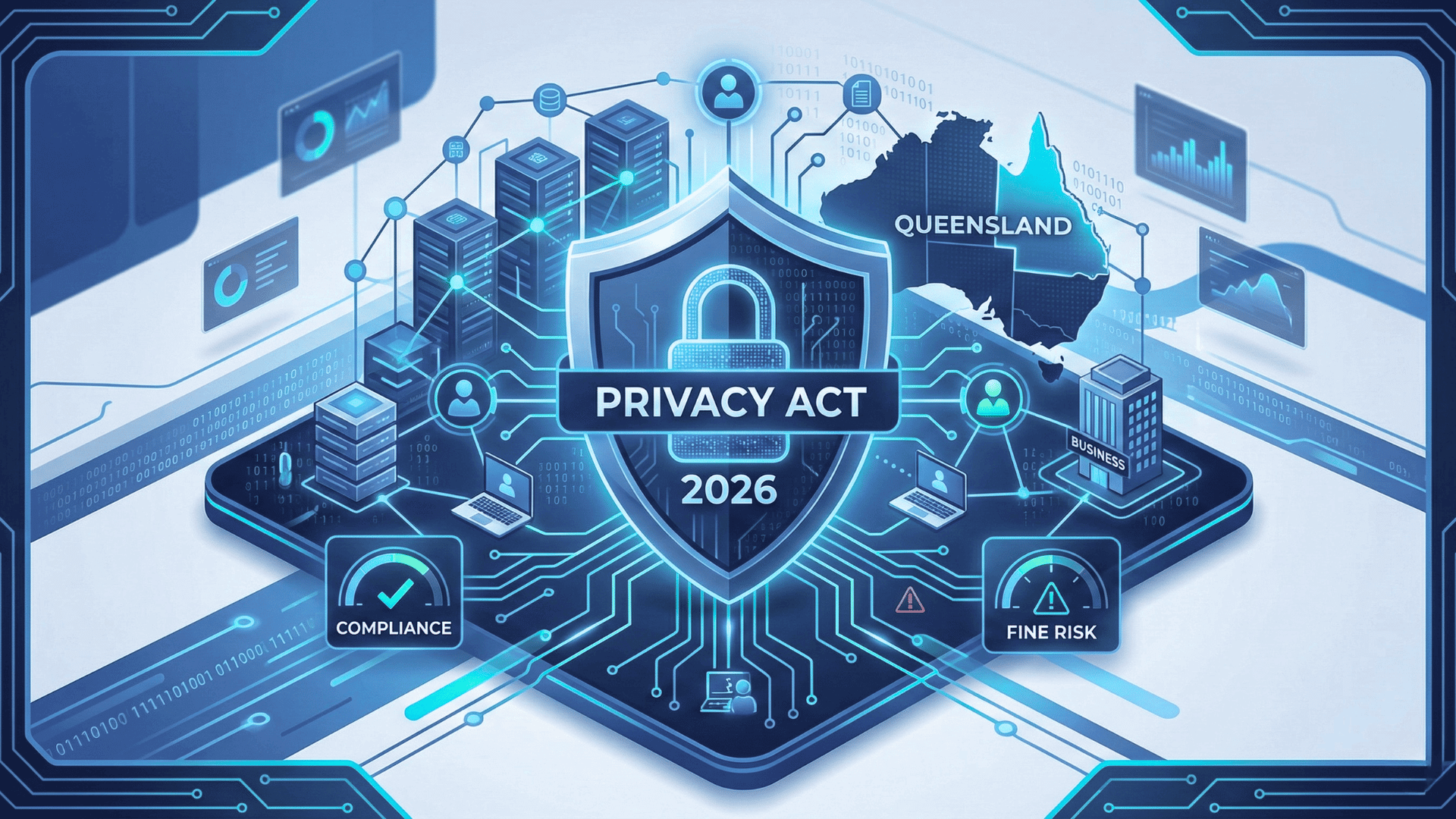
Here’s something the legal articles often miss — the practical benefit of keeping your data local.
The new Privacy Act reforms place greater emphasis on where your data is stored and who can access it. Specifically, APP 1.4 requires businesses to disclose whether personal information is likely to be sent overseas and, if so, to which countries.
For many Queensland businesses, data is silently stored on overseas servers — US-based cloud platforms, for example — without their customers knowing. Consequently, this creates a direct compliance issue under the Act. Moreover, if data is stored overseas, it’s governed by that country’s laws, not Australian ones, making compliance significantly harder.
Conversely, by partnering with a local Brisbane Managed Service Provider (MSP) like Netcomp Solutions, your business data stays under Australian jurisdiction. This approach makes it far simpler to:
- Comply with data sovereignty requirements under the Privacy Act
- Accurately disclose data storage locations in your privacy policy
- Respond quickly to any OAIC inquiry or audit
- Demonstrate to customers that their data is protected locally
For Brisbane and Gold Coast businesses, keeping data onshore isn’t just ethically sound — it’s increasingly a legal requirement that simplifies your overall compliance position.
Your Quick Privacy Compliance Checklist
Use this checklist to identify any gaps in your current privacy practices. Importantly, tick every item before considering your policy compliant.
- Data collection methods listed? Does your policy explain how you collect data — e.g., website cookies, paper forms, phone calls, and in-person collection?
- Overseas storage disclosed? Do you name the countries where data might be stored — e.g., US-based cloud platforms vs. Australian-based servers?
- Complaints process visible? Is there a clear, easy-to-find process for customers to raise a privacy complaint?
- AI tools disclosed? Have you updated your policy to mention any AI tools or automated software that uses customer data?
- Plain English language? Could a non-technical person — say, a 14-year-old — understand your policy without a law degree?
- Policy reviewed in 2024 or later? Has your privacy policy been reviewed since the POLA Act passed?
What Should Brisbane and Gold Coast Small Businesses Do Right Now?
This doesn’t have to be overwhelming. In fact, here’s a practical, prioritised action plan:
Step 1 — Audit your existing privacy policy. Specifically, review it against the APP 1.4 checklist above. Does it clearly explain what you collect, how, why, and where it goes?
Step 2 — Rewrite it in plain English. Ditch the legal templates. Instead, use simple, conversational language that your customers will actually understand.
Step 3 — Map your data. Understand exactly what data you collect, how you collect it, and where it’s stored. Notably, this includes any third-party tools, cloud platforms, or apps you use.
Step 4 — Check for AI tools. Review every piece of software your business uses. Furthermore, identify anything that uses automation or AI to process customer data, and plan to disclose it in your policy before December 2026.
Step 5 — Work with a local IT partner. An experienced Brisbane IT support and cyber security provider can help you map your data, review your systems, ensure your data stays onshore, and build a compliance-ready IT environment.
How Netcomp Solutions Helps Brisbane Businesses Stay Compliant
At Netcomp Solutions, we’ve been helping Brisbane and Gold Coast businesses navigate IT security and compliance challenges for years. Consequently, we understand that privacy compliance isn’t just a legal checkbox — it’s a business risk that needs practical, local expertise.
Our team can help you:
- Audit your current IT systems to identify where personal data is stored and how it flows
- Recommend Australian-based, data-sovereign cloud solutions to keep your data onshore
- Implement cyber security controls that reduce your risk of a data breach and simplify compliance
- Provide ongoing IT support so your systems stay secure, compliant, and up to date
We’re a local Brisbane MSP — not a global faceless platform. As a result, when your business needs answers fast, we’re right here.
Ready to get your Privacy Act compliance sorted? Contact Netcomp Solutions today and let’s make sure your business is protected before the next compliance sweep finds you.
This article is for informational purposes only and does not constitute legal advice. For specific legal guidance, consult a qualified Australian privacy lawyer.