Technically reviewed by Vitaly Ogulev, founder of Netcomp Solutions (Brisbane managed IT and cyber security since 2002).
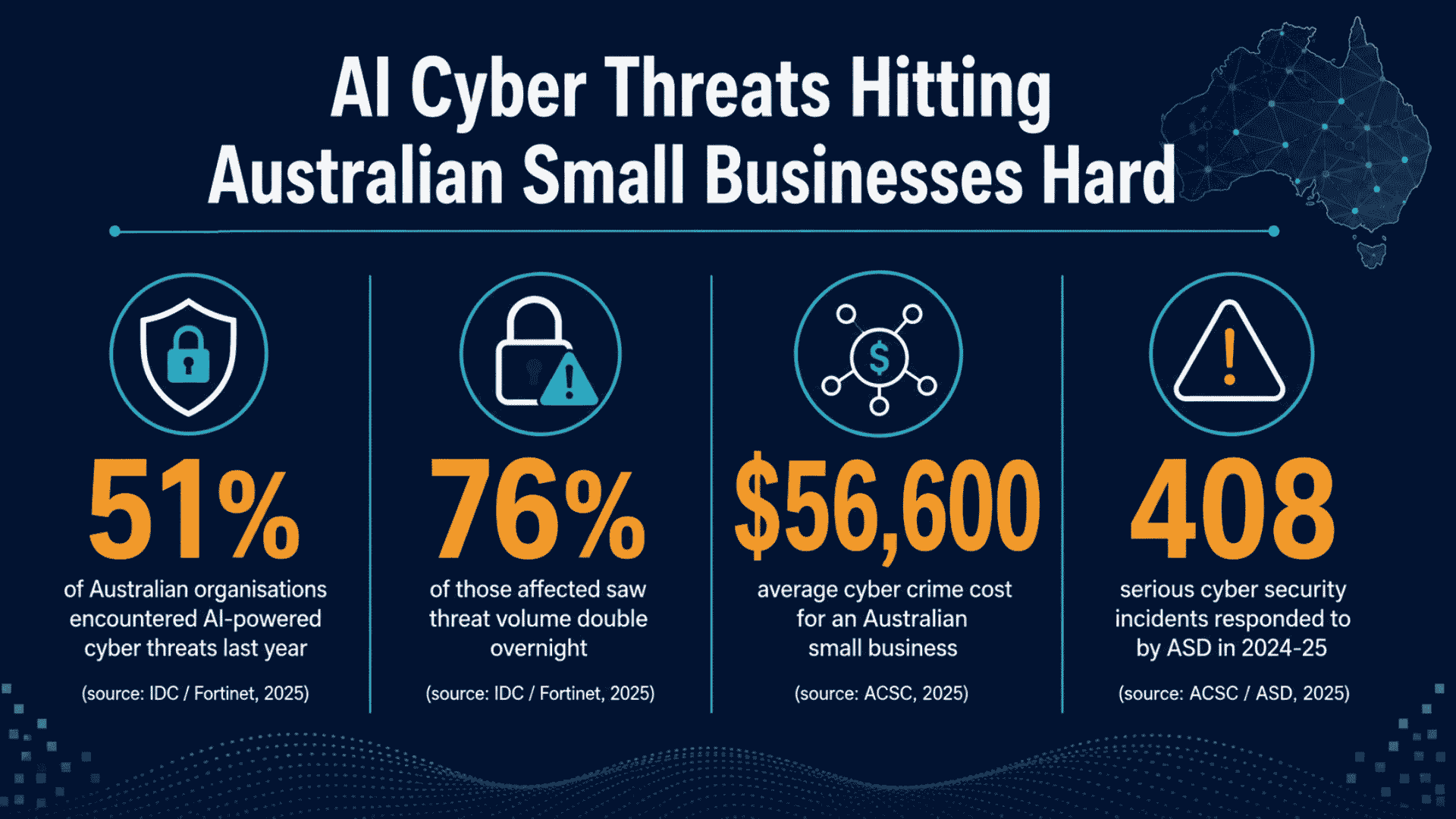
Australian small businesses are under attack like never before. The weapon of choice is artificial intelligence. According to recent research, nearly 51% of organisations across Australia reported encountering AI-powered cyber threats in the past year. 76% of those affected saw threat volumes double overnight. For Brisbane small business owners juggling tight budgets and lean IT resources, this is not a distant corporate problem. The average cost of a cyber crime incident for a small business in Australia has climbed to $56,600, up 14% in a single year. One convincing phishing email, one automated intrusion attempt, one AI-generated invoice scam, and your year’s profit is gone. Understanding how AI cyber security Australia has become a frontline issue — and what you can actually do about it — is no longer optional.
How Weaponised AI Is Supercharging Cyber Attacks on Australian SMEs
Not long ago, a phishing email was relatively easy to spot. Odd grammar, suspicious sender addresses, and generic greetings were dead giveaways. AI has changed all of that. Cybercriminals now use large language models and machine learning tools to craft hyper-personalised phishing messages. These messages read like they came from your accountant, your supplier, or even your own director.
AI-powered cyber attacks are not a future concern in Australia. They are happening right now. Threat actors use AI to scrape publicly available information from LinkedIn, business websites, and social media. They build detailed profiles of their targets. They then generate emails, SMS messages, and even voice calls that are almost indistinguishable from legitimate contacts. This is called spear-phishing at scale. It used to require significant manual effort. AI automates the entire process.
Beyond phishing, AI now accelerates reconnaissance, identifies software vulnerabilities faster than human analysts can patch them, and adapts malware in real time to evade traditional antivirus detection. Moreover, weaponised AI is the defining threat theme of 2026, requiring adaptive, intelligence-driven defence programs. For a Brisbane tradie, retailer, or professional services firm with no dedicated IT team, that is a genuinely alarming shift in the threat landscape.
The Specific AI Threats Hitting Brisbane Small Businesses Right Now
While large enterprises attract headlines, small businesses are increasingly the preferred target precisely because their defences tend to be weaker. Here are the AI-driven attack types most relevant to Brisbane SMEs in 2026.
AI-Generated Business Email Compromise
Business Email Compromise (BEC) has always been lucrative for attackers. AI makes it devastatingly efficient. Using publicly available data and sometimes access to a compromised email thread, AI tools can generate convincing payment redirection requests or supplier invoice fraud. They do this at a scale that would previously have required a team of human attackers. A single successful BEC event can cost a small business tens of thousands of dollars with no guarantee of recovery.
Automated Credential Stuffing and Account Takeover
AI-driven tools can test millions of stolen username and password combinations against business systems in minutes. If your staff reuse passwords across personal and work accounts — which is extremely common — attackers can quietly compromise your Microsoft 365, your accounting platform, or your cloud storage without triggering any obvious alarm.
AI-Assisted Ransomware Deployment
Ransomware operators use machine learning to identify the most valuable files on a network, spread laterally to connected systems, and time their encryption to cause maximum disruption. What used to take days of manual intrusion can now happen in hours. Supply-chain risk assessments have dropped to just 70% among even larger Australian organisations, leaving entry points into small businesses through their technology suppliers dangerously underguarded.
Why Brisbane Small Businesses Are Especially Vulnerable
There is a persistent and dangerous myth that small businesses are too small to be worth attacking. The reality in 2026 is the opposite. AI makes attacking thousands of small businesses simultaneously more cost-effective for criminals than targeting one well-defended enterprise. Brisbane SMEs are attractive targets for several reasons.
First, many operate with limited or no dedicated IT support. Business owners make security decisions while also managing operations, staff, and cash flow. There is rarely time to stay across evolving threats. Second, small businesses frequently hold valuable data — including client records, financial details, and intellectual property — without the enterprise-grade protections that larger organisations employ. Third, small firms often serve as entry points into larger supply chains. Compromising a Brisbane bookkeeper or logistics company can give an attacker a foothold into their much larger clients.
The numbers reinforce this reality. ASD’s ACSC responded to over 1,200 cyber security incidents across Australia in 2024–25 — an 11% increase on the prior year — and that figure only captures reported incidents. The true volume is almost certainly far higher, as unreported incidents quietly devastate small businesses every day. AI-powered attacks now run at double or even triple last year’s volume. The risk window for SMEs is widening rapidly.
AI as a Defender: How Machine Learning Can Level the Playing Field
The same AI technology attackers weaponise can also defend your business. This is where the conversation gets genuinely encouraging for Brisbane small businesses, particularly those working with a managed IT provider.
AI cyber defence for small business is now commercially viable in a way it simply was not five years ago. Modern security platforms use machine learning threat detection Australia-wide to establish what normal looks like inside your network and flag anomalies in real time. Instead of waiting for a known malware signature, machine learning models detect unusual login times, strange data transfers, or unexpected software behaviour and trigger alerts or automatic responses before damage occurs.
According to the ASD Annual Cyber Threat Report 2024–25, AI and machine learning are increasingly critical for under-resourced SMEs. They automate the monitoring and response work that would otherwise require a full-time security analyst. A Brisbane business that cannot afford a 24/7 security operations centre can use an AI-assisted managed detection and response service to get equivalent coverage at a fraction of the cost.
Key AI-driven defensive capabilities to look for include behavioural analytics that spot compromised accounts even when attackers use the correct password, automated phishing detection in email platforms, and AI-assisted vulnerability prioritisation that tells you which patches to apply first based on actual risk rather than just publication date.
Your Practical AI-Era Defence Checklist for 2026

Knowing the threat is one thing. Taking action is another. The following checklist gives Brisbane small business owners concrete steps they can take with or without a full IT team. These align with ASD guidance for 2026, which stresses foundational controls alongside any AI investment.
- Enable multi-factor authentication (MFA) everywhere. AI-powered credential attacks cannot bypass a properly configured MFA setup. Enable it on email, accounting software, cloud storage, and any remote access tools. This is your single highest-value defensive action.
- Patch promptly and consistently. AI-assisted attackers scan for known vulnerabilities at speed. A robust patching schedule — ideally automated and managed — removes the window of opportunity before attackers can exploit it.
- Segment your network. Keep staff workstations, financial systems, and customer data on separate network segments. If an attacker gains access through one area, segmentation limits how far they can spread.
- Deploy AI-assisted email filtering. Modern email security platforms use machine learning to detect AI-generated phishing, BEC attempts, and malicious attachments that traditional filters miss. This is now an essential layer, not a nice-to-have.
- Conduct regular staff awareness training. Even the best technical defences can fail when a staff member clicks a convincing AI-generated link. Short, frequent training sessions focused on current threats are more effective than annual compliance exercises.
- Establish and test an incident response plan. While 90% of larger Australian entities now have incident response plans, many small businesses still do not. Document a clear procedure for what to do when — not if — something goes wrong.
- Review your supply-chain access controls. Know which third-party vendors and technology suppliers have access to your systems. Remove unnecessary access, and monitor supplier account activity as you would your own staff.
- Consider a managed detection and response service. For businesses without in-house IT security expertise, partnering with a managed security provider that uses AI-powered monitoring gives you enterprise-grade threat detection at an SME price point.
Building a Sustainable AI Cyber Security Posture for Your Business
A checklist is a strong start. Sustainable protection, however, requires treating AI cyber security Australia as an ongoing programme rather than a one-time project. The threat landscape evolves continuously. The businesses that stay protected build regular security reviews into their operations rather than reacting only after an incident.
Start by understanding your current posture. A cyber security assessment will identify your most exposed areas so you can prioritise investment where it matters most. From there, work toward the Australian Signals Directorate’s Essential Eight framework, even at Maturity Level 1 or 2. The fact that only 22% of Australian government entities have reached Essential Eight Maturity Level 2 as of 2025 demonstrates how significant a competitive advantage even basic compliance can be. Small businesses that get the fundamentals right are dramatically harder and more expensive for AI-powered attackers to compromise, causing those attackers to move on to easier targets.
Brisbane businesses should also stay informed about local threat intelligence. Queensland-specific scams and industry-targeted fraud campaigns often surface through local business networks, industry associations, and the Australian Cyber Security Centre’s alert service. Subscribing to ACSC alerts costs nothing and can give you early warning of campaigns actively targeting your sector.
The investment required to implement these measures is modest compared to the $56,600 average cost of a successful cyber crime incident against a small business. Framed as risk management, AI-era cyber security is simply good business practice in 2026.
If you would like expert guidance tailored to your Brisbane business, the team at Netcomp Solutions is ready to help. Get in touch with Netcomp today to discuss a cyber security assessment and find out exactly where your business stands against the AI-powered threats of 2026.
Frequently Asked Questions
What are AI-powered cyber attacks and how do they affect Australian small businesses?
AI-powered cyber attacks use machine learning and automation to supercharge traditional threats like phishing, ransomware, and credential theft. For Australian small businesses, this means attacks are more personalised, harder to detect, and arrive at far greater volume than before. Nearly 51% of Australian organisations reported encountering AI-powered threats in 2025, and small businesses are increasingly targeted because their defences tend to be weaker than those of larger enterprises.
Is AI cyber security Australia affordable for small businesses in Brisbane?
Yes. AI-assisted security tools — including machine learning threat detection, AI-driven email filtering, and managed detection and response services — are now available at price points designed for small and medium businesses. Working with a managed IT provider means you access enterprise-grade AI defences without needing to hire a full-time security team. The cost is a fraction of the average $56,600 small businesses lose to a successful cyber incident.
What is the most important first step a Brisbane small business can take against AI cyber threats?
Enabling multi-factor authentication across all business accounts is the single most impactful action you can take immediately. It stops the majority of automated credential attacks in their tracks. Combine this with up-to-date patching and an AI-assisted email security platform and you will have addressed the most common attack vectors used against Australian SMEs in 2026.
How does machine learning threat detection help under-resourced small businesses?
Machine learning threat detection establishes a baseline of normal behaviour inside your network. It then flags deviations — such as unusual login times, unexpected data transfers, or anomalous software behaviour — in real time. This allows even a small business without a dedicated security team to catch intrusions early, before attackers cause serious damage. AI-assisted managed detection and response services deliver this capability at a price point accessible to SMEs.