Technically reviewed by Vitaly Ogulev, founder of Netcomp Solutions (Brisbane managed IT and cyber security since 2002).
Australian businesses face a cyber attack every six minutes. Data breaches now cost businesses an average of $4.88 million per incident globally. Traditional security methods simply aren’t enough anymore.
Zero trust security offers a modern approach to protecting your business. This framework assumes no one is trustworthy by default — not even your own employees.
What Is Zero Trust Security?
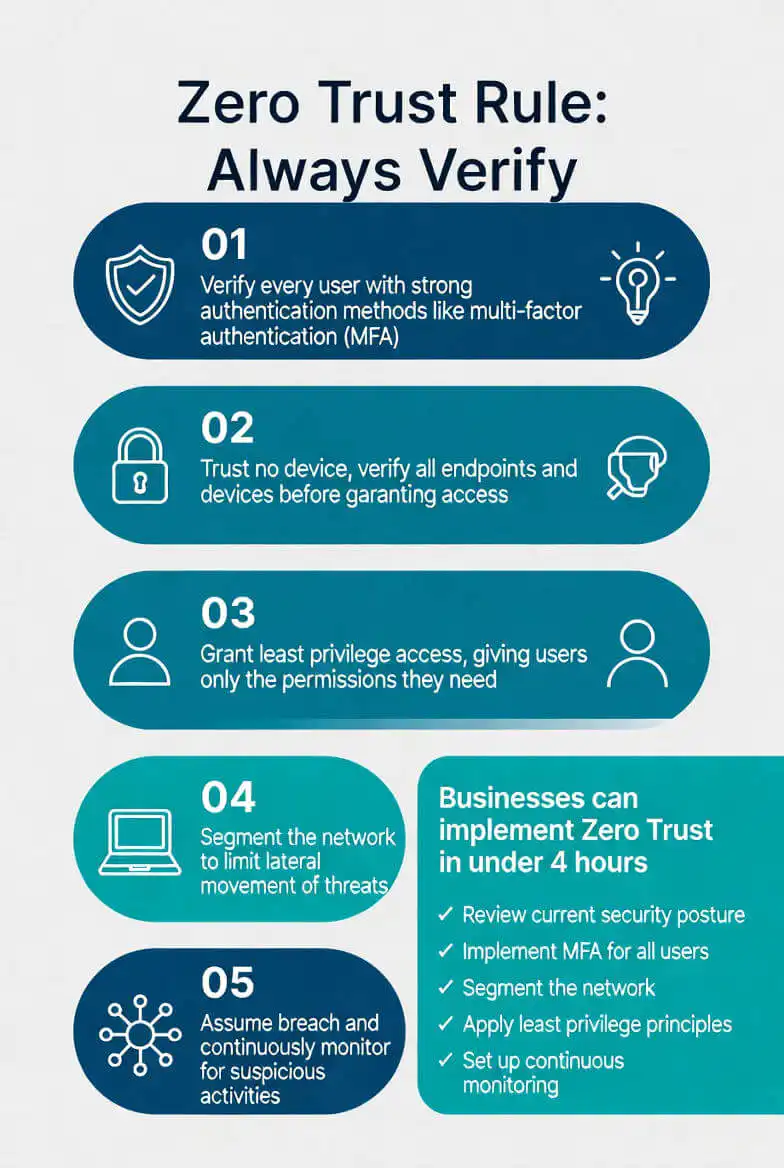
Zero trust is a cybersecurity model built on one critical principle: “never trust, always verify.” Every access request is treated as a potential threat — regardless of where it comes from.
Traditional security works like a castle with strong outer walls. Once someone gets inside, they can move freely. Zero trust is different. According to NIST Special Publication 800-207, zero trust assumes no implicit trust based on network location alone. Every user and device must be verified — every single time.
Why Australian Businesses Need Zero Trust Now
The Australian Cyber Security Centre (ACSC) reports alarming statistics. They responded to over 1,200 cyber security incidents in 2024–25. Between July and December 2024, the OAIC received 595 data breach notifications — the highest count since reporting began.
Queensland and New South Wales businesses face particularly high risks. Small businesses often lack dedicated security staff, making them easy targets. Individuals in Australia now face an average $33,000 loss per cyber incident. The financial impact reaches far beyond large corporations.
Core Principles of Zero Trust Architecture
Never Trust, Always Verify
Zero trust eliminates automatic trust for anyone or anything. Every user must prove their identity before accessing any system. The framework treats all requests as potential threats — regardless of origin.
Least Privilege Access
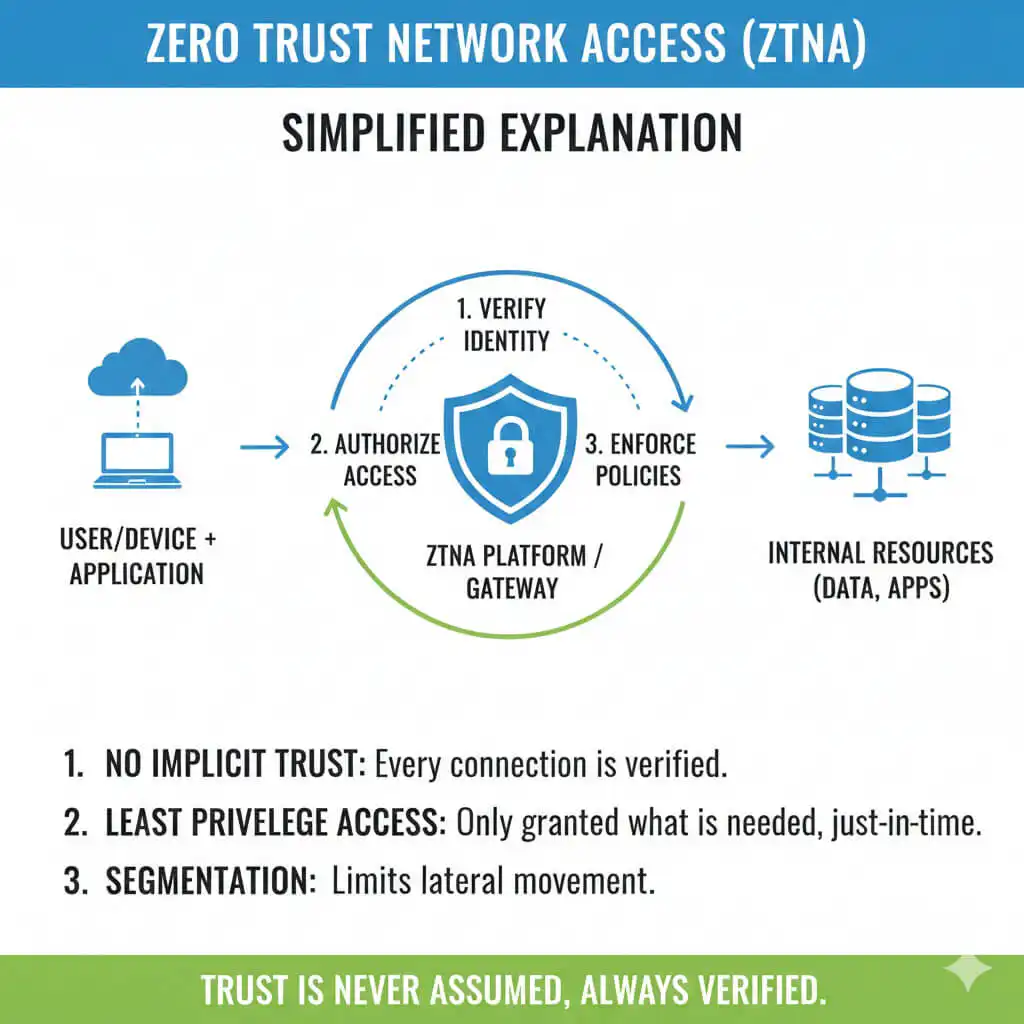
Users receive only the minimum access needed for their specific role. This principle significantly limits damage if an account is compromised. Your marketing team shouldn’t access financial records. Sales staff don’t need access to HR systems.
Continuous Authentication and Monitoring
Traditional systems verify identity once at login. Zero trust continuously validates users throughout their session. It verifies each device, user, transaction, and data flow — during the entire access process.
Micro-Segmentation
Networks are divided into small, isolated segments with separate access controls. This prevents attackers from moving freely through your systems. A segmented network may contain dozens of separate, secure zones. Breaches are contained to a single segment rather than spreading everywhere.
Assume Breach Mentality
Zero trust operates under the assumption that breaches will occur. The framework focuses on limiting damage and enabling fast recovery. This mindset drives organisations to implement multiple security layers. It also ensures rapid response when incidents happen.
Key Components of Zero Trust Implementation
Identity and Access Management (IAM)
Strong identity verification is the foundation of zero trust. Multi-factor authentication (MFA) becomes mandatory for all users. Role-based access control (RBAC) ensures permissions align with job functions. Identity governance tools automate access reviews and enforce policies.
Device Security and Health Verification
Zero trust requires continuous validation of each device. This includes checks for up-to-date operating systems, security patches, and encryption. Your employees may use many different devices for work. Each device undergoes security checks before access is granted.
Network Security and Segmentation
Traditional perimeter defences no longer work in distributed environments. Zero trust provides granular control over who accesses what — and when. Software-defined perimeters create secure access channels. Virtual private networks (VPNs) are enhanced with additional verification layers.
Application and Workload Security
Applications need protection whether hosted on-premises or in the cloud. Zero trust applies security controls at the application layer itself. API security is crucial for modern application architectures. Every interaction requires authentication and authorisation.
Data Security and Protection
Data is your most valuable asset. Encryption must cover data at rest, in transit, and in use. Data loss prevention (DLP) tools monitor and control information movement. Classification systems help identify and protect your most sensitive information.
Benefits of Zero Trust for Australian SMBs
Enhanced Security Posture
Zero trust reduces your attack surface by enforcing least privilege and continuous authentication. Unauthorised users cannot easily access sensitive data. The framework provides multiple defence layers against sophisticated attacks. Even if one control fails, others remain active.
Reduced Data Breach Risk
Zero trust minimises breach risk even if a device inside your network is compromised. Micro-segmentation contains threats before they spread. Brisbane and Gold Coast businesses particularly benefit from this protection. Reduced breach risk also means lower cyber insurance premiums.
Improved Visibility and Control
Zero trust gives you comprehensive monitoring across all systems. Security teams can identify threats before they cause serious damage. Real-time analytics detect unusual behaviour immediately. Detailed logging supports compliance reporting and forensic investigations.
Support for Remote Work
Australian businesses are embracing flexible work arrangements. Traditional security struggles to keep up with remote access needs. Zero trust enables secure access from anywhere, on any device. Security standards are maintained regardless of location.
Regulatory Compliance
The 2025 PSPF guidelines highlight the need for continuous improvement and a breach-assumption mindset. Zero trust directly supports these requirements. Australian regulations increasingly mandate stronger data protection. Zero trust frameworks satisfy many of these obligations by design.
Cost Efficiency
Zero trust requires upfront investment but reduces long-term security costs. Preventing a breach is far cheaper than recovering from one. Consolidated security platforms reduce complexity and operational expenses. Businesses can redirect savings to growth and innovation.
Implementing Zero Trust: Practical Steps for Australian Businesses
Phase 1: Assessment and Planning
Start by mapping all your data, applications, and users. Identify your most critical assets and where they are stored. Assess current security tools and identify gaps. Document all access pathways to sensitive systems.
Organisations should understand where sensitive data is stored, processed, and transmitted. This forms the foundation of your zero trust strategy.
Phase 2: Identity and Access Controls
Implement multi-factor authentication across all systems immediately. This is the single most impactful first step you can take. Deploy single sign-on (SSO) to centralise access management. Establish clear role-based access policies for every team member.
Phase 3: Device Management and Monitoring
Ensure all devices meet minimum security standards before granting access. Deploy endpoint detection and response (EDR) tools across all devices. Every user and device accessing the network requires continuous monitoring. This ensures everyone behaves as expected — and flags when they don’t.
Phase 4: Network Segmentation
Divide your network into logical segments based on function. Implement access controls between each segment. Start with your most sensitive systems and data. Gradually extend segmentation across your entire infrastructure.
Phase 5: Continuous Monitoring
Deploy a security information and event management (SIEM) system. SIEM tools aggregate logs from all sources for centralised visibility. Establish baseline behaviour patterns for users and systems. Configure alerts for any anomalous activity.
Phase 6: Testing and Refinement
Regular security testing validates your zero trust implementation. Penetration testing identifies weaknesses before attackers do. Conduct quarterly reviews of access policies and permissions. Remove unnecessary access rights as roles change.
Common Zero Trust Implementation Challenges
Legacy System Integration
Older systems may lack modern authentication capabilities. Gateways and proxies can bridge the gap without replacing everything. Gradual migration strategies allow phased zero trust adoption. Prioritise high-risk systems first to maximise early impact.
User Experience Concerns
Excessive security measures can frustrate legitimate users. Balance security with usability to maintain productivity. Modern MFA solutions offer seamless authentication experiences. Risk-based authentication adjusts requirements based on context and behaviour.
Resource and Budget Constraints
Smaller organisations may struggle with budget or expertise. Phased adoption allows manageable investment over time. Start with high-risk assets to maximise risk reduction from day one. Managed service providers offer cost-effective zero trust solutions for SMBs.
Complexity and Integration
Multiple security tools must work together seamlessly. Choose solutions that support open standards and APIs. Integrated platforms reduce complexity significantly. Consolidated management interfaces simplify day-to-day operations.
Zero Trust and Australian Compliance Requirements
Essential Eight Alignment
The ACSC‘s Essential Eight framework aligns well with zero trust principles. Implementing zero trust helps you satisfy multiple Essential Eight controls at once. Multi-factor authentication is one Essential Eight control. Application control and patching are two others that zero trust supports directly.
Privacy Act Obligations
Australian Privacy Principles require appropriate data security measures. Zero trust provides robust frameworks for protecting personal information. Continuous monitoring helps detect and respond to breaches quickly. Detailed logging supports compliance with notification obligations.
Industry-Specific Requirements
Financial services face additional APRA prudential standards. Healthcare organisations must comply with state-based health records legislation. Zero trust architectures support these various compliance frameworks. The approach provides auditable security controls across all industries.
Choosing the Right Zero Trust Solution
Assess Your Business Needs
Consider your industry, size, and specific risk profile. Identify your most critical assets requiring protection. Evaluate your existing technology infrastructure and capabilities. Determine whether cloud-based or on-premises solutions suit your environment.
Evaluate Vendor Solutions
Research vendors with proven Australian market experience. Check their understanding of local compliance requirements. Request demonstrations showing real-world implementation scenarios. Verify integration capabilities with your existing systems.
Consider Managed Services
Many Australian SMBs lack dedicated security expertise. Managed security service providers (MSSPs) can fill this gap cost-effectively. Brisbane and Gold Coast businesses can partner with local IT support providers. Managed services provide expert guidance without the cost of a full in-house team.
The Future of Zero Trust in Australia
The Australian government has pledged to develop a whole-of-government zero trust culture. Private sector adoption will likely accelerate significantly as a result. Cloud-native architectures are increasingly incorporating zero trust principles by default. Artificial intelligence will enhance automated threat detection capabilities further.
Zero trust network access (ZTNA) will become a standard component of enterprise architecture. Early adopters gain competitive security advantages today.
Getting Started with Netcomp Solutions
Implementing zero trust doesn’t require massive upfront investment. Start with foundational controls and build progressively. Netcomp Solutions helps Brisbane and Gold Coast businesses implement practical zero trust strategies.
We provide comprehensive IT support and cyber security services tailored to SMBs. Our team understands the unique challenges Australian small businesses face. Contact us today for a free security assessment. We’ll develop a customised zero trust roadmap for your business.
Our Zero Trust Services Include:
- Security Assessment: Comprehensive evaluation of current security posture
- Identity and Access Management: Implementation of MFA and SSO solutions
- Network Segmentation: Designing and deploying secure network architectures
- Endpoint Protection: Deploying and managing EDR solutions
- Security Monitoring: 24/7 monitoring and threat detection services
- Compliance Support: Ensuring adherence to Australian regulations
- Staff Training: Security awareness programs for your team
Key Takeaways
Zero trust represents the future of cyber security for Australian businesses. The framework delivers stronger protection, better compliance, and lower breach costs.
Australian small businesses face increasing cyber threats every day. Implementing zero trust now puts you ahead of the attackers. Start with a phased, manageable implementation. Partner with experienced providers to accelerate your journey.
The cost of prevention remains far lower than breach recovery expenses. Zero trust protects your data, your customers, and your reputation. Don’t wait for a breach to take security seriously. Implement zero trust principles now to stay protected.
Ready to protect your business with zero trust security? Contact Netcomp Solutions today:
- Phone: 1300 363 127
- Email: info@netcomp.com.au
- Website: netcomp.com.au
- Locations: Brisbane & Gold Coast, Queensland