Technically reviewed by Vitaly Ogulev, founder of Netcomp Solutions (Brisbane managed IT and cyber security since 2002).
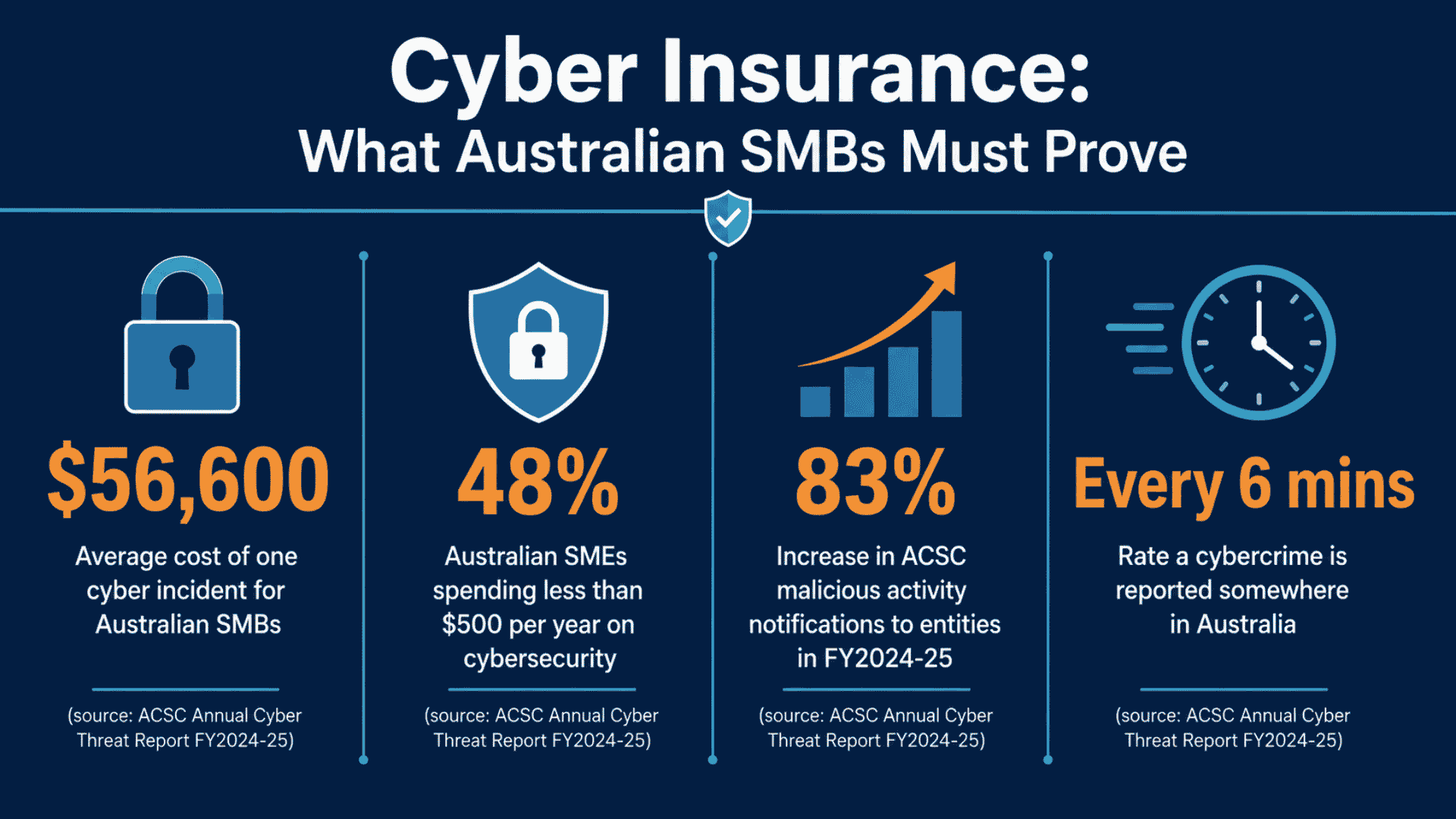
Is your cyber insurance renewal coming up? Has your broker started asking questions you cannot answer? You are not alone. The average cost of a cybersecurity incident for an Australian small business rose 14% to $56,600 in FY2024-25. That’s according to the ACSC’s Annual Cyber Threat Report 2024-25. This makes cyber insurance one of the most important financial safety nets a Brisbane or Gold Coast business can hold. The problem is that insurers have dramatically tightened their underwriting criteria heading into 2026. Insurers are denying policies, and premiums are surging. They are also catching out businesses that cannot demonstrate a baseline of verifiable security controls. This article explains exactly what insurers are looking for and which gaps are triggering denials. It also explains how to get your business across the line before your next renewal date.
Why Cyber Insurers Are Getting Harder to Satisfy in 2026
The Australian cyber threat landscape has shifted significantly, and insurers are responding accordingly. According to the ACSC, the agency responded to more than 1,200 cybersecurity incidents in FY2024-25. That is an 11% increase on the prior year. The agency also notified entities of malicious activity targeting their systems more than 1,700 times, an 83% increase. That scale of exposure has made underwriters far more selective about who they cover and on what terms.
In practical terms, this means insurers are no longer taking your word for it when it comes to security posture. Many insurers now require a completed technical questionnaire, an independent audit, or documented evidence of specific controls. They want this evidence before they will issue or renew a policy. For small businesses that have historically treated cybersecurity as an afterthought, this shift is a serious problem. Answering “yes” to security questions you cannot substantiate is risky. It is a fast path to a denied claim when you need coverage most.
The underlying driver is straightforward: insurers are pricing risk. If your business cannot demonstrate it has taken reasonable precautions, you represent a higher likelihood of a costly claim. The result is either a policy refusal or a heavily loaded premium. Or you may get a policy with broad exclusions. Those exclusions can make the policy nearly useless during a ransomware attack or data breach.
The Security Spending Gap That Gets Australian SMBs Rejected
One statistic stands out in the Australian small business cybersecurity landscape. It shows how little most businesses actually invest in protection. According to ACSC, 48% of Australian SMEs spend less than $500 per year on cybersecurity. To put that in context, $500 does not cover a single hour of incident response work from a qualified professional. It certainly does not cover the kind of layered, documented security programme insurers now require.
This spending gap translates directly into policy denials. When an underwriter reviews your application, they look for evidence of MFA, backup and recovery documentation, endpoint protection, and patch management. If they find none of these controls, they will not extend coverage at a reasonable premium. The qualification bar in 2026 is not unreasonably high, but it does require deliberate, documented action.
For Brisbane and South East Queensland businesses, this creates a clear commercial risk. On average, a cybercrime incident costs $56,600. Without insurance coverage, that cost alone can force a business to close. The irony is that many of the controls insurers require are not enormously expensive to implement. This is especially true for a business working with the right IT partner to manage them correctly.
What Cyber Insurers Specifically Require in 2026
Each insurer’s policy wording varies. But the core technical requirements converging across the Australian market in 2026 map closely to the ACSC Essential Eight framework. Understanding essential eight compliance australia requirements is no longer just a government or enterprise concern. It is the practical checklist that determines whether a small business can obtain or keep cyber insurance.
The controls insurers most commonly require documented evidence of include:
- Multi-factor authentication (MFA) on all remote access, email, and privileged accounts. Insurers scrutinise this control more closely than any other, and require it in virtually all policies.
- Application patching: patch operating systems and third-party applications within a defined timeframe, typically 14 to 30 days for high-risk vulnerabilities.
- Automated daily backups: store backups offline or in an immutable cloud environment, and document and test your recovery procedures.
- Endpoint detection and response (EDR): deploy EDR across all devices, not just traditional antivirus.
- Privileged access restrictions, meaning staff do not operate with administrator rights for day-to-day tasks.
- Macro and application control policies that limit what can execute on your systems.
- An incident response plan: keep it documented, accessible, and tested within the last 12 months.
For many small businesses, the challenge is not understanding these requirements. It is having the technical capability and documentation to demonstrate compliance when asked. Verbal assurances do not satisfy an underwriter’s questionnaire.
The Role of Managed Detection and Response in Meeting Insurer Requirements
One of the most significant shifts in cyber insurance requirements for 2026 is a growing expectation. Insurers now expect businesses to have some form of continuous monitoring and response capability in place, not just preventative tools. Insurers now recognise that breaches are often inevitable. What separates a manageable incident from a catastrophic one is how quickly you detect and contain it.
This is where managed detection and response australia services come in. They have moved from a nice-to-have to a practical necessity for businesses seeking ransomware insurance australia coverage. According to the ACSC, Australians report cybercrime at an extraordinary rate. The volume of incidents continues to rise each year. A business that relies solely on reactive measures, waiting until something breaks before investigating, is unlikely to meet current standards. Insurers now formally assess detection and response standards like these.
Managed Detection and Response (MDR) services provide 24/7 monitoring of your network, endpoints, and logs. These services can identify and isolate threats before they spread. For a small business in Brisbane, maintaining this capability in-house is not realistic. A managed IT provider that includes MDR as part of a security package offers real advantages. This path is increasingly the most cost-effective way to achieve both genuine protection and insurability.
You can present your insurer with documented evidence of 24/7 detection and response coverage. That capability materially reduces your risk profile. In many cases, it also directly influences the premium your insurer offers you.
How to Prepare Your Business for a 2026 Cyber Insurance Application
If you are approaching a renewal or applying for cyber insurance for the first time, preparation is everything. Insurers are unlikely to take your application at face value. They want documentation, and in some cases they want independent verification. Here is a practical approach for Brisbane SMB owners and CFOs to follow before submitting an application.
- Conduct a security gap assessment. Before you fill in any insurer questionnaire, understand exactly where your current controls stand against the Essential Eight. An honest internal assessment, or ideally an external one, will prevent you from making inaccurate declarations.
- Prioritise MFA immediately. If you have not implemented MFA on your Microsoft 365 or Google Workspace environment, do it before applying. The same goes for remote access tools and any financial systems. This is the control that generates the most immediate impact on your insurability.
- Document your backup and recovery process. Having backups is not enough. You need to document where you store your backups and how frequently they run. You also need to record how long recovery takes and when you last tested a restore. Keep this evidence accessible.
- Deploy EDR across all endpoints. Standard antivirus does not meet 2026 requirements. Insurers now expect endpoint detection and response tools that provide behavioural analysis and real-time alerting as a baseline.
- Engage a managed security provider. For businesses without internal IT security capability, partnering with the right provider is the fastest route to qualification. A good provider can implement and document these controls on your behalf, and do so cost-effectively.
- Review your incident response plan. If you do not have one, create one. If you have one, test it. An untested plan is unlikely to satisfy an insurer’s requirements.
The goal is to build a documented, verifiable security posture that matches what your insurer asks on their application form. Cyber resilience brisbane businesses need in 2026 is not about perfection; it is about demonstrable, consistent effort.

The Cost of Getting It Wrong
The financial consequences of a cyber incident without adequate insurance are severe. According to ASD, the average cost of a cybercrime incident for an Australian small business exceeded $49,600 in FY2023-24. That figure climbed a further 14% in FY2024-25. For a business with a handful of employees and tight cash flow, this creates serious risk. An uninsured incident at that scale is often unrecoverable.
The threat environment that drives these costs is well established. Generally, Australia reports a cybercrime every 6 minutes, and 43% of those attacks target small and medium businesses. Evidence has thoroughly disproven the idea that small businesses are too small to be targets. Automated attack tools do not discriminate by company size; they look for the path of least resistance.
Cyber insurance for small business australia is not a luxury item or a box-ticking exercise. It is a core component of financial risk management. But obtaining insurance is not enough. Having it pay out when you need it requires that you have done the foundational security work first. An insurer may discover during a claim assessment that your declared controls were not actually in place. If this happens, the insurer has grounds to deny that claim entirely, regardless of whether you hold a policy.
How Netcomp Solutions Helps Brisbane Businesses Qualify for Cyber Insurance
At Netcomp Solutions, we work with small and medium businesses across Brisbane and South East Queensland. We help them build the security foundations that modern cyber insurers require. Our approach starts with an honest assessment of where your business sits against the Essential Eight controls. We then map a practical, prioritised remediation plan that closes the gaps most likely to affect your insurability.
We deploy and manage MFA, EDR, automated backup solutions, patch management, and privileged access controls. These form part of our managed IT and security services. For businesses that need continuous monitoring, our managed detection and response capability provides 24/7 coverage. Insurers increasingly require this coverage before they will issue or renew policies.
We also help you prepare the documentation insurers ask for. Knowing you have the right controls in place is one thing. Being able to evidence them clearly in a policy application is another. Our team has direct experience helping Brisbane SMBs navigate insurer questionnaires and audits successfully.
If your renewal is coming up in the next three to six months, now is the time to act. Closing security gaps takes time. Presenting a last-minute application without evidence of sustained controls is unlikely to produce the result you need.
Contact the team at Netcomp Solutions today to book a cyber security assessment. We’ll help you understand exactly where your business stands before your next insurance renewal.
Frequently Asked Questions
What is the minimum level of security required to qualify for cyber insurance in Australia in 2026?
Requirements vary between insurers. But most insurers require the same baseline controls for cyber insurance for small business australia in 2026. These controls include multi-factor authentication on all remote access and email systems. You must also document and test backups, and store them offline or in immutable cloud storage. In addition, insurers require endpoint detection and response (EDR) across all devices and a current patch management process. They also require a documented incident response plan. Businesses that can demonstrate alignment with the ACSC Essential Eight framework are significantly better positioned to qualify. This is true even at Maturity Level 1, and it also helps you receive competitive premiums.
Can a small business be denied a cyber insurance claim even if they hold a policy?
Yes. Suppose a business declares security controls on its policy application that were not actually in place at the time of an incident. In that case, the insurer may deny the claim on the grounds of misrepresentation. This is one of the most significant risks associated with completing insurer questionnaires without verified, documented evidence. You must genuinely implement the controls you declare in your application, and you must be able to demonstrate them. Working with a managed IT provider that documents your security posture creates a clear evidence trail. This trail supports both your application and any future claim.
How does the ACSC Essential Eight relate to cyber insurance requirements?
The Australian Signals Directorate developed the Essential Eight, a prioritised set of cybersecurity mitigation strategies. The framework originally targeted government and enterprise environments. Today, it has become the de facto benchmark that Australian cyber insurers use to assess small business security maturity. Many insurer questionnaires and audit frameworks now directly reference essential eight compliance australia requirements. Achieving Maturity Level 1 across the eight controls provides a strong foundation for insurance qualification. Higher maturity levels typically support premium reductions and broader coverage terms.
How much does it cost to implement the controls needed for cyber insurance qualification?
Most Brisbane small businesses can implement the foundational controls for cyber insurance qualification through a comprehensive managed IT services arrangement. These controls include MFA, EDR, automated backups, and basic patch management. The exact cost depends on the size of your business and your current technology environment. What is clear is that the investment is substantially less than the average cost of a cyber incident. That average cost exceeded $56,600 for Australian small businesses in FY2024-25. Many businesses find that implementing these controls also reduces their insurance premium. This saving can partially offset the ongoing cost of the managed services that maintain them.