Technically reviewed by Vitaly Ogulev, founder of Netcomp Solutions (Brisbane managed IT and cyber security since 2002).
Imagine your accounts manager receives a video message from you, the business owner. In the message, she is asked to urgently transfer $47,000 to a new supplier account. Your face is on screen. Your voice sounds right. The request feels completely legitimate. She approves the transfer. The money is gone. This is not a hypothetical scenario for 2030. In fact, it is happening to Australian small businesses right now. Meanwhile, the technology behind it is becoming cheaper and more convincing by the month. According to Acrisure, security researchers are warning of a sharp rise in AI-driven attacks in 2026. Specifically, this includes deepfake videos of leadership figures authorising fraudulent wire transfers. For Brisbane and Gold Coast small businesses, understanding exactly how these attacks work is the first step to stopping them.
Why AI Phishing Is a Fundamentally Different Threat in 2026
Traditional phishing emails were relatively easy to spot. Poor spelling, suspicious sender addresses, generic greetings and awkward phrasing were reliable warning signs. For instance, even non-technical staff could learn to identify these signs. However, AI has stripped away almost every one of those tells.
Today’s AI phishing tools can scrape a target business’s website, LinkedIn profiles, recent news mentions and public social media. As a result, they generate hyper-personalised emails that reference real projects, real colleagues and real suppliers. The grammar is flawless. The tone matches the person being impersonated. And the attacks are being deployed at scale.
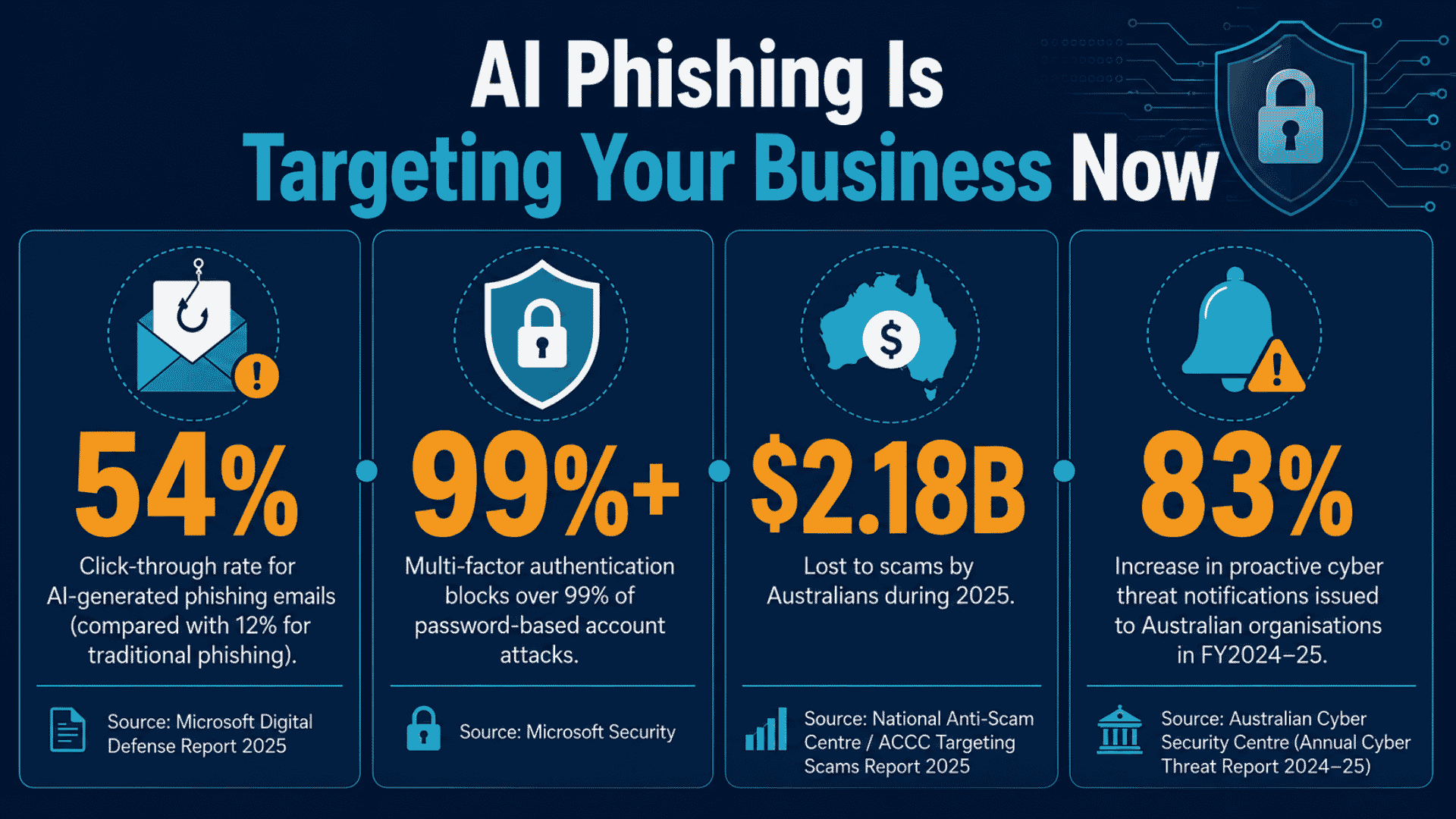
Between September 2024 and February 2025, 82.6% of phishing emails detected used AI. This is according to a KnowBe4 report covered by Security Magazine. Additionally, that figure is up 17.3% on the prior six months. More alarming still, a Harvard-affiliated study found that AI-automated phishing emails achieve a 54% click-through rate. By comparison, generic phishing emails only achieve a 12% click-through rate. That makes AI-driven attacks more than four times as effective. Your staff are not failing because they are careless. They are failing because the attacks have become genuinely difficult to distinguish from real communications.
Consider owners running a Brisbane trades business, a Gold Coast medical practice, a legal firm or a small retail operation. For these owners, this shift has profound implications. You do not have a dedicated security team watching for these threats around the clock. Consequently, that asymmetry is exactly what attackers are exploiting.
How Deepfake Scams Are Targeting Australian Business Owners
Deepfake technology has moved well beyond novelty. AI tools now need only a few minutes of publicly available audio or video. With this, they can clone a person’s voice and face with convincing accuracy. As a result, attackers are weaponising this capability in two primary ways. These ways directly threaten Brisbane and Gold Coast small businesses.
The first is the fraudulent authorisation call. Typically, a staff member in accounts or operations receives a phone call or voice message. It sounds exactly like the business owner or a senior manager. The instruction is to process an urgent payment, share login credentials or bypass a normal approval process. The urgency is manufactured. The authority sounds real.
The second is the supplier or partner impersonation. Attackers often combine business email compromise with AI-cloned voice messages. By doing so, they pose as a known supplier, accountant or bank contact to redirect payments or extract sensitive information. Business email compromise Brisbane cases have increased as local businesses increasingly rely on digital communication with suppliers and contractors.
Australians reported $2.18 billion in total scam losses in 2025, up 7.8% from the prior year. Additionally, 274,577 individual financial loss reports were recorded by the ACCC and Scamwatch. Many of these losses involved impersonation fraud, and AI is accelerating the sophistication of these attacks significantly.
The key vulnerability is not your firewall. Instead, it is the human moment when a trusted-sounding voice or a familiar face appears on a screen. In that moment, people override their instinct to pause and verify.
The Scale of the Problem for Australian Small Businesses
Small businesses are not minor targets. They are frequently the primary targets, because they combine meaningful financial assets with limited security resources. According to research cited by StationX, 61% of small and medium businesses experienced a breach in the past year. Furthermore, 88% of SMB breaches included a ransomware component. That far exceeds the 39% rate seen at larger organisations.
Phishing remains the dominant entry point. Phishing scams were the most reported scam type to Scamwatch in 2025, with 65,361 reports. In fact, this was more than any other scam category. This is according to the National Anti-Scam Centre’s Targeting Scams Report.
The economic case for attacking small businesses is also improving from an attacker’s perspective. According to a Harvard-affiliated study, AI-automated spear phishing achieves a 54% click-through rate. This matches the effectiveness of human expert attackers, but at 95% lower cost. Consider a highly convincing, personalised attack against a Brisbane landscaping company or a Gold Coast physiotherapy clinic. As the cost of such an attack drops to near zero, the volume targeting smaller businesses increases dramatically.
Cyber security incidents in Australia rose 11% in FY2024-25. Meanwhile, ASD’s Cyber Security Centre issued 83% more warnings of malicious activity than the year before. This is according to the Australian Signals Directorate’s Annual Cyber Threat Report 2024-25. The trajectory is not improving on its own.
Building a Human Defence Layer: What Your Team Needs to Know
Because AI phishing targets people rather than technology, the most important defence layer is a trained, sceptical workforce. This does not mean running a one-hour induction once a year. It means embedding specific behaviours that interrupt the automatic compliance response attackers rely on.
Start with a verbal verification protocol for any financial request. This applies regardless of how the instruction arrives, whether by email, voice message, video call or text. Specifically, any request to transfer funds, change bank account details or approve a new vendor needs verification. That verification must happen through a second, independent channel. If the instruction came by email, call the sender on a number you already have saved. If it came by phone, send a separate message through a platform you both use regularly. This single habit blocks the majority of business email compromise and voice deepfake attacks.
Train your team to recognise the hallmarks of urgency manipulation. AI phishing emails frequently create artificial time pressure, framing requests as overdue, urgent or confidential to bypass normal approval processes. Any communication that combines an unusual request with pressure to act immediately should trigger your verification protocol automatically.
Establish a clear internal norm that no one will be penalised for pausing to verify a suspicious request. This holds true even if that request genuinely came from the business owner. Fear of appearing unhelpful or doubting a manager is a real obstacle that attackers exploit. Removing that social barrier is a management decision, not a technology one.
Run regular phishing simulation exercises. Exposing staff to realistic but safe test emails helps build pattern recognition. In turn, this reduces the shock factor when a real attack arrives. Managed security providers can run these exercises on your behalf and provide reporting on which staff need additional training.
Technical Controls That Stop AI Phishing in Its Tracks

Behavioural training alone is not sufficient. The right technical controls significantly reduce the volume and quality of attacks that reach your staff in the first place. They also limit the damage when a click does occur.
Phishing-resistant multi-factor authentication (MFA) is the single most impactful technical control available to small businesses. Sophisticated attackers can bypass Standard SMS-based MFA. By contrast, hardware security keys and passkey-based authentication methods resist credential phishing. This is because they verify the actual website domain at the point of authentication. Attackers use a convincing fake login page to trick a staff member into entering their password. Even then, a phishing-resistant MFA solution will still block the attacker from accessing the account. Therefore, deploy phishing-resistant MFA across all business applications, particularly email, accounting software and cloud storage. This should be an immediate priority for any Brisbane or Gold Coast SMB that has not already done so.
A secure email gateway adds an important layer of filtering before messages reach your staff. Modern gateways use AI themselves to detect spoofed sender addresses, suspicious link patterns and malicious attachments. They also identify signs of impersonation at the email header level. Many of the most convincing AI phishing emails can be caught at this stage. As a result, they never even appear in an inbox.
DNS filtering prevents staff from visiting malicious websites even when they click a link in a phishing email. It acts as a last line of defence in the human layer. As a result, it stops the attack from completing even after the initial click has occurred.
Finally, implement strict payment authorisation controls within your accounting and banking systems. Require dual approval for any payment above a defined threshold. Additionally, configure your banking platform to send real-time alerts for new payee additions. These controls mean that a successful social engineering attack cannot result in an unauthorised transfer. Instead, a second person must independently approve it.
What to Do If You Suspect You Have Been Targeted
Suppose a staff member believes they have received a deepfake call. Or perhaps they’ve received a suspicious CEO impersonation email or a fraudulent supplier communication. Either way, the response needs to be fast and structured.
First, do not engage further with the communication. Do not click any links, reply to the email or call back any number provided in the suspicious message.
Second, contact your bank immediately if attackers may have initiated any financial transactions. Australian banks have dedicated fraud teams and time is critical in recovering transferred funds. Many transfers can be recalled if the report is made within hours.
Third, report the incident to ReportCyber via the Australian Cyber Security Centre’s online portal. Reporting helps the ACSC track emerging attack patterns and issue warnings to other businesses across the country.
Fourth, contact your managed IT provider to conduct an immediate review of any accounts or systems. Specifically, check whether attackers have compromised any of these accounts. If you entered your credentials on a suspicious site, change those passwords immediately. Then revoke all active sessions across every platform.
Consider Gold Coast and Brisbane cyber security SMB incidents where you do not have an existing managed IT relationship. In this case, engaging a provider for an incident response review is far less costly. The alternative is discovering the full extent of a breach weeks later.
Conclusion: The Threat Is Real, the Response Is Achievable
AI phishing for Brisbane small businesses is not a future problem. It is the dominant threat vector right now. Moreover, the technology behind these attacks is improving faster than most businesses’ awareness of them. The combination of AI-generated emails, cloned voices and deepfake video is creating a new social engineering environment. In this environment, trusting your instincts is no longer enough.
The good news is that the defences are practical, affordable and achievable for businesses of any size. Phishing-resistant MFA, a secure email gateway and verified payment protocols form part of this layered defence. So does a trained team who know to pause and verify. Together, these address both the technical and human dimensions of this threat.
Netcomp Solutions works with Brisbane and Gold Coast small businesses to implement exactly these controls. These include managed security monitoring, secure email filtering and staff phishing simulation programmes. Perhaps you want to assess your current exposure and build a defence strategy that matches the 2026 threat environment. If so, contact the Netcomp team today for a no-obligation conversation.
Frequently Asked Questions
What is AI phishing and how is it different from regular phishing?
AI phishing uses machine learning tools to automatically research targets. It then generates highly personalised, grammatically perfect emails, voice messages or even video impersonations. Traditional phishing relies on generic templates with obvious errors. By contrast, AI-generated attacks reference real names, real projects and real business relationships. This makes them significantly harder for staff to identify. Studies show AI-automated phishing emails can achieve click-through rates around 54%. That is more than four times higher than generic, non-personalised phishing attempts.
Are deepfake scams actually targeting small businesses in Australia, or is this mainly a large-enterprise problem?
Deepfake and voice cloning scams are increasingly targeting small and medium businesses across Australia. This includes businesses in Brisbane and the Gold Coast. Small businesses are attractive targets precisely because they typically lack the dedicated security infrastructure of larger organisations. Consider the fraudulent authorisation scenario, where a cloned voice or video instructs a staff member to process an urgent payment. This is particularly effective in smaller teams. That’s because a single person may have authority to approve transfers.
What is phishing-resistant MFA and do I need it for my small business?
Standard multi-factor authentication, such as receiving a code via SMS, can be bypassed by attackers. These attackers simply set up convincing fake login pages. Phishing-resistant MFA uses cryptographic verification that is tied to the legitimate website domain. As a result, it cannot be intercepted or replicated by a fake site. Methods include hardware security keys and passkey authentication. This applies to any Brisbane or Gold Coast SMB that uses cloud-based email, accounting software or file storage. For these businesses, phishing-resistant MFA is strongly recommended as a baseline control.
How do I report an AI phishing or deepfake scam attempt in Australia?
You can report phishing and cyber fraud incidents through ReportCyber, operated by the Australian Cyber Security Centre. Financial scam attempts and losses can also be reported to Scamwatch, which is managed by the ACCC. If any funds have been transferred, contact your bank immediately, as time-sensitive fraud recalls are possible in many cases. Reporting to these agencies also helps protect other Australian businesses by enabling pattern tracking and public alerts.