Technically reviewed by Vitaly Ogulev, founder of Netcomp Solutions (Brisbane managed IT and cyber security since 2002).
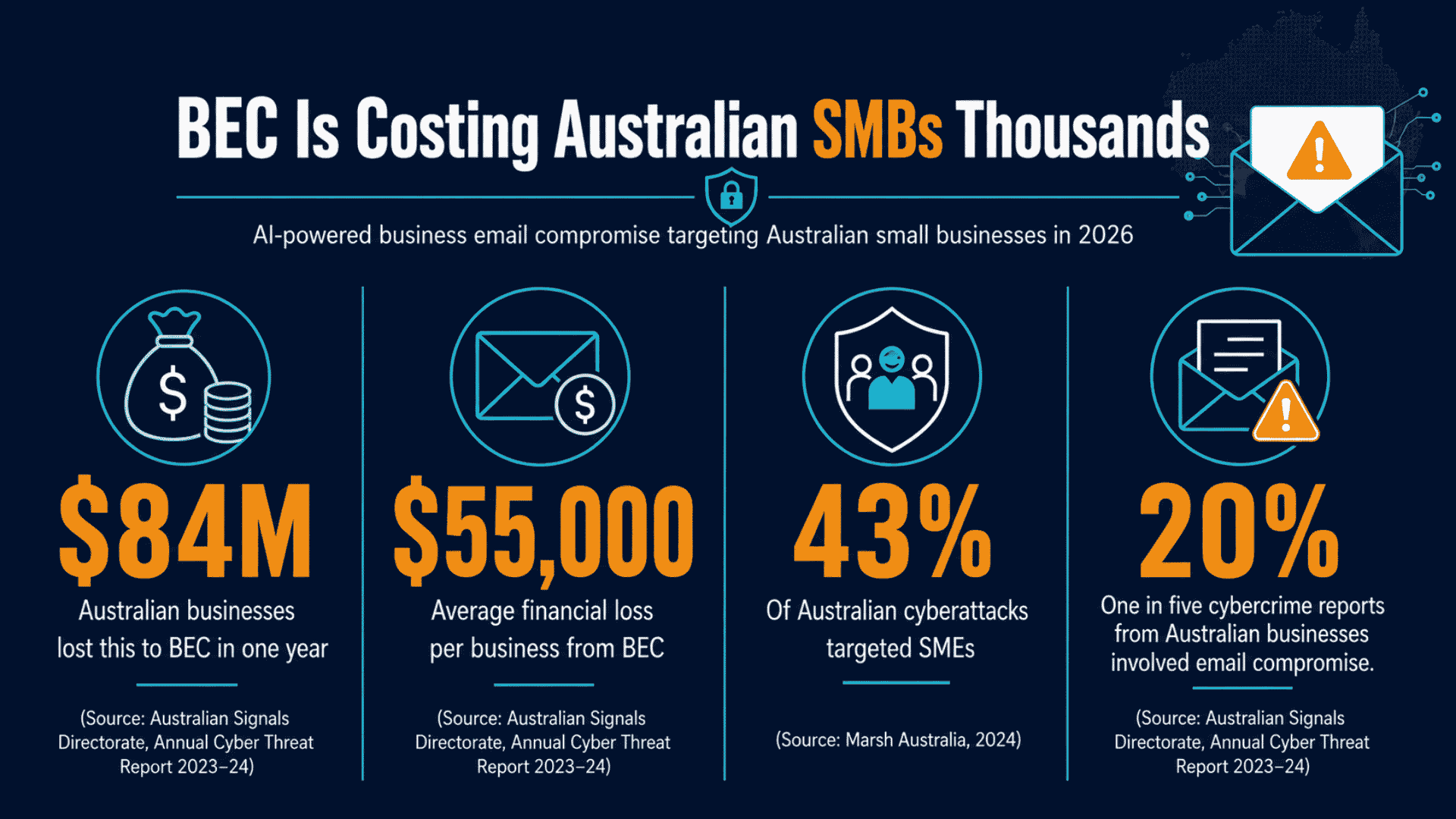
Business email compromise, which Australia small business owners now face, is one of the country’s most destructive financial threats. According to Aryon, Australian businesses lost AUD $84 million to these attacks in a single year. Additionally, the average loss reached $55,000 per business. Now, artificial intelligence is supercharging the speed, scale, and believability of these attacks. As a result, the threat facing Brisbane and Gold Coast small businesses in 2026 is more serious than ever. If your business handles invoices, payroll, or bank transfers by email, this article is for you. Here is what AI-powered business email compromise looks like today. Moreover, here is exactly what you can do to stop it before it costs you thousands.
What Is Business Email Compromise and Why Is It Thriving in 2026?
Business email compromise (BEC) is a targeted scam where criminals impersonate a trusted contact. For example, they might pose as your CEO, a supplier, or your accountant. Ultimately, their goal is to trick someone in your team into transferring money or sensitive information. Unlike mass phishing blasts, BEC attacks are surgical. Specifically, the criminal studies your business and mimics real communication styles. Then, they strike at exactly the right moment. Often, this happens when someone is under deadline pressure or a key decision-maker is unavailable.
In 2026, AI has transformed this scam from an obvious nuisance into a precision financial weapon. Attackers now use large language models to write flawless, contextually accurate emails. As a result, these messages carry none of the spelling mistakes or awkward phrasing that used to give them away. Additionally, attackers use AI voice cloning to impersonate executives in follow-up phone calls. Furthermore, they scrape LinkedIn, your company website, and social media to personalise every message.
The numbers reflect just how serious this has become. According to Hoxhunt, BEC attacks in Australia increased by 7% year-on-year. Notably, this is slightly above the global average, signalling a disproportionate risk for local businesses. According to the ACSC, 22% of small and medium enterprise owners reported being impacted by cybercrime in 2024. Therefore, business email compromise Australia small business owners face is not just a big-business problem. Instead, it is specifically designed to exploit leaner teams and informal processes. Additionally, it targets the tighter cash flows that define most Brisbane and Gold Coast SMBs.
How AI Has Changed the Attack: What Brisbane SMBs Are Actually Seeing
Understanding what a modern BEC attack looks like in practice is the first step toward stopping one. Here are the scenarios your team is most likely to encounter right now.
- The CEO payment request: An email arrives appearing to come from your director or owner. Specifically, it asks a staff member to urgently process a payment to a new supplier account. The email tone, sign-off, and language are a perfect match. The account number, of course, belongs to the attacker.
- The supplier invoice swap: Criminals compromise or convincingly spoof a supplier email address. Then, they send an updated invoice with new banking details, often citing a routine bank account change.
- The payroll redirect: An employee emails HR or payroll claiming their bank details have changed and asking for their salary to be redirected. The email looks like it came from the staff member’s real account.
- The conveyancing scam: Particularly active in Queensland, attackers intercept property settlement communications. Then, they redirect final payments to fraudulent accounts at the most vulnerable moment of a transaction.
AI phishing attacks targeting SMBs are escalating rapidly. According to the ACSC, medium-sized Australian businesses saw cybercrime costs rise 55% in FY2024-25, reaching $97,200 per report. Meanwhile, business email compromise Australia small business owners face is growing at a similarly fast pace.
Why Standard Email Security Is No Longer Enough
Many small business owners assume their email provider’s built-in filtering will catch BEC attempts. This is a dangerous misconception. Standard spam filters are built to detect malware attachments and known malicious links. A well-crafted BEC email typically contains neither. Instead, it is a clean, plain-text message with no suspicious links and no attachments. As a result, it sails straight through basic filters and lands in the inbox looking completely legitimate.
The ACSC has responded to the surge in threat activity by dramatically scaling its warnings to Australian organisations. According to the ACSC, over 1,700 malicious cyber activity notifications were issued to Australian entities in FY 2024-25. This represents an 83% increase from the prior year. That volume of alerts reflects an environment where the threat is escalating faster than most businesses are adapting their defences.
Brisbane and Gold Coast businesses often operate with small teams. Often, one person handles accounts, payroll, and supplier communications. Consequently, a single successful BEC attack can be genuinely catastrophic. Email fraud targeting Gold Coast businesses has been particularly prevalent in property, construction, professional services, and retail. This is because these industries involve high transaction volumes and frequent contact with external parties.
Relying on default settings from Microsoft 365 or Google Workspace leaves critical gaps. Without additional layered controls, AI-assisted attackers can exploit these gaps with ease.
Five Defences Every Queensland SMB Should Put in Place Now
The good news is that effective BEC scam prevention does not require an enterprise-sized budget. The following controls, applied consistently, will stop the overwhelming majority of attacks targeting your business.
- Enforce multi-factor authentication on all email accounts: This is the single most impactful control available. Even if an attacker obtains an employee’s password through phishing or a data breach, MFA still protects the account. As a result, they cannot use it to send fraudulent emails from the inside.
- Implement a verbal confirmation policy for payment changes: Any request to change banking details, redirect payroll, or authorise an unusual payment must be confirmed by phone. Importantly, call a known number, not one provided in the suspicious email. This one rule stops the majority of BEC attacks that reach the payment stage.
- Deploy advanced email authentication: Ensure your domain has DMARC, DKIM, and SPF records properly configured. These technical controls make it significantly harder for attackers to spoof your domain or your suppliers’ domains in outbound emails.
- Use AI-aware email filtering: Modern email security platforms, such as Microsoft Defender for Business, use behavioural analysis and machine learning. Specifically, they detect anomalies in sender patterns, writing style, and message context. These tools catch the clean, link-free BEC emails that basic filters miss entirely.
- Train your team regularly with realistic simulations: According to the ACSC, phishing was used for initial access in 38% of cyber incidents in FY2024-25. This makes it the single dominant threat vector. Regular, realistic training that simulates actual BEC scenarios builds the muscle memory your staff need. Consequently, they learn to pause and question requests that would once have seemed routine.
Cyber security for small business in Queensland does not need to be complex. It needs to be consistent. Attackers look for the path of least resistance. However, businesses that enforce even these five controls become significantly harder targets than most SMBs around them.
What to Do If Your Business Has Already Been Targeted
If you suspect a BEC attack has already occurred, or is in progress, the order of your response matters significantly. Speed is critical in limiting financial damage.
First, contact your bank immediately. Australian banks have fraud response teams available around the clock. Therefore, if a fraudulent transfer was made recently, acting within hours gives you a real chance of recovery. Do not wait until the next business day.
Second, report the incident to the ACSC via ReportCyber at cyber.gov.au. Reporting helps the ACSC identify active campaigns targeting Australian businesses and can trigger broader protective alerts across the sector.
Third, preserve all evidence. Do not delete the suspicious emails or alter any systems. Instead, wait until a cyber security professional has had the opportunity to investigate. Evidence of how the attacker gained access is critical to closing the vulnerability and preventing a repeat incident.
Fourth, notify affected parties. If a supplier’s email was compromised and fraudulent invoices were sent from their account, they need to know immediately. This way, they can warn their other clients. Transparency here protects your business relationships and demonstrates responsible conduct.
Finally, engage a managed security provider to conduct a post-incident review. Understanding exactly how the attack succeeded is the only way to ensure it cannot happen again through the same vector.
The Business Case for Acting Before an Incident Occurs

Many SMB owners treat cyber security as a cost for later. Typically, they wait until their business is larger or a problem actually occurs. The data makes a compelling argument against this approach.
According to Station X, 61% of small businesses experienced a breach in the past year. The question for most Brisbane and Gold Coast SMBs is not whether an attack will be attempted. Rather, the real question is whether their defences will hold when it happens. Australians reported $2.18 billion in scam losses in 2025 alone, according to the National Anti-Scam Centre. Clearly, the financial exposure is real, present, and growing.
The cost of a managed security engagement with a Brisbane-based provider is a fraction of the average loss. For context, that average loss is $55,000 per successful BEC attack. For businesses that process regular supplier payments, run payroll, or handle client funds, the return is clear. In fact, investing in proper email security and staff training is not theoretical. It is measurable and immediate.
Business email compromise targeting Australia small business owners face is the defining financial cyber threat of 2026. AI has removed the rough edges that once made these scams identifiable, and the volume of attacks is accelerating. The window for building effective defences before an incident occurs is open now, and it will not stay open indefinitely.
Protect Your Brisbane or Gold Coast Business Today
At Netcomp Solutions, we help Brisbane and Gold Coast SMBs build practical, affordable defences against business email compromise. Additionally, we defend against the broader range of cyber threats targeting Australian businesses in 2026. Our services range from advanced email security configuration to staff awareness training and incident response planning. As a result, our team delivers locally relevant, hands-on support. This makes a real difference for small businesses operating with lean teams and real financial exposure.
Do not wait for an invoice to disappear before taking action. Contact the Netcomp Solutions team today to secure your email environment. Together, we can protect the payments your business depends on.
Frequently Asked Questions
What is business email compromise and how does it differ from regular phishing?
Business email compromise Australia small business owners face is a targeted form of email fraud. Attackers impersonate a trusted individual, such as a CEO, supplier, or employee. Their goal is to trick your business into transferring money or sensitive data. Unlike bulk phishing campaigns that are sent to thousands of recipients with generic bait, BEC attacks are researched and personalised. They typically contain no malicious links or attachments. As a result, they bypass standard spam filters and appear completely legitimate to the recipient.
How are AI tools making BEC attacks harder to detect in 2026?
AI tools allow attackers to generate emails that perfectly mimic writing style and tone. Additionally, these emails copy the vocabulary of the person being impersonated. They can scrape your company’s public communications, LinkedIn profiles, and social media to make the content contextually accurate and timely. AI voice synthesis is also being used to follow up email requests with convincing phone calls. The result is that traditional red flags are largely absent from modern BEC attempts. Specifically, these red flags include poor grammar, unusual phrasing, and generic greetings.
What is the fastest thing a small business can do right now to reduce BEC risk?
The single fastest and highest-impact action is to implement a verbal confirmation rule. This rule applies to any request involving a payment change or new banking details. Before acting on any email instruction to transfer funds or update an account, pause first. Then, call the requestor on a known, pre-existing phone number to confirm the request is genuine. This simple, zero-cost process control stops the majority of BEC attacks at the critical payment stage. Best of all, it requires no technology to implement.
Is cyber insurance enough protection against business email compromise losses?
Cyber insurance can help recover some losses after a BEC incident, but it is not a substitute for prevention. Many policies contain conditions around what security controls must be in place before a claim will be paid. Furthermore, payouts may not cover the full financial and operational damage of a significant incident. Insurers are also increasingly scrutinising BEC claims. Prevention through proper email authentication, MFA, and staff training remains the most reliable approach. Ultimately, it is the most cost-effective way to protect Australian small businesses from email fraud.