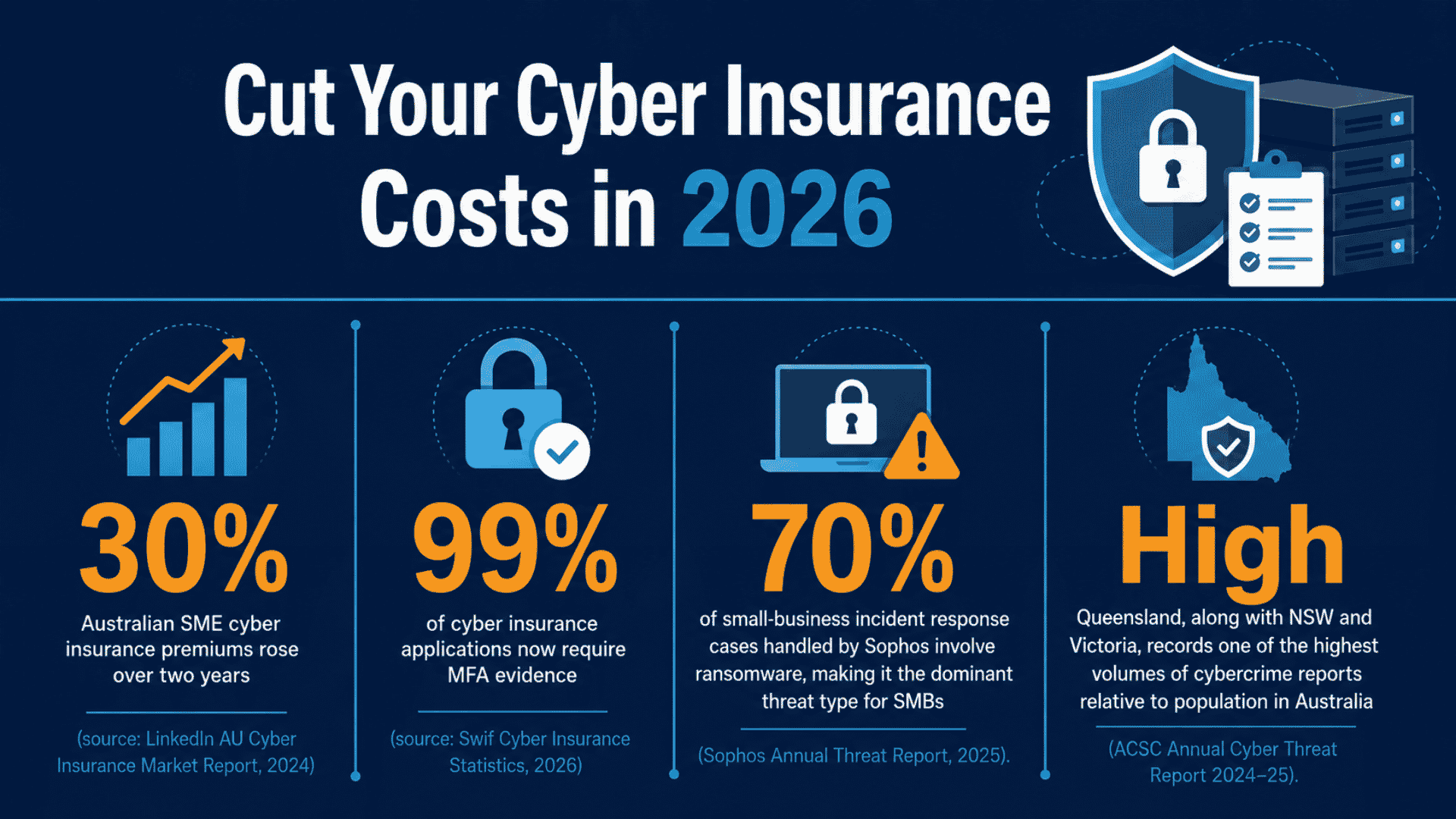
If your cyber insurance renewal is coming up in 2026, you are likely facing a bill that looks nothing like what you paid two years ago. According to the Australian cyber insurance market report, average premiums for Australian SMEs rose approximately 30% over the past two years, and insurers are not finished tightening the screws. For Brisbane business owners, the stakes are particularly high. The good news is that the controls driving the biggest premium reductions are also the controls most likely to prevent a costly incident in the first place. This guide explains exactly which investments will help you reduce cyber insurance premiums in Australia and give you a stronger position at your next renewal.
Why Brisbane SMEs Are in the Insurer’s Crosshairs
Insurers price risk based on data, and the data coming out of Queensland is not flattering. According to ITStart’s Queensland cybersecurity trends report, cyber attacks on Queensland small and medium-sized businesses increased 15% in 2024-25, with Queensland accounting for 28% of national cybercrime reports. That regional concentration matters because insurers segment risk by geography and industry, and being a Brisbane SME automatically places you in a higher-risk pool.
The financial exposure underpinning those figures is equally sobering. The same report found the average cyber incident cost for medium-sized Queensland businesses reached AUD $97,200, while small businesses averaged AUD $56,600 per incident. When insurers see figures like these alongside rising claim frequency, the result is predictable: higher premiums, stricter underwriting questions, and in some cases outright refusal to renew coverage without evidence of specific security controls.
Add to this the fact that 44% of Australian small businesses now generate more than 10% of their revenue online, according to CPA Australia’s small business survey, and the financial impact of any cyber incident or downtime event is amplified well beyond the immediate recovery costs. Understanding why premiums are rising is the first step toward doing something concrete about it.
What Insurers Are Actually Asking You in 2026
Gone are the days when a cyber insurance application asked little more than your annual revenue and industry. Today’s application forms read more like a technical security audit. Insurers want specific answers about the controls you have in place, and the presence or absence of those controls directly influences both your premium and your eligibility for cover.
According to Swif’s cyber insurance statistics report, 99% of cyber insurance applications now include specific questions about multi-factor authentication (MFA) implementation. MFA is no longer a value-add feature; it is a baseline requirement. Failing to have it deployed across your critical systems, particularly email and remote access, will either increase your premium significantly or trigger an exclusion clause that leaves you uninsured for credential-based attacks, which happen to be among the most common.
Beyond MFA, underwriters are increasingly asking about:
- Patch management cadence and whether edge devices and VPNs are kept up to date
- Endpoint detection and response (EDR) tools deployed across devices
- Privileged access controls and whether administrator accounts are limited and monitored
- Offline and tested backups that cannot be encrypted by ransomware
- Staff security awareness training conducted within the past 12 months
- Incident response planning and whether a documented plan exists
If you cannot answer these questions confidently, your renewal conversation will be an uncomfortable one.
The Essential Eight: Your Most Powerful Premium Reduction Tool
The Australian Signals Directorate’s Essential Eight mitigation strategies were designed to address the most common attack vectors targeting Australian organisations. As a framework for reducing cyber insurance premiums in Australia, it has become increasingly influential because insurers recognise it as a credible, independently verified benchmark.
The eight strategies are: application control, patch applications, configure Microsoft Office macro settings, user application hardening, restrict administrative privileges, patch operating systems, multi-factor authentication, and regular backups. Achieving even Maturity Level One across all eight strategies closes off the majority of attack pathways that generate insurance claims.
Consider the patching problem specifically. According to ITStart’s Queensland cybersecurity trends report, unpatched edge devices and VPNs are the initial access point in 25 to 33% of SMB incidents. That is an enormous proportion of claims originating from a control that costs relatively little to address but is frequently neglected by time-poor small business operators. Insurers know this, and they price accordingly.
When you engage a managed IT provider to implement and maintain Essential Eight controls, you are not simply ticking compliance boxes. You are building a documented, auditable security posture that you can present directly to your insurer at renewal. Many Brisbane businesses are now working with their managed service provider to generate an Essential Eight maturity assessment report specifically for their insurance broker’s use. This shifts the conversation from “we think we are secure” to “here is independent evidence of our security maturity.”
For a broader view of how strategic IT leadership can align your security investment with business outcomes, our guide to virtual CIO services for Australian SMEs walks through how this works in practice.
The Ransomware and Phishing Problem You Cannot Ignore
Two threat categories dominate the claim landscape for Australian SMEs, and both are directly addressable through controls that insurers reward. According to Huntress’ 2026 ransomware statistics, ransomware now accounts for roughly 88% of SMB breaches, underscoring its role as the dominant cause of small‑business security incidents. Ransomware claims are also among the most expensive for insurers to settle, which is why businesses without demonstrable ransomware resilience controls face the steepest premium loading.
The controls that directly reduce ransomware risk and appeal to underwriters include immutable, offline backups tested at least quarterly; application control to prevent unauthorised software execution; network segmentation to limit lateral movement; and EDR tools capable of detecting ransomware behaviour before encryption completes.
On the phishing front, the picture is equally challenging. Phishing surged 57.5% in Australia in 2024-25, driven largely by AI-generated emails that are increasingly indistinguishable from legitimate communications. Insurers are acutely aware that a single successful phishing email can lead to a business email compromise claim worth tens of thousands of dollars. Demonstrating that your organisation runs regular simulated phishing training, maintains email filtering with advanced threat protection, and enforces MFA on all email accounts meaningfully reduces your perceived risk profile.
The practical implication is straightforward: the businesses that invest in these controls before renewal rather than after an incident will pay less for the same coverage. The businesses that wait will either pay more or face gaps in their policy that only become apparent when they need to make a claim.

How Managed IT Services Translate Directly Into Premium Savings
One of the most underappreciated arguments for engaging a managed IT and cyber security provider is the direct line between documented, ongoing security management and lower insurance costs. Insurers apply premium loadings partly because they cannot verify what an unmanaged SME is actually doing day-to-day. When you work with a managed IT provider, you generate a continuous paper trail of patching records, security monitoring logs, backup verification reports, and staff training completions. That documentation is exactly what a sophisticated insurance broker needs to negotiate on your behalf.
For Brisbane SMEs, managed IT cyber insurance benefits extend beyond documentation. A managed service provider actively reduces the likelihood of a claimable incident by maintaining controls consistently, not just at renewal time. This is the distinction insurers have started to formalise: businesses with managed security services attract different premium bands than businesses relying on in-house staff who may lack the time or specialisation to maintain controls rigorously.
The economics are worth running carefully. If your current cyber insurance premium is $8,000 per year and a documented security uplift programme reduces it by 20%, that is $1,600 in annual savings. If the same programme prevents even a partial incident that would have cost $20,000 in downtime and recovery, the return on investment becomes obvious. For many Brisbane SMEs, the managed IT retainer cost is partially or fully offset by the premium reduction it enables, before accounting for the incident prevention value.
When you combine this with the operational benefit of having a team monitoring your environment around the clock, the conversation shifts from “can we afford managed IT security” to “can we afford not to have it.”
Practical Steps to Take Before Your Next Renewal
If your renewal is within the next six months, here is a prioritised action plan that focuses on the controls with the greatest influence on premium outcomes.
- Deploy MFA across all critical systems immediately. Email, remote access, cloud applications, and financial platforms should all require MFA. This is the single highest-impact action for improving insurability.
- Commission an Essential Eight maturity assessment. Engage a qualified managed IT provider to assess your current maturity level and produce a written report. This document becomes a negotiating asset with your insurer.
- Verify your backup strategy. Confirm you have at least one offline or immutable backup, that restoration has been tested in the past 90 days, and that backup logs are available for review.
- Establish a patch management schedule. Prioritise internet-facing systems, VPNs, and edge devices. Document every patch cycle with timestamps.
- Run simulated phishing training. Conduct at least one simulated phishing exercise and retain the results. Training completion records should be available for your broker.
- Prepare a cyber incident response plan. Even a one-page document outlining who to call, what to isolate, and how to communicate internally demonstrates a level of preparedness that underwriters value.
- Work with a broker who understands the Australian SME market. Not all brokers have the technical knowledge to present your security controls to insurers effectively. A specialist broker, supported by documentation from your managed IT provider, can often negotiate meaningfully better terms.
Conclusion
The path to reducing cyber insurance premiums in Australia is not a mystery. It runs directly through the security controls that insurers have made explicit: MFA, patching, backups, staff training, and documented security management. For Brisbane SMEs, the regional risk environment makes this work even more urgent, given that Queensland businesses face higher incident rates and average losses that are well above the national norm.
The businesses that treat cyber security investment as a premium reduction lever rather than an overhead cost will be better insured, better protected, and better positioned when they sit down with their broker. Those that approach renewal without documented controls will find themselves paying for the risk that others have taken the time to manage.
If you would like help building a security posture that genuinely moves the needle on your renewal terms, the team at Netcomp Solutions works with Brisbane SMEs to implement Essential Eight controls, produce audit-ready documentation, and support your broker with technical evidence. Contact Netcomp Solutions today to discuss your upcoming renewal and find out what a managed IT and cyber security partnership could mean for your premiums in 2026.
Frequently Asked Questions
What security controls have the biggest impact on reducing cyber insurance premiums in Australia?
Multi-factor authentication consistently has the strongest influence, appearing in 99% of insurer application forms. Beyond MFA, patch management for internet-facing systems, offline and tested backups, endpoint detection and response tools, and documented staff security awareness training are the controls most frequently cited by Australian underwriters as premium-reducing factors. Achieving a demonstrated Essential Eight maturity level provides the most comprehensive evidence of a managed security posture.
Do insurers actually verify the security controls I claim to have in place?
Increasingly, yes. Many insurers now require third-party attestation or documentation for higher coverage limits, and some conduct technical questionnaires that go well beyond tick-box answers. More importantly, if you make a claim and an investigation reveals that controls you declared on your application were not in place at the time of the incident, your insurer may decline the claim or reduce the payout on the basis of material misrepresentation. Accurate, documented controls are therefore both a premium tool and a claims protection measure.
Is the Essential Eight mandatory for Australian SMEs to obtain cyber insurance?
The Essential Eight is not a legal requirement for most private sector SMEs, but it has become a de facto benchmark in the Australian insurance market. Insurers are familiar with the framework and increasingly use it as a reference point when assessing risk. Demonstrating Maturity Level One or above gives your broker a credible, structured argument for lower premiums and better policy terms. For businesses in regulated sectors such as finance or health, additional obligations may apply.
How much can Brisbane SMEs realistically expect to save on cyber insurance premiums by improving their security posture?
The savings vary depending on your current controls, industry, revenue, and the specific insurer. However, businesses moving from minimal controls to a documented Essential Eight Maturity Level One posture have reported premium reductions in the range of 15 to 25% in the current Australian market. Given that average premiums for SMEs have risen approximately 30% over the past two years, a meaningful security uplift can effectively offset a significant portion of that increase. The financial case becomes even stronger when you factor in the incident prevention value of the controls themselves.