Technically reviewed by Vitaly Ogulev, founder of Netcomp Solutions (Brisbane managed IT and cyber security since 2002).
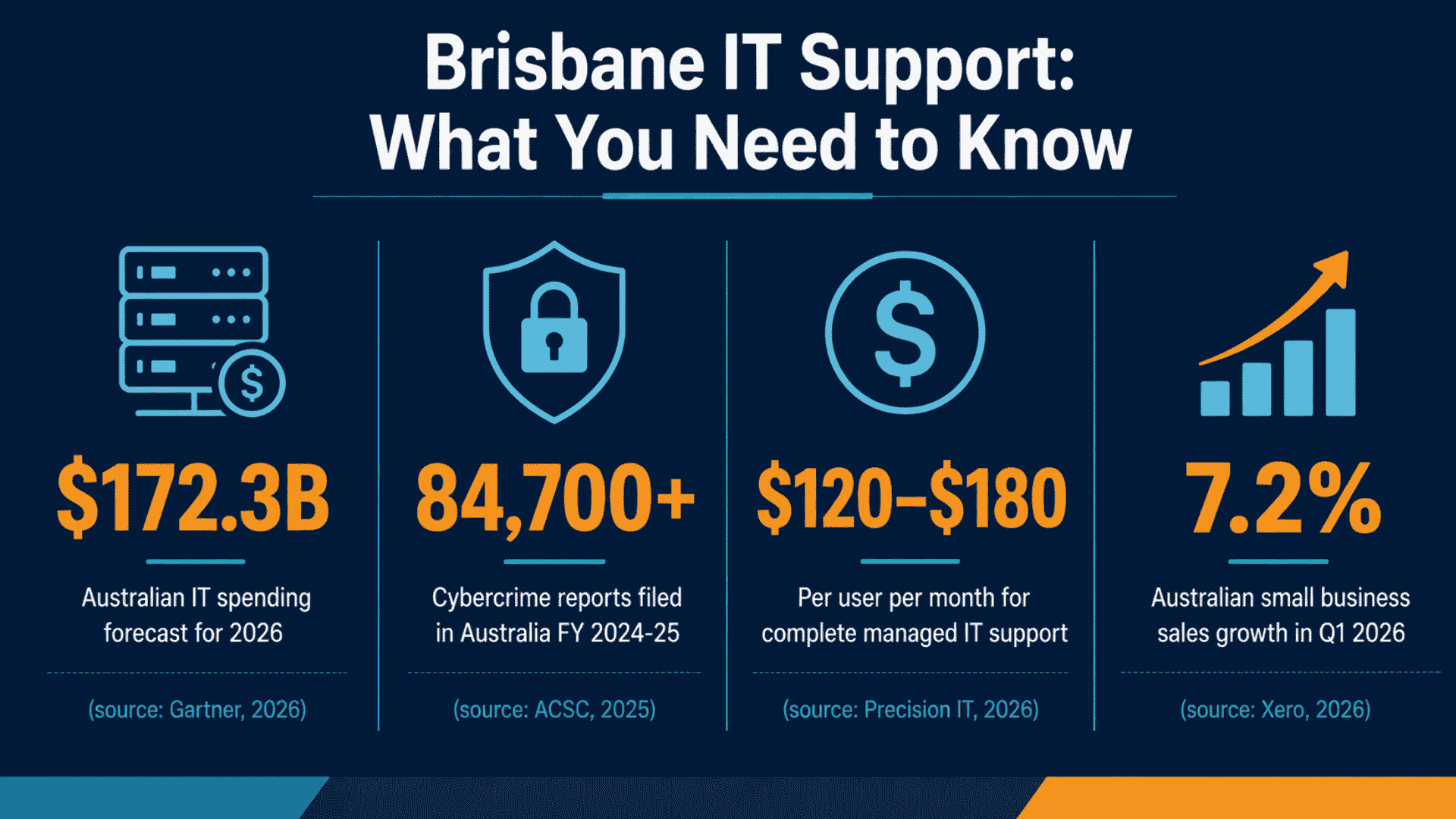
Choosing the right managed IT support provider is one of the most important technology decisions a small business owner can make in 2026. With Gartner forecasting Australian IT spending to exceed AUD $172.3 billion this year, the market for outsourced IT services has never been more competitive or more confusing. Brisbane small businesses are spoiled for choice, but not every provider delivers equal value. Some bundle genuine security and backup into their monthly fee. Others charge bare-bones rates and quietly upsell you for everything that actually matters. This guide cuts through the noise so you can compare managed IT support in Brisbane with confidence, ask the right questions, and avoid signing a contract you will regret.
What Is Managed IT Support and What Should It Include?
Managed IT support means outsourcing your day-to-day technology management to a specialist provider for a predictable flat monthly fee. Rather than calling a technician only when something breaks, you pay for ongoing monitoring, maintenance, and helpdesk access as a continuous service. This model protects your cash flow and keeps your systems running before problems escalate into costly outages.
A reputable managed IT support Brisbane provider should bundle several core services into their standard offering. According to the Australian Cyber Security Centre, cybercrime reports in Australia averaged one every six minutes during FY 2024-25, with over 84,700 reports received in that period alone. Given this threat landscape, security cannot be an optional add-on.
A complete managed IT package for small businesses should include:
- Helpdesk support with defined response times for priority issues
- Proactive monitoring of servers, workstations, and network devices
- Security patching for operating systems and third-party applications
- Managed backup and disaster recovery with tested restore procedures
- Endpoint security including antivirus, EDR, or managed detection and response
- Cloud and SaaS management covering Microsoft 365, Google Workspace, and line-of-business apps
- Vendor liaison so your provider deals with ISPs, software vendors, and hardware suppliers on your behalf
If a provider’s standard plan excludes backup or security and positions them as paid extras, treat that as an early warning sign about their overall approach to transparency.
What Does Managed IT Support Actually Cost in Brisbane?
Pricing is where many buyers get confused, and where some providers take advantage. The honest answer is that pricing varies based on the number of users, the complexity of your environment, and the depth of security services included.
According to Precision IT, small Australian businesses with 10 to 30 users should budget between $120 and $180 per user per month for managed IT services that genuinely include security and backup. The same source notes that comprehensive managed IT support across Australia ranges from $100 to $350 per user per month, depending on complexity and security requirements.
For a Brisbane business with 15 staff, that means a realistic monthly investment of $1,800 to $2,700 for a properly scoped managed service. Be cautious of providers offering rates well below $100 per user. At that price point, something is almost always missing, whether it is 24/7 monitoring, genuine cyber security tooling, or an adequate helpdesk capacity to respond within a reasonable timeframe.
When requesting quotes, ask providers to break down exactly what is included in the per-user fee versus what is billed separately. Watch for common upsell items like backup storage overages, after-hours call surcharges, onsite visit fees, and project work rates. A transparent provider will disclose all of these upfront.
The Key Questions to Ask Before You Sign
Switching managed IT providers is disruptive and expensive, so your due diligence before signing matters enormously. Treat the sales conversation as an interview. Any reputable small business IT support Brisbane provider should answer these questions clearly and without hesitation.
- What are your response time commitments, and are they in the contract? A verbal promise of “fast response” is meaningless. Your agreement should specify response times for critical, high, medium, and low priority issues, and ideally include a resolution time target for common requests.
- Where is your helpdesk located? Local knowledge matters. A Brisbane-based or at minimum Australian-based helpdesk understands business hours, public holidays, local software ecosystems, and common infrastructure setups in Queensland.
- How do you handle cyber security incidents? Your provider should have a documented incident response process. Ask whether they offer 24/7 security monitoring or only business-hours coverage, and what happens if a breach is detected at 2am on a Sunday.
- Who owns my data and documentation if I leave? Some providers hold your network documentation, passwords, and licensing details hostage during a transition. Confirm in writing that all documentation belongs to your business.
- Can I speak with two or three current clients similar to my business? Reference checks remain one of the most reliable ways to verify whether a provider delivers on its promises.
- What is your technical escalation path? Understand whether your helpdesk tickets are resolved by Level 1 staff reading from scripts or by experienced engineers who can handle complex issues without delays.
Red Flags That Should Disqualify a Provider
Not every managed IT provider in Queensland is worth your time. These warning signs indicate a provider may not deliver the reliable, secure service your business depends on.
No written service level agreement. If a provider is reluctant to commit response times and service standards to writing, walk away. Accountability requires documentation.
Cyber security is an add-on. Given that Australian mid-sized businesses experienced double-digit growth in cyber incidents in 2024-25, according to Kaine Mathrick Tech citing ACSC data, any provider treating security as optional is not aligned with the current threat environment.
Lock-in contracts with no exit provisions. Twelve-month agreements are standard and reasonable. Contracts requiring two or three years with no exit clause or punitive break fees suggest a provider that relies on retention through contracts rather than service quality.
Vague pricing with excessive exclusions. If the quote document contains more exclusions than inclusions, the flat monthly fee is not what it appears to be.
No local presence or account management. Outsourced IT support Queensland businesses rely on works best when there is an identifiable account manager who knows your environment and can attend your office when needed. An overseas helpdesk with no local escalation is a false economy for most small businesses.
Poor online reviews or no verifiable client history. Check Google reviews, Clutch profiles, and ask for case studies relevant to your industry. A provider with a thin online presence and no verifiable client base is a risk.

Cyber Security: Why It Must Be Central to Your Decision
Cyber security is no longer a separate conversation from managed IT support. The two are inseparable for any Brisbane business operating in 2026. According to Grand View Research, managed security is the most lucrative and fastest-growing solution segment in Australia’s managed services market. Providers are investing heavily in this area because demand is rising sharply.
For small businesses, the practical implication is clear. Your managed IT provider should offer, at a minimum:
- Managed endpoint detection and response (EDR or MDR)
- Email filtering and anti-phishing protection
- Multi-factor authentication (MFA) enforcement across all user accounts
- Patch management that covers both operating systems and applications
- Regular security awareness training for staff
- Dark web monitoring for compromised credentials
Providers who align with the Australian Cyber Security Centre’s Essential Eight framework offer a particularly strong baseline. The Australian Government recommends the Essential Eight framework as the baseline mitigation strategy for small and medium businesses. Working with a provider familiar with these strategies signals genuine local expertise rather than a generic, offshore approach.
When comparing providers, ask specifically which Essential Eight controls their standard plan includes and which ones require an upgrade. This single question will reveal a great deal about how seriously a provider takes security versus how seriously they treat it as a revenue opportunity.
Evaluating Local Expertise and Cultural Fit
Technology competency is only part of the equation. A managed IT support relationship is a long-term partnership, and cultural fit matters more than many business owners realise until they are six months into a frustrating engagement.
Brisbane’s small business community is growing rapidly. According to Xero, Australian small business sales rose 7.2% year-on-year in Q1 2026 across 520,000 businesses. This growth means more businesses are hiring and expanding their technology stack. Consequently, they need IT support that can scale with them rather than hold them back.
A provider with genuine Brisbane roots understands local business hours, the Queensland public holiday calendar, and specific suburban NBN infrastructure challenges. Furthermore, they grasp the precise compliance requirements that apply to industries concentrated in southeast Queensland. For example construction, professional services, health, and real estate.
During the sales process, pay attention to how the provider communicates. Do they explain technical concepts in plain language? Or do they ask about your business goals before recommending solutions? Do they follow up promptly? The behaviour you see during the sales process typically provides the best indicator of the service you will receive once you sign the contract.
Consider also whether the provider has experience with businesses in your size range. A provider whose typical client has 200 staff may not prioritise a 12-person firm. Equally, a sole-trader-focused provider may lack the technical depth to support a business with a more complex environment. Ask about their average client size and whether your business would be a typical engagement or an outlier.
Conclusion: Making the Right Choice for Your Brisbane Business
Selecting a managed IT support provider in Brisbane is a significant decision that deserves careful evaluation, not a rushed comparison based on price alone. The right provider will protect your business from cyber threats, keep your systems running reliably, and scale with you as your business grows. The wrong one will leave you frustrated, exposed, and paying more than you expected.
Use the questions and red flags in this guide as your evaluation framework. Prioritise providers who are transparent about pricing, committed to local service delivery, and who treat cyber security as a core component of their offering rather than an upsell. In a market where technology investment is accelerating and cyber threats are intensifying, those standards are the baseline, not a premium expectation.
Netcomp Solutions is a Brisbane-based managed IT and cyber security provider working exclusively with Australian small businesses. If you are ready to compare your options or simply want an honest conversation about what your business actually needs, get in touch with the Netcomp team today.
Frequently Asked Questions
What is a fair price for managed IT support in Brisbane in 2026?
For small businesses with 10 to 30 users, a fair price in the current Queensland market is between $120 and $180 per user per month when the service genuinely includes helpdesk support, security, patching, and backup. Pricing below this range typically indicates that key services have been excluded. Always request a detailed breakdown of what is and is not included in the quoted fee.
What is the difference between managed IT support and break-fix IT support?
Break-fix support means you call a technician only when something goes wrong and pay by the hour or job. Managed IT support is a proactive, ongoing service where your provider monitors and maintains your systems continuously for a flat monthly fee. Managed support is generally more cost-effective for businesses that depend on technology daily, because it prevents problems rather than simply reacting to them.
Should cyber security be included in my managed IT plan?
Yes. Given the current threat environment in Australia, cyber security should be a core component of any managed IT support agreement, not an optional extra. At a minimum, your plan should include endpoint protection, patch management, email filtering, and multi-factor authentication. Providers who align with the Australian Government’s Essential Eight framework are a strong choice for small businesses in Brisbane and southeast Queensland.
How do I switch managed IT providers without disrupting my business?
The key to a smooth transition is documentation. Before ending your current contract, ensure you have obtained all network documentation, passwords, software licences, and configuration records from your existing provider. Your new provider should offer a structured onboarding process that includes a full environment audit. Plan the transition during a lower-activity period for your business, and ensure both providers agree on a clear handover timeline to avoid gaps in support coverage.