Technically reviewed by Vitaly Ogulev, founder of Netcomp Solutions (Brisbane managed IT and cyber security since 2002).
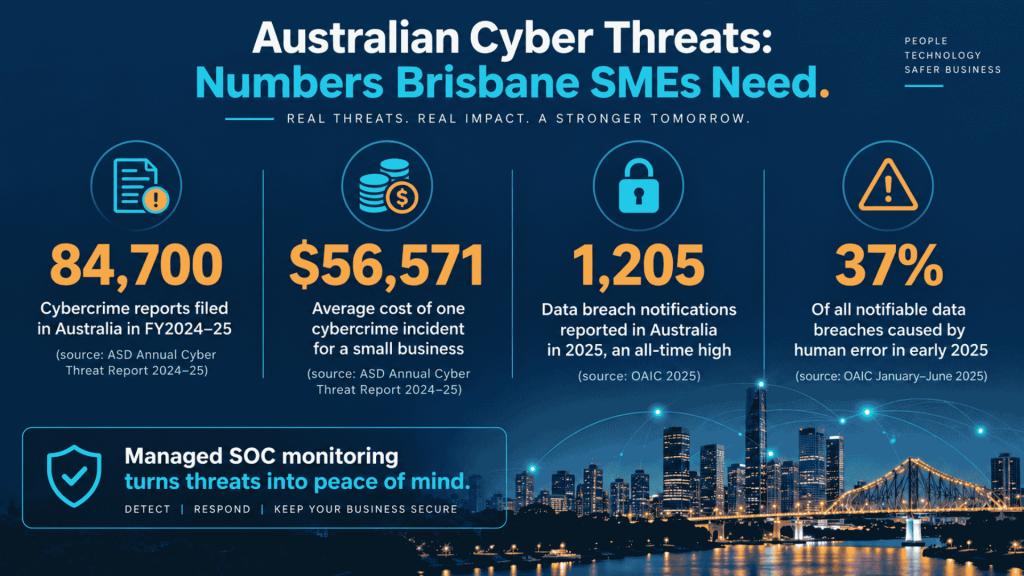
Australian businesses report a cybercrime every six minutes. According to the Australian Signals Directorate, businesses and individuals lodged over 84,700 cybercrime reports in FY2024–25. Moreover, the average self-reported cost for a small business reached $56,571 per incident. Consider a Brisbane tradie, accounting firm, or healthcare practice running on tight margins. For them, a single breach is not just an IT headache. Instead, it is a genuine business-threatening event. As a result, terms like “managed SOC” and “SIEM monitoring” now appear more often in conversations with IT providers. But what do these terms actually mean? Furthermore, does a five or fifteen person business in Brisbane genuinely need that level of protection? This article cuts through the jargon and gives you a straight answer.
What Is a Managed SOC, in Plain English?
A Security Operations Centre, or SOC, is a dedicated team of security analysts. Their entire job is to watch your IT environment around the clock. They detect threats and respond before damage occurs. Large enterprises build their own SOCs, complete with custom tooling, shift rosters, and six-figure analyst salaries. However, that model is out of reach for almost every small business in Australia.
A managed SOC flips the economics. Instead of building your own, you subscribe to a shared service. A specialist provider runs the infrastructure, the tooling, and the analyst team on your behalf. You pay a predictable monthly fee, typically per device or per user, on top of your managed IT costs. In return, you get enterprise-grade detection and response without the enterprise headcount.
The core technology behind a managed SOC is a SIEM, which stands for Security Information and Event Management. A SIEM monitoring service collects logs and alerts from every corner of your environment. This includes endpoints, firewalls, cloud platforms, and business applications. It then correlates them to identify patterns that no single tool would catch on its own. In short, think of it as a centralised security brain that connects the dots in real time.
When you pair a SIEM with managed detection and response, the service goes beyond simply raising an alarm. Human analysts review confirmed threats, contain affected systems, and guide your team through remediation. Ultimately, that full loop separates a managed SOC from a basic antivirus subscription.
What Threats Is a Managed SOC Actually Detecting?
To understand the value of continuous monitoring, it helps to know what is hitting Australian businesses right now. According to the OAIC’s latest Notifiable Data Breaches report, phishing caused 34 per cent of reported cyber incidents. Ransomware caused 24 per cent, and stolen or compromised credentials caused another 21 per cent. These are not exotic, nation-state attacks. Rather, they are the everyday threats that small and medium businesses across Brisbane face constantly.
What makes them dangerous is their ability to hide in plain sight. A compromised credential looks like a legitimate login. Similarly, a phishing email that tricks one staff member into entering their Microsoft 365 password generates no endpoint alert. Ransomware often sits quietly in a network for days or weeks before detonating. Even well-configured firewalls and endpoint protection generate too much noise on their own. Consequently, your IT team cannot spot these patterns manually.
A SIEM monitoring service aggregates all of that signal into a single view. For example, a user logs in from Brisbane at 9am and then from an overseas IP at 9:15am. The SIEM flags the anomaly immediately. Likewise, a file server might start encrypting unusual volumes of files at 2am. In that case, the system pages an analyst straight away. That kind of correlation separates managed security services from point-in-time protection.
It is also worth noting that not every threat is malicious. According to the OAIC, human error caused 37 per cent of notifiable data breaches in the first half of 2025. A managed SOC does not eliminate employee mistakes. However, it does give your business a faster path to discovery and containment when they occur.
The Breach Numbers Every Brisbane Business Owner Should Know
Australia’s breach landscape is not improving. According to the OAIC, organisations lodged 1,205 data breach notifications in the 2025 calendar year. That figure is an all-time high. Malicious or criminal activity caused 716 of those breaches. In addition, health service providers alone accounted for 225 notifications, or 19 per cent of all reported breaches. Therefore, healthcare remains one of the highest-risk sectors for any Brisbane practice.
Under the Notifiable Data Breaches scheme, many of these organisations faced mandatory disclosure obligations and regulatory scrutiny. They also suffered reputational consequences on top of the direct remediation costs. Consider a growing Brisbane business holding client data, payroll records, or medical information. For them, a breach is not just an IT problem. It creates legal exposure and can directly affect their ability to hold onto cyber insurance coverage.
Speaking of insurance, underwriters in the Australian market now pay close attention to ongoing security monitoring. Continuous monitoring and documented incident response processes increasingly influence premiums and even whether insurers offer coverage at all. A managed SOC provides the documented, auditable security posture that insurers want to see. For that reason, it is a commercially relevant consideration even for businesses with fewer than 20 staff.
For context on the financial stakes, the ASD reports a higher figure for medium businesses. There, cybercrime costs $97,166 per incident on average. In other words, if your business is growing, the risk profile grows with it.
What Is Actually Included in Managed Security Services for Australian SMEs?
When Brisbane small businesses engage managed security services, the service layer typically sits on top of existing managed IT. Here is what a well-structured managed SOC engagement generally includes:
- SIEM log aggregation and correlation: The SOC centrally collects security events from endpoints, servers, firewalls, cloud services, and applications. Automated rules then flag anomalies.
- 24/7 threat monitoring: Analysts provide around-the-clock coverage. As a result, a threat detected at 3am on a Sunday does not wait until Monday morning for review.
- Managed detection and response (MDR): When the SOC team confirms a real threat, they act to contain it. That may mean isolating an endpoint, resetting credentials, or blocking a malicious IP at the firewall.
- Endpoint detection and response (EDR): Advanced endpoint agents provide deeper behavioural visibility than traditional antivirus. They feed data directly into the SIEM.
- Vulnerability management: Regular scans identify misconfigurations and unpatched systems before attackers can exploit them.
- Incident reporting and documentation: The SOC records every detected event and the response taken. This supports internal review as well as insurance and compliance requirements.
That active monitoring and response layer is the key distinction. It separates managed security services Australia-wide from a basic managed IT plan. Standard managed IT keeps your systems running. In contrast, a managed SOC keeps your systems safe.

SOC for Small Business: Is the Cost Justified at Your Scale?
This is the question most Brisbane business owners are really asking. The short answer is that it depends. Specifically, it depends on your risk profile, your industry, and the true cost of a breach.
If your business handles personal information, payment data, health records, or any regulated data, the calculus shifts quickly. The Privacy Act, the Notifiable Data Breaches scheme, and sector-specific rules all impose obligations. Consequently, a breach carries costs well beyond the technical remediation. Add the reputational damage to client relationships built over years. Suddenly, the monthly cost of a managed SOC looks very different against the alternative.
For businesses in lower-risk categories, the answer is more nuanced. A good starting point is to ask your IT provider for an honest assessment of your current detection capability. If a threat actor gained access to your environment right now, how long would it take someone to notice? Perhaps the honest answer is “days” or “we’re not sure.” If so, that gap is exactly what a SIEM monitoring service closes.
Cyber security monitoring in Brisbane is no longer an enterprise-only concern. The shared-service model behind modern managed SOC offerings changes the economics. Now, 24/7 monitoring is affordable for businesses with ten users or a hundred. Therefore, the question is not whether you can afford SOC-grade protection. It is whether you can afford to go without it.
How Netcomp Delivers SOC-Grade Protection for Brisbane Small Businesses
Netcomp Solutions builds managed security services for Australian small and medium businesses. Our clients want enterprise-grade visibility without enterprise pricing or complexity. Our approach integrates SIEM-based threat detection, endpoint protection, and managed detection and response into a single monthly service. Moreover, it works alongside your existing managed IT plan.
We do not sell you a standalone security product and walk away. Instead, we embed security monitoring into the broader management of your environment. That means our team understands your normal baseline. In turn, this makes anomaly detection faster and more accurate. When an alert fires, the responding team already knows your business.
We work with Brisbane businesses across professional services, healthcare, finance, construction, and retail. Our cyber security monitoring in Brisbane meets you where you are. For instance, you might be starting from a basic antivirus posture. Alternatively, you might want to uplift an existing managed IT arrangement to include 24/7 SOC coverage.
Perhaps you are weighing up managed security services for your Australian small business. You may want a clear-eyed view of what your current environment leaves exposed. If so, we are happy to have that conversation. Above all, we do it without pressure or jargon.
Ready to find out where your business stands? Contact the Netcomp team today for a no-obligation security conversation with a Brisbane-based specialist.
Frequently Asked Questions
What is the difference between a managed SOC and standard managed IT?
Standard managed IT focuses on keeping your systems operational. That includes patching, backups, helpdesk support, and device management. A managed SOC adds a continuous security monitoring layer on top. It actively watches for threats, correlates suspicious activity across your environment, and responds when it confirms a real incident. In short, the two services complement each other rather than overlap.
How much does a managed SOC cost for a small business in Australia?
Providers typically price managed security services in Australia per user or per device. They then add this on top of existing managed IT fees. The exact cost depends on the size of your environment, the depth of coverage, and the specific tools deployed. However, the more meaningful comparison is the monthly service cost against the cost of a breach. For an Australian small business, the ASD puts that average cost at $56,571 per cybercrime incident.
Does my business need a managed SOC if I already have antivirus and a firewall?
Antivirus and firewalls are foundational controls. However, they cannot detect the kinds of threats that now dominate the Australian breach landscape. Compromised credentials, phishing, and slow-moving ransomware can bypass or simply avoid triggering these tools. In contrast, a SIEM monitoring service correlates activity across your entire environment to catch patterns that individual tools miss. For most businesses handling client data or regulated information, the additional layer deserves serious consideration.
Which Brisbane businesses are most likely to need cyber security monitoring?
Many Brisbane businesses hold personal information, health records, financial data, or payment details. Each of them has meaningful exposure under the Privacy Act. The Notifiable Data Breaches scheme adds further obligations. Healthcare providers, accounting and legal firms, financial advisers, and online payment processors are the highest-priority candidates. However, supply chain risk means even smaller operators can become a pathway into larger client organisations. For that reason, the risk is relevant across every sector.