Technically reviewed by Vitaly Ogulev, founder of Netcomp Solutions (Brisbane managed IT and cyber security since 2002).
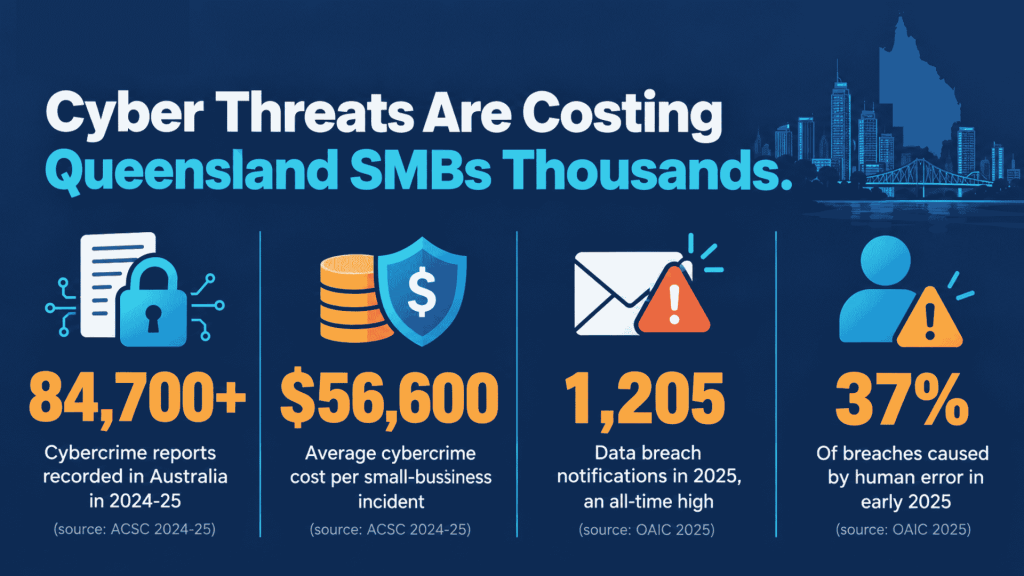
Australian small businesses face constant cyber attacks, and the latest national figures confirm it. The Australian Signals Directorate’s Australian Cyber Security Centre (ASD’s ACSC) received over 84,700 cybercrime reports in 2024–25. In other words, that equals one report roughly every six minutes. Small businesses reported an average cost of $56,600 per cybercrime report, up 14 per cent on the previous year. For owners in Brisbane, the Gold Coast and South East Queensland, these figures are not abstract. In practice, they mean lost revenue, damaged client relationships and weeks of recovery work. The good news is that a structured IT security audit shows your real exposure. It lets Brisbane businesses close the gaps before an incident forces their hand. This guide explains what the audit covers, what the findings look like and what to do next. In brief:
- An IT security audit reviews your devices, accounts, cloud services, backups, suppliers and staff practices. It measures them against a standard such as ASD’s Essential Eight.
- Small businesses reported an average cost of $56,600 per cybercrime report in 2024–25, according to ASD’s ACSC.
- The OAIC received a record 1,205 data breach notifications in calendar year 2025.
- A good audit ranks findings by business impact. It turns them into immediate, 30–90 day and 12-month actions.
- A common approach is a full audit once a year and a lighter review every six months.

What Is an IT Security Audit?
An IT security audit is an independent, structured review of your business’s technology and security practices. The auditor checks devices, user accounts, cloud services, backups, suppliers and staff behaviour. They then compare the results against a recognised standard, such as ASD’s Essential Eight. Finally, you receive a written report that ranks each gap by business risk and recommends a fix.
Why Brisbane and Gold Coast SMBs Need an IT Security Audit Now
The threat environment for Queensland small businesses has changed significantly in recent years. Importantly, cybercriminals no longer target only large enterprises. Moreover, automated tools let attackers probe thousands of small-business networks at once. They look for weak passwords, unpatched systems and poorly configured cloud services. Meanwhile, the financial impact keeps climbing. The ASD’s ACSC Annual Cyber Threat Report 2024–25 puts the average cost per business cybercrime report at $80,850. That is a 50 per cent increase on the previous year. Medium businesses averaged $97,200 per report, and large businesses averaged $202,700. Similarly, data breaches have hit record levels.
The Office of the Australian Information Commissioner (OAIC) received 1,205 data breach notifications in 2025. That is the highest annual total since the Notifiable Data Breaches scheme began in 2018. It is also 8 per cent more than in 2024. Malicious or criminal attacks caused 716 of those breaches. Health service providers lodged the most notifications of any sector (225). Legal, accounting and management services lodged 81. If the Privacy Act covers your business, a single breach can trigger mandatory notification obligations. This group includes all health service providers and businesses with annual turnover above $3 million. Beyond that, a breach can lead to compensation claims and reputational damage that far exceed the direct clean-up cost. An IT security audit gives you a clear, documented picture of your defences before something goes wrong. It is not a one-off compliance exercise. Rather, it forms the foundation of an ongoing risk management program tailored to your size and industry.
What a Structured IT Security Audit Covers: The Checklist
Many business owners assume an audit is a quick network scan. However, a thorough IT security audit in Brisbane goes considerably deeper. The checklist below covers the six domains a professional assessment reviews.
1. Asset and User Inventory
You cannot protect what you do not know exists. Auditors start by documenting every device, server, cloud service and software application your business uses. This includes shadow IT: apps and tools staff adopted without formal approval. In addition, auditors catalogue every user account, paying close attention to accounts with administrator rights. Accounts that stay active after staff leave are a common and easily exploited entry point.
2. Access Controls and Identity Management
Auditors examine multi-factor authentication (MFA), password policies, role-based permissions and single sign-on settings. This matters because email compromise is now the most commonly reported business cybercrime. In 2024–25, email compromise without financial loss made up 19 per cent of business cybercrime reports to ASD’s ACSC. Business email compromise (BEC) fraud with financial loss made up another 15 per cent. Both figures come from the ACSC’s 2024–25 cyber threat factsheet for businesses. As a result, auditors check that your email platform enforces MFA and look for suspicious mailbox forwarding rules. They also confirm that staff follow documented payment-verification procedures.
3. Patch Management and Vulnerability Assessment
Attackers reliably exploit unpatched operating systems, browsers and third-party applications. Auditors review patch status across all devices and check firmware on routers and network appliances. They also run vulnerability scans to identify known weaknesses. Auditors then map findings to ASD’s Essential Eight, a set of eight baseline mitigation strategies. The Essential Eight gives small businesses a practical benchmark for security maturity. In fact, even government agencies find this baseline hard to reach. ASD’s report The Commonwealth Cyber Security Posture in 2025 covers the 2024–25 financial year. It found only 22 per cent of Commonwealth entities reached Essential Eight Maturity Level 2. That result shows how far typical practice sits from the recommended baseline.
4. Backup, Recovery and Business Continuity
Auditors review backups for frequency, storage location, encryption and, most importantly, whether anyone has tested a restore. Some businesses discover during an audit that their backups have been failing silently for months. After that, auditors assess your recovery time objectives. Finally, they check whether you have a documented incident response plan that staff have actually read.
5. Third-Party and Vendor Access
Suppliers, contractors and managed service providers often hold ongoing access to business systems. Auditors document every third-party connection and review the permissions each one holds. They also check that you revoke access promptly when a vendor engagement ends. Unfortunately, small businesses often overlook this area, yet it represents a significant supply-chain risk.
6. Staff Awareness and Human Error Controls
Of course, technology controls alone are not enough. Human error caused 193 data breaches between January and June 2025, according to the OAIC’s January to June 2025 statistics. That was 37 per cent of all notifications in that period, up from 29 per cent previously. Auditors check whether staff have completed security awareness training and whether you have run phishing simulations. They also confirm that staff understand your documented data-handling procedures. Any credible cybersecurity risk assessment in Australia includes this human-factors component alongside the technical review.
What Audit Findings Look Like and How to Read Them
A professional audit produces a structured report, not a raw list of technical vulnerabilities. Good reports explain each finding in plain language. Each finding includes a risk rating, the business impact if someone exploits it, and a recommended fix with a timeline. A useful audit prioritises findings by business impact, not technical severity alone. This separates it from a compliance checkbox exercise. For example, a misconfigured firewall rule might rate as high severity on paper. But if it only exposes a test environment with no live data, it needs a different response timeline. By contrast, staff sharing one administrator account on your accounting platform needs urgent attention. Your auditor should help you see which findings carry the greatest real financial or operational consequence. Most reports group findings into three categories:
- Immediate actions to complete within days.
- Short-term improvements to address within 30 to 90 days.
- Strategic recommendations for the next 12 months.
This structure turns the audit into an actionable roadmap rather than a document that sits in a drawer. Businesses that use ongoing IT audit services in Australia commonly run a full review once a year. They add a lighter reassessment every six months to capture staff changes, new software and shifts in the threat landscape. A one-off audit beats no audit at all. Regular reassessment, however, is what drives lasting risk reduction.
How to Prepare Your Brisbane Business for an IT Security Audit
You do not need technical expertise to prepare. Before the audit begins, gather a few practical items so the process runs efficiently:
- A list of your software subscriptions and cloud services, including tools individual staff use for their own work.
- Recent IT invoices or support records, which help auditors identify hardware age and support contract status.
- Copies of any existing IT or security policies, even informal ones. The auditor compares documented intent with actual practice.
- Contact details for external IT providers or contractors who currently have access to your systems.
- A summary of recent security incidents, including phishing emails staff reported or unexpected account lockouts.
Above all, you do not need perfect answers to any of these. The audit exists to uncover gaps, not to judge whether you have already solved them. A good cyber risk review provider on the Gold Coast or in Brisbane treats the engagement as collaborative discovery.
Taking Action After Your IT Security Audit
The audit report marks the beginning of the process, not the end. A common mistake is treating findings as a theoretical concern rather than an operational priority. Small businesses reported an average cost of $56,600 per cybercrime report in 2024–25. Against that figure, fixing even a handful of critical findings delivers a clear return. First, tackle the immediate actions in your report. These are usually quick wins. Examples include enabling MFA where it is missing, disabling unused accounts and confirming backups restore correctly. Next, work through the short-term recommendations in priority order. Assign a responsible person and a target date to each item so nothing stalls. On the other hand, some findings need a bigger investment.
Examples include replacing end-of-life hardware, deploying endpoint detection and response (EDR) tools, or implementing security information and event management (SIEM). Your audit report should give enough context to support a business case for your leadership team or board. Review a small business IT audit checklist like this one every year and act on it systematically. It is one of the most practical investments a Queensland SMB can make in long-term resilience. The national data shows business cybercrime costs rising sharply and data breach notifications at record levels.
Summary: Why an IT Security Audit Is No Longer Optional
Brisbane and Gold Coast small businesses face a demanding cyber threat landscape in 2026. Data breach notifications hit a record high in 2025. The average cost per business cybercrime report rose 50 per cent in 2024–25. Furthermore, attackers actively target SMBs. For Brisbane businesses, a structured IT security audit is now a core part of responsible management, not an optional extra. Netcomp Solutions has supported small and medium businesses across Brisbane, the Gold Coast and South East Queensland since 2002. We deliver practical, plain-language IT security audits and cybersecurity risk assessments. Our process covers every item in this checklist. It delivers a prioritised action plan your team can act on immediately. To see what an audit would look like for your business, contact the Netcomp team today.
Frequently Asked Questions
How long does an IT security audit take for a small business?
A thorough audit for an SMB with 5 to 50 staff usually takes one to three days of assessment. Analysis and report preparation follow. The timeline depends on the number of locations, systems and users. Your provider should give you a clear scope document before work begins, so there are no surprises.
How much does an IT security audit cost for a small business in Queensland?
Costs depend on business size and scope. Ask for a fixed-price, written scope so you know exactly what the audit includes. Compare that cost with the $56,600 average small businesses reported per cybercrime report in 2024–25. Seen that way, even a comprehensive audit represents strong value. Some providers offer tiered options, so you can start with a foundational assessment and expand over time.
What is the difference between an IT security audit and a cybersecurity risk assessment?
People often use the terms interchangeably, but there is a practical difference. An IT security audit documents your current controls and compares them against a defined standard, such as the Essential Eight. A cybersecurity risk assessment goes further. It estimates the likelihood and business impact of specific threat scenarios. In practice, a quality cybersecurity risk assessment in Australia combines both elements in a single engagement.
What is the Essential Eight?
The Essential Eight is a set of eight baseline mitigation strategies from the Australian Signals Directorate (ASD). The eight strategies are:
- Patch applications
- Patch operating systems
- Multi-factor authentication
- Restrict administrative privileges
- Application control
- Configure Microsoft Office macro settings
- User application hardening
- Regular backups
ASD measures each strategy against Maturity Levels zero to three. Each business should choose a target maturity level that matches its risk.
How often should a Brisbane small business conduct an IT security audit?
A common recommendation is a full audit at least once a year, with a lighter review every six months. The lighter review captures changes in staff, systems and the threat environment. Schedule an extra review after an incident, a new cloud platform rollout or significant staff turnover. ASD’s ACSC received a cybercrime report roughly every six minutes in 2024–25. Higher-risk industries such as healthcare, legal and accounting may need more frequent checks.
Sources
- ASD’s ACSC, Annual Cyber Threat Report 2024–25 (published 14 October 2025).
- ASD’s ACSC, Annual Cyber Threat Report 2024–25: factsheet for businesses and organisations (October 2025).
- OAIC, Data breach notifications increase to all-time high in 2025 (July 2026).
- OAIC, Latest Notifiable Data Breach statistics for January to June 2025 (November 2025).
- ASD’s ACSC, The Commonwealth Cyber Security Posture in 2025 (February 2026).
- ASD’s ACSC, Essential Eight explained.
Last reviewed: October 2026. Figures reflect the most recent official Australian data available at that date.