Technically reviewed by Vitaly Ogulev, founder of Netcomp Solutions (Brisbane managed IT and cyber security since 2002).
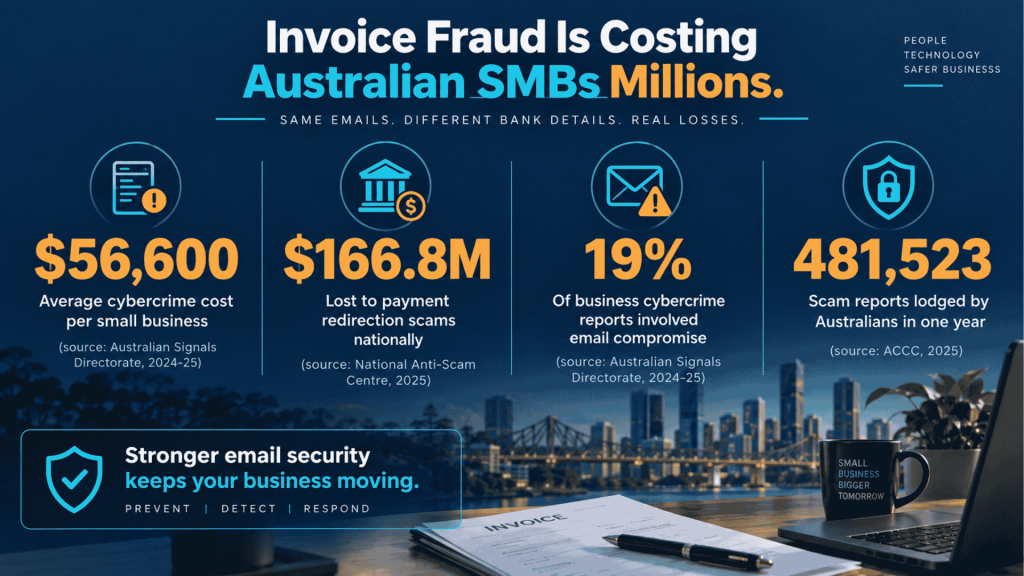
Imagine approving a routine invoice from your regular supplier. Three days later, you discover the bank details had changed. A criminal had quietly read your emails for weeks and altered the account number. This is not a hypothetical. According to the Australian Signals Directorate, cybercrime cost the average small business $56,600 in 2024-25. That is a 14% rise on the previous year. Payment redirection and email compromise incidents drove much of that increase. Gold Coast and Brisbane business owners manage supplier payments, payroll, and client invoices every week. For them, that figure represents a very real financial threat. So, it pays to understand exactly how these attacks work. It also pays to know how managed IT services Gold Coast businesses rely on can close the gaps.
How Business Email Compromise Actually Works
Business email compromise, commonly called BEC, is not a crude hack. Instead, it is a patient, methodical fraud that exploits trust and routine. A typical attack follows a recognisable pattern. However, many Gold Coast and Brisbane SMB owners would not spot it immediately.
First, an attacker gains access to a business email account. Often, they use a stolen password bought on the dark web or captured through a phishing email. Once inside, they read. They study invoice templates, supplier names, payment schedules, and the language your team uses. They learn who authorises payments and who processes them. This reconnaissance phase can last weeks.
Then they act. The attacker sends a fraudulent invoice from inside the compromised account. Alternatively, they register a lookalike domain. For example, they replace an “m” with “rn” to create an address that passes a quick glance. The invoice looks identical to your real supplier’s documents. The only change is the bank account number at the bottom.
According to the Australian Signals Directorate, 15% of business cybercrime reports in 2024-25 involved BEC fraud with financial loss. In addition, email compromise without financial loss accounted for another 19% of reports. These are not rare events. Rather, they form a consistent, high-volume category of crime targeting organisations exactly like yours.
What makes BEC so damaging is its simplicity. There is no malware to detect and no suspicious file attachment to flag. It is social engineering layered on top of legitimate-looking communication. As a result, technical defences alone are not enough.
The Invoice Fraud Numbers Gold Coast Businesses Need to See
The financial scale of invoice fraud in Australia is significant and growing. According to the National Anti-Scam Centre, payment redirection scams cost Australians $166.8 million in 2025. That is a 9.3% increase on the $152.6 million lost in 2024. This figure captures BEC-style attacks. In these attacks, criminals intercept or impersonate invoicing communications and redirect funds into accounts they control.
Even so, these figures almost certainly understate the true cost. Many businesses never report fraud at all. Some feel embarrassed, some are unsure about the reporting process, and others simply want to move on. Consequently, the real losses across Australian businesses are likely far higher.
Across the entire scam landscape, the picture is just as stark. The ACCC reports that Australians made 481,523 scam reports in 2025. Financial losses totalled $2.18 billion. Invoice fraud and BEC sit squarely inside that broader pool of losses. Those losses drain money from businesses and consumers alike.
For growing Gold Coast and Brisbane businesses, the risk profile is even sharper. The Australian Signals Directorate recorded an average cybercrime cost of $97,200 for medium-sized businesses in 2024-25. That is a 55% jump in a single year. Therefore, if your payment volumes are increasing, your financial exposure grows with them.
One successful invoice fraud incident does not just cost money. It also costs time on bank disputes, legal advice, and staff hours investigating what went wrong. Often, it damages a supplier relationship too, because the supplier also feels compromised.
The Four Controls That Stop Most Invoice Fraud Attacks
Here is the encouraging reality. The right technical and procedural controls can prevent most BEC and invoice fraud attacks. The challenge for busy SMB owners is knowing which controls to prioritise. Just as importantly, they need to configure those controls correctly rather than leave them half-finished.
Multi-Factor Authentication on Every Email Account
Suppose an attacker steals your password but still cannot log in to your email account. In that case, you have closed the most common entry point for BEC. Multi-factor authentication, or MFA, requires a second verification step. This might be a code sent to your phone or generated by an authenticator app. MFA setup for small business in Australia is now straightforward on Microsoft 365 and Google Workspace. Moreover, the ACSC’s 2025 Small Business Cyber Security Guide lists MFA among its three core protections. Every SMB should implement these first. A managed IT services Gold Coast provider can deploy and enforce MFA across your organisation within hours.
Mailbox Monitoring and Suspicious Rule Detection
Attackers who gain access to a mailbox often set up hidden email rules. These rules forward copies of every email to an external address or quietly delete security alerts. This lets them monitor your communications indefinitely without you noticing. Proactive mailbox monitoring detects these hidden rules, unusual login locations, and access from unfamiliar devices. A managed cyber security Gold Coast service delivers this monitoring and catches the problem before the damage occurs.
DMARC, DKIM, and SPF Email Authentication
These three email authentication protocols work together. In combination, they stop criminals from spoofing your domain and sending fraudulent invoices from your business email address. Without them, anyone can send an email that looks like it came from you. Configuring these records correctly requires technical knowledge. Nevertheless, it is a standard part of email security for small business deployments that a qualified IT partner manages.
Call-Back Verification for Payment Changes
No technical control replaces a clear internal procedure. Your team must verify any request to change bank account details on an invoice. To do this, they should call the supplier on a phone number you already have on file. They should never use the number in the suspicious email or invoice. When your team follows this single procedural control consistently, it stops payment redirection fraud in its tracks. It costs nothing to implement. Furthermore, a short staff training session is enough to embed it as standard practice.

Staff Awareness: The Human Layer Attackers Exploit Most
Technology controls only work if the people using them understand why they matter. BEC attacks do not succeed because businesses have weak firewalls. Instead, they succeed because a staff member approved a payment under time pressure. That staff member skipped the verification steps because nobody had clearly taught them.
Effective staff awareness training for invoice fraud and BEC in Gold Coast businesses does not require a full-day workshop. Rather, it means short, regular sessions that walk through real examples of fraudulent invoices. These sessions show what a lookalike sender address looks like. They also reinforce the call-back verification rule as non-negotiable.
Phishing simulation exercises are particularly effective. In these exercises, your IT provider sends test phishing emails to your team and reports on who clicked. They give you objective data on where your human vulnerability sits. As a result, you can target training where your team needs it most. A managed IT services Gold Coast partner can run these simulations quarterly. This dramatically reduces the likelihood of a successful social engineering attack.
It is also worth establishing a clear, blame-free reporting culture. Staff who suspect they clicked something suspicious should feel comfortable raising it immediately. They should not simply hope nothing happens. Early reporting often makes the difference between a contained incident and a significant financial loss.
What to Do If Attackers Have Already Targeted Your Business
You might receive a suspicious invoice, discover a hidden forwarding rule, or realise a payment went to the wrong account. In every case, speed is critical. The Australian Government now provides a free Small Business Cyber Resilience Service. It helps SMBs strengthen controls and recover after incidents. Alongside it, a free Cyber Health Check Tool lets you assess your current posture in under five minutes.
Take these immediate steps when you suspect a BEC incident:
- Contact your bank immediately. Australian banks have fraud teams available around the clock. The sooner you report a misdirected payment, the higher the chance of recovery.
- Change all email account passwords and revoke active sessions. Do this before investigating further. Otherwise, the attacker can monitor your response.
- Remove any suspicious email forwarding rules from all affected accounts.
- Report the incident to the ACSC via ReportCyber at cyber.gov.au. Your report contributes to national threat intelligence that helps protect other Australian businesses.
- Engage your managed IT provider to conduct a full forensic review of affected accounts. They will identify how the attacker gained access and close the vulnerability before operations resume.
According to the Australian Signals Directorate, the ACSC received over 84,700 cybercrime reports in 2024-25. That is roughly one report every six minutes. Every one of those reports represents a business or individual who had to navigate exactly this kind of response. Having a plan and a trusted IT partner before an incident occurs makes recovery far less costly and disruptive.
Why a Managed IT Partner Changes the Risk Equation for Gold Coast SMBs
Most Gold Coast and Brisbane small businesses do not have an in-house IT security team. Instead, they rely on default email settings, occasional software updates, and staff common sense. Against a determined attacker who has studied your invoicing patterns for three weeks, that is not enough.
Engaging a managed IT services Gold Coast provider that specialises in cyber security changes the equation. Rather than reacting to incidents after the damage, you gain continuous monitoring and enforced security policies. You also gain regular threat assessments. Above all, you gain a team that understands the attack patterns targeting Australian SMBs right now.
Managed cyber security for Gold Coast businesses through Netcomp includes MFA deployment and enforcement. It covers mailbox monitoring and email authentication configuration. It also includes staff phishing simulations and a documented incident response process. These are not one-off installations. Rather, they are ongoing services that adapt as the threat landscape evolves.
Consider a business that processes even a handful of supplier invoices each month. The managed IT services Gold Coast businesses invest in cost a fraction of the average $56,600 BEC loss. Invoice fraud protection is not an IT luxury. For Brisbane and Gold Coast SMBs managing real payments and real supplier relationships, it is a business continuity essential.
Are you ready to assess where your business stands before your next invoice cycle? Then contact the Netcomp team today for a straightforward conversation about protecting your payments and your business.
Frequently Asked Questions
What is business email compromise and how does it differ from a standard phishing attack?
Business email compromise is a targeted fraud. Attackers either gain access to a legitimate business email account or impersonate one using a lookalike domain. Broad phishing campaigns cast a wide net. By contrast, BEC is highly targeted, and the attacker often studies your business communications before acting. The goal is financial theft, typically by redirecting invoice payments to a fraudulent bank account. Standard phishing usually aims to steal credentials at scale. BEC, on the other hand, steals money through deception that looks entirely legitimate to the recipient.
How do I know if someone has already compromised my email account?
Common indicators include emails in your sent folder that you did not write and unexpected password reset notifications. Colleagues or clients may also receive emails you did not send. In addition, you may find hidden forwarding rules in your mailbox settings that you did not create. If your IT provider does not proactively monitor for these signs, you may not discover a compromise in time. Often, businesses only notice after someone has processed a fraudulent payment. Regular mailbox audits by a managed IT services Gold Coast provider can detect these warning signs early.
Is MFA enough to protect my business from invoice fraud?
MFA is essential, and it closes the most common entry point for BEC attacks. However, it is only one layer of a broader security posture. Email authentication protocols like DMARC and SPF prevent domain spoofing. Mailbox monitoring detects suspicious activity if an attacker obtains credentials through other means. Staff training ensures your team knows how to verify payment change requests. Finally, call-back verification stops fraudulent invoices even when an attacker has bypassed every technical control. Effective invoice fraud protection combines all of these layers working together.
What government resources are available to help Australian small businesses recover from email fraud?
The Australian Government offers a free Cyber Health Check Tool to help SMBs identify gaps in their security posture. It also funds the Small Business Cyber Resilience Service, which supports businesses both before and after a cyber incident. Businesses can report cybercrime through the ReportCyber platform at cyber.gov.au. In addition, they should contact their bank immediately if a payment has gone to the wrong account. The ACSC also publishes a free Small Business Cyber Security Guide. It provides step-by-step guidance on the core protections most likely to prevent these incidents in the first place.