Technically reviewed by Vitaly Ogulev, founder of Netcomp Solutions (Brisbane managed IT and cyber security since 2002).
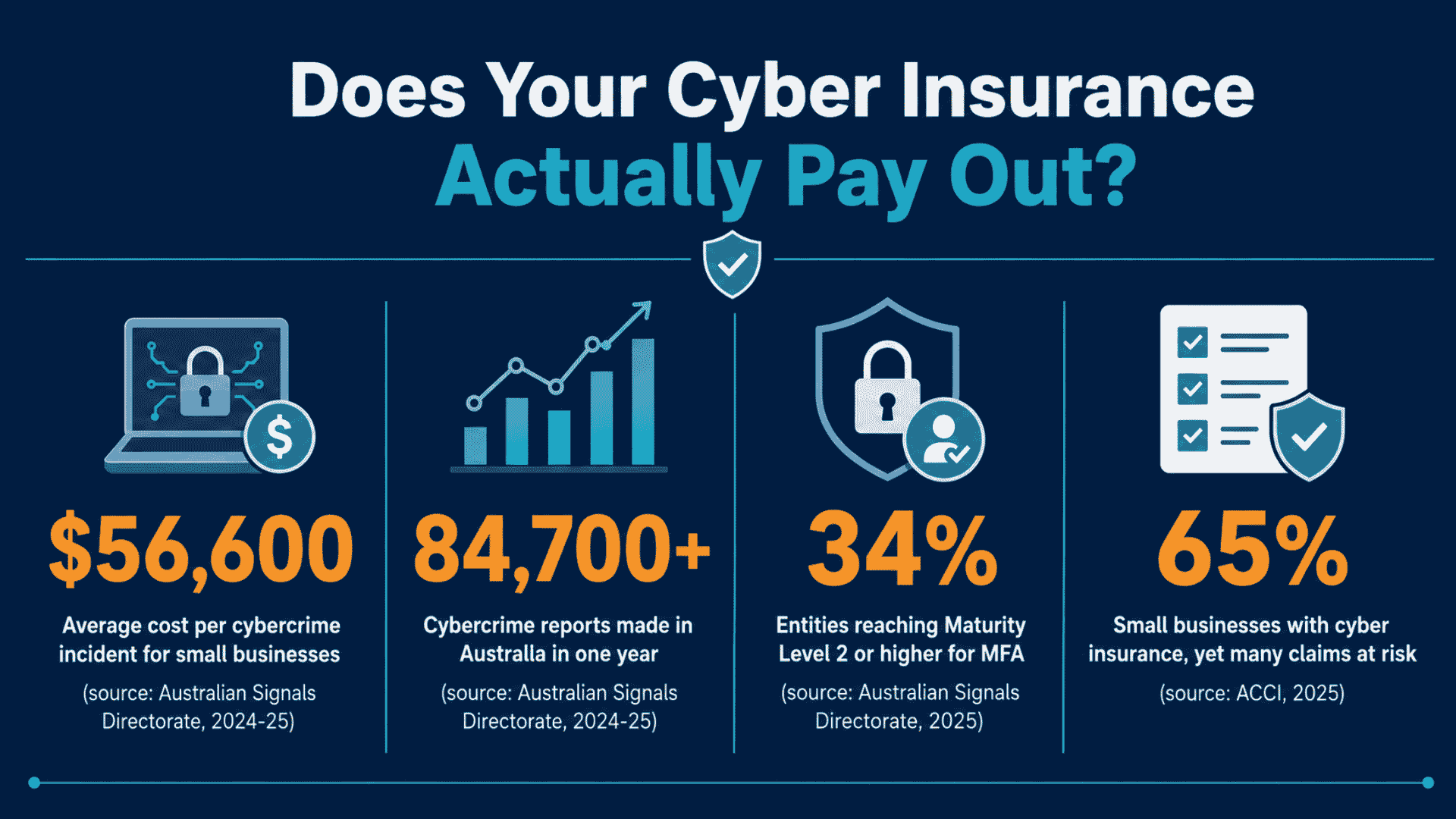
Are you a Brisbane small business owner with cyber insurance? Ask one question before your next renewal. Would your insurer actually pay out if you suffered a breach today? According to the Australian Signals Directorate, small businesses lost an average of $56,600 per cybercrime incident in 2024-25. That figure stings on its own. However, it stings far more when an insurer declines your claim. Insurers decline claims when your security controls fail to meet the policy conditions. In 2026, Essential Eight compliance cyber insurance alignment is no longer a nice-to-have for Australian SMBs. Increasingly, it marks the line between a claim that pays and one that does not. This article explains what Brisbane business owners need to understand before their next renewal.
Why Insurers Are Paying Attention to the Essential Eight
The Essential Eight is the Australian Signals Directorate’s prioritised set of mitigation strategies. These strategies protect organisations against the most common cyber threats. The ASD originally developed the framework for government agencies. Since then, it has steadily moved into the private sector. Insurers now want objective, measurable benchmarks for cyber hygiene. They apply those benchmarks before writing a policy or settling a claim.
The reason is straightforward. Australians lodged more than 84,700 cybercrime reports in 2024-25, according to the Australian Signals Directorate. That volume flows through the system every year. Consequently, insurers cannot afford to underwrite businesses without a documented approach to basic security controls. The Essential Eight gives underwriters a structured question. Has this business done the minimum to protect itself?
For Brisbane SMBs, this matters in two specific ways. First, insurers use Essential Eight maturity level insurance assessments at the application stage. Those assessments set your premium and decide whether the insurer offers cover. Second, your documented compliance posture becomes evidence at claim time. Suppose your policy requires reasonable security measures. You then suffer a breach without a patch management process or multi-factor authentication. Your insurer has clear grounds to reduce or reject the payout.
Not every Australian commercial insurer mandates the framework yet. Nevertheless, the direction of travel is clear. Treat Essential Eight compliance cyber insurance alignment as a business priority now. That choice puts you well ahead of the market.
What the 2026 Essential Eight Updates Mean for Your Cover
The Essential Eight is not static. The 2026 updates have raised the bar for every organisation. They directly affect how insurers assess your cyber hygiene. That assessment happens during underwriting and again after a loss event.
Patching represents the most significant change for SMBs. Saltt Tech reports that Maturity Level 2 now requires 48-hour patching for critical vulnerabilities. That window applies to internet-facing assets. This is a material shift. Many Brisbane businesses expose servers, cloud applications or remote access tools to the internet. If you still run a weekly or monthly patch cycle, you now lag the framework. Moreover, an insurer will review your incident response after a ransomware attack. The forensic team checks when you knew about the vulnerability and when you fixed it. A 30-day gap is difficult to defend.
The updates also emphasise phishing-resistant multi-factor authentication and backup restoration testing. The ASD Essential Eight maturity model sets out both requirements in detail. Insurers now examine these two control areas closely when they assess risk. Furthermore, they treat SMS and email codes as insufficient MFA. Underwriters want hardware keys or authenticator apps on email, remote access and privileged accounts. Backup testing means documented, scheduled restoration tests. An assumption that backups run does not satisfy an insurer.
You should understand these Essential Eight 2026 updates before your renewal conversation. Has your IT provider briefed you on the changes yet? If not, raise the question at your next review.
The Controls Insurers Actually Check at Renewal
Not all eight mitigation strategies carry equal weight with underwriters. As the market evolves, five controls attract the closest scrutiny. Underwriters check them at renewal and again at claim time during Brisbane SMB cyber security assessments.
- Multi-factor authentication: Most insurers treat this control as a baseline requirement. Yet Australian Signals Directorate figures show only 34% of government entities reached Maturity Level 2 for MFA. If government agencies struggle, SMBs without a managed IT provider face even greater risk.
- Patch management: As noted above, the 48-hour window now sets the standard for internet-facing systems. Insurers want evidence of a documented patch process, not verbal assurances.
- Backup and recovery: Assessors handling ransomware claims ask when you last tested your backups. They also ask whether you documented your recovery time. Insurers do not count untested backups as a control.
- Application control: Blocking unauthorised software signals strong cyber hygiene maturity. It also shrinks the attack surface that insurers price against.
- Restrict administrative privileges: Attackers commonly exploit accounts that hold unnecessary admin rights. Insurers call this a basic governance failure when it contributes to a breach.
Most Brisbane SMBs can realistically reach Maturity Level 1 across these five controls. The work does not require enterprise-level spending. It does, however, require a structured approach.
Will Your Policy Pay Out? The Compliance Gap Risk
Many Brisbane SMB owners hesitate to ask this question. They should ask it anyway. Cyber insurance for small business Australia is increasingly conditional. Most modern policies include clauses that let insurers reduce or deny a claim. Those clauses trigger when the insured fails to maintain reasonable security controls. Meanwhile, the definition of reasonable keeps shifting toward frameworks like the Essential Eight.
Consider the compliance gap risk in practical terms. You suffer a ransomware attack through an unpatched remote desktop vulnerability. Your insurer’s forensic team finds the patch sat available for 45 days. The updated Essential Eight expects you to patch internet-facing systems within 48 hours. Your insurer therefore argues that you failed to maintain reasonable controls. The insurer disputes your claim.
This is not a hypothetical edge case. Insurers invest heavily in post-incident forensic review. Those reviews identify control failures that let insurers limit payouts. The Australian Chamber of Commerce and Industry found that 65% of small businesses held cyber insurance in 2025. Still, holding a policy and holding a policy that pays are different things. The minority without cover face total exposure. Even insured businesses face partial exposure when their controls fall short.
Essential Eight compliance cyber insurance alignment therefore serves two purposes. It manages your premium and it protects your claim. A formal maturity assessment documents your controls. That documentation gives you evidence when an insurer disputes a payout.

The Procurement Dimension Brisbane SMBs Cannot Ignore
Beyond insurance, Essential Eight compliance now opens and closes commercial doors. Epic IT reports that government and enterprise buyers increasingly require Essential Eight or SMB1001 certification. Buyers ask for that certification before they sign contracts. Many Brisbane businesses supply state agencies, local councils or large corporates. For them, compliance is a direct revenue consideration.
This commercial dimension strengthens the business case for Essential Eight uplift. Compliance protects your claim, reduces your premium and qualifies you for procurement. As a result, the return on investment becomes much easier to calculate. The Australian Chamber of Commerce and Industry found that 61% of small businesses spent over $20,000 yearly on compliance. Channel part of that existing spend into a structured Essential Eight programme. That approach uses your budget far more efficiently than ad hoc activities.
Do you serve government clients or plan to win government work? Then Maturity Level 1 across all eight strategies is no longer optional. It is a commercial prerequisite.
How to Approach Essential Eight Compliance Without Overwhelm
Clarity, not willingness, is the most common barrier Brisbane SMBs face. The framework can appear technical and complex. This is especially true for owners without an in-house IT team. The following approach serves your insurance and commercial objectives directly.
- Commission a maturity assessment: Understand your current state before you spend a dollar on new tools. A structured maturity assessment identifies gaps against each of the eight strategies. It then hands you a prioritised remediation roadmap.
- Prioritise the controls insurers weight most heavily: Focus first on MFA, patch management and backup testing. These three controls deliver the most risk reduction per dollar spent.
- Document everything: An insurer reviewing a claim cannot see undocumented compliance. Your IT policies, patch logs, MFA records and backup reports all count as evidence. Keep them accessible and current.
- Align your renewal conversation: Prepare to present your Essential Eight posture at renewal. Insurers increasingly reward demonstrated compliance with better premiums and broader cover.
- Review annually: The 2026 updates prove that the framework keeps evolving. Build an annual review into your IT governance calendar. Your posture then keeps pace with insurer expectations.
A managed IT provider with Essential Eight experience can guide you through each step. You do not need to become a technical expert yourself. The goal is practical, documented compliance that survives insurer scrutiny. A certification exercise that sits in a drawer achieves nothing.
Conclusion
In 2026, Essential Eight compliance connects directly to real financial protection for Brisbane SMBs. That connection keeps growing stronger. Framework updates, tighter patching rules and closer scrutiny of MFA all point one way. So does the expanding role of Essential Eight in government procurement. Compliance is no longer a technical nicety. Ultimately, it decides whether your insurance pays when you need it most.
Netcomp Solutions helps Brisbane businesses assess their Essential Eight maturity. We close the gaps that put insurance claims at risk. We also build the documented evidence base that holds up when it counts. Are you approaching a renewal, or have you never assessed your posture? Now is the right time to act. Contact the Netcomp team today to arrange a no-obligation Essential Eight assessment.
Frequently Asked Questions
Does my cyber insurance policy require Essential Eight compliance?
Few Australian cyber policies name the Essential Eight explicitly. Most, however, require you to maintain reasonable or industry-standard security controls. In 2026, insurers increasingly treat Maturity Level 1 as that baseline. Missing the standard gives them grounds to dispute or reduce a claim. Review your policy wording carefully. Then ask your broker how they define adequate security controls.
Which Essential Eight controls matter most for cyber insurance?
Underwriters examine MFA, patch management and backup testing most closely. Many treat MFA as a hard requirement for cover. They scrutinise patch management after incidents involving known vulnerabilities. Backup testing matters most in ransomware claims. Untested backups do not qualify as a functioning recovery control. Assessors also review application control and administrative privileges during investigations.
What Essential Eight maturity level do I need for cyber insurance?
Most insurers currently look for Maturity Level 1 across the core controls. Larger policies or sharper premium rates may require Maturity Level 2. This applies particularly to businesses handling sensitive data or working in regulated industries. Above all, keep a documented, assessable posture rather than informal practices. Informal practices leave you nothing to evidence after an incident. A formal maturity assessment shows you exactly where you stand.
Can achieving Essential Eight compliance reduce my cyber insurance premium?
Yes, in many cases it can. Insurers price cyber risk on the likelihood and severity of a claim. Documented compliance with a recognised framework presents a lower risk profile. That profile can translate into lower premiums, broader cover terms or both. In contrast, businesses without any documented programme may face higher premiums at renewal. They may also find their cover options reduced.