Cyber threats are not slowing down for Australian small businesses. According to Australian Signals Directorate, Australians report a cybercrime every six minutes. The average self-reported cost of an incident for a small business has reached $56,600, up 14% year on year. Most of those incidents trace back to a human decision: clicking a suspicious link, sharing a password, or failing to spot a fraudulent invoice. Security awareness training for Australian small businesses is no longer a nice-to-have. It is the most cost-effective line of defence your organisation can build in 2026. This article gives Brisbane SMB owners a practical framework for turning your staff into your strongest security asset.
Why Human Error Still Dominates the Threat Landscape
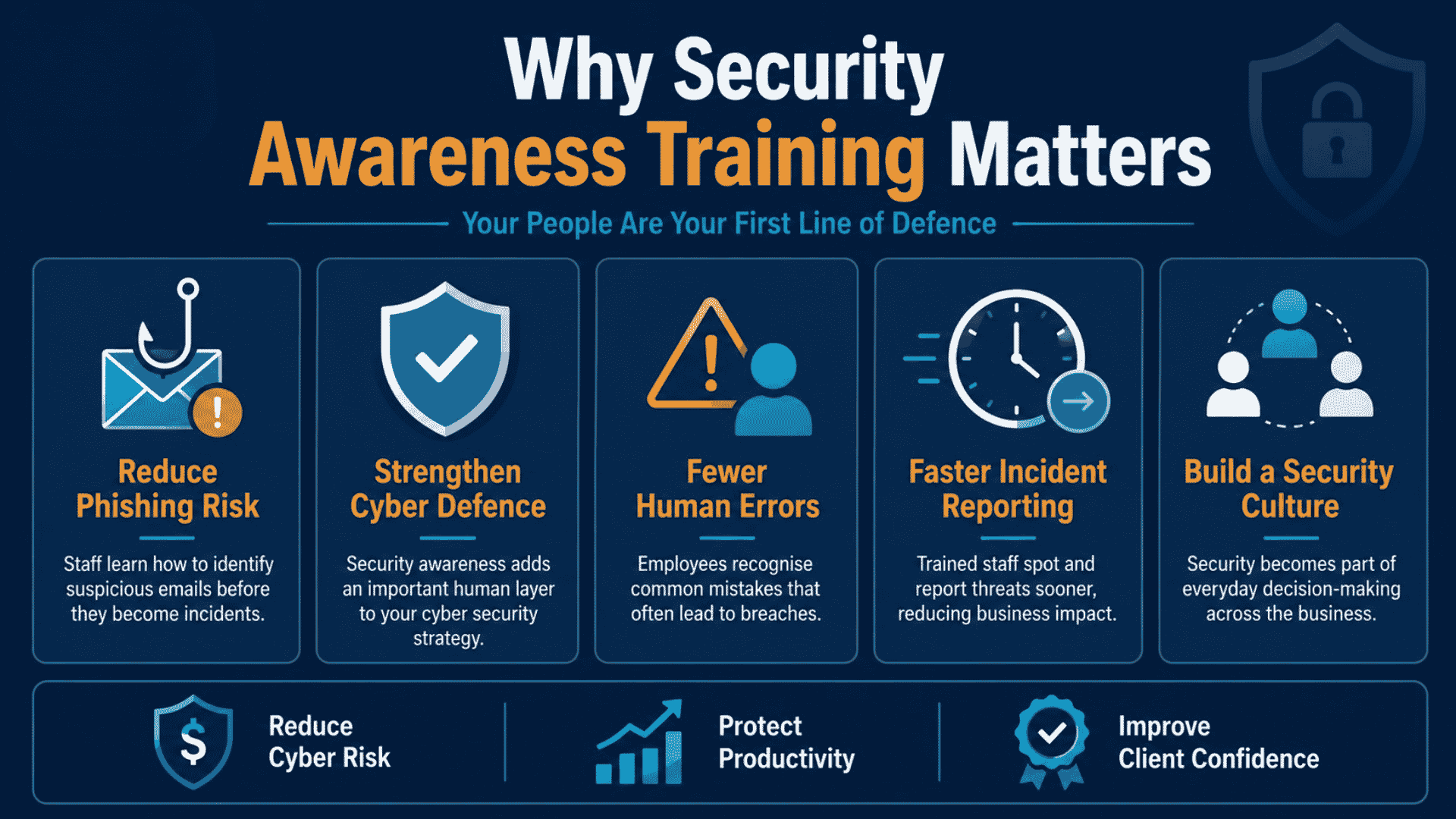
Technology controls such as firewalls, antivirus, and multi-factor authentication are essential. They cannot fully compensate for untrained staff behaviour, however. According to Databox Solutions citing ASD data, 60% of incidents reported to the Australian Signals Directorate involved phishing, meaning the majority of successful attacks begin with an employee opening a malicious email or clicking a deceptive link. That statistic alone makes phishing training for employees the single highest-return investment a small business can make.
The scale of the problem is also specific to your sector. According to Cosca citing the ACSC, 43% of reported cybercrime incidents in Australia involved small businesses. Attackers deliberately target smaller organisations because they know resources and training are often limited. When your staff cannot recognise a social engineering attempt, a spoofed supplier email, or a credential-harvesting login page, attackers can bypass even the best technical controls.
The encouraging reality is that trained employees who know what to look for can interrupt an attack before it causes damage. Building that capability does not require a dedicated security team. It requires a structured, repeatable awareness program.
The Problem With One-Off Compliance Training
Most small businesses that do invest in cyber security training for staff in Australia fall into the same trap: they run a single annual session, tick the compliance box, and move on. Research consistently shows that staff forget knowledge they gained in a one-off workshop within weeks. Behaviour rarely changes unless learning is reinforced over time and connected to real, job-specific scenarios.
Boards and regulators are now taking a harder look at this. Australian compliance guidance increasingly expects organisations to demonstrate that training occurred. It also requires evidence that training produced measurable behavioural outcomes. If your business handles personal data under the Privacy Act, manages client financial information, or operates within a supply chain with security requirements, a single annual slide deck will not satisfy scrutiny.
The shift you need to make is from treating security awareness training as a compliance obligation to treating it as a continuous staff development program. That reframe changes everything: the format, the frequency, the metrics, and the culture it creates.
Core Components of an Effective 2026 Awareness Program
Effective cyber security training for staff in Australia in 2026 combines three evidence-based components. Each one reinforces the others.
Simulated Phishing Campaigns
Simulated phishing involves sending your employees realistic but harmless fake phishing emails and tracking who clicks, who submits credentials, and who reports the attempt. This is the most powerful tool available for building phishing awareness because it creates a safe consequence for a dangerous behaviour. When a staff member clicks a simulated link, they receive immediate, contextual feedback. The feedback explains what they missed and why it mattered. Over time, click rates fall and reporting rates rise. For Brisbane small businesses, platforms such as KnowBe4, Proofpoint Security Awareness Training, and similar tools make it practical to run these campaigns without an in-house security team.
Micro-Learning Modules
Rather than long annual sessions, micro-learning delivers short focused lessons, typically two to five minutes, on a single topic. Examples include spotting a business email compromise attempt, creating a strong passphrase, or safely handling a USB device. Delivered weekly or fortnightly, these modules maintain awareness without overwhelming staff. They are also easy to fit into busy schedules, which matters enormously in small business environments where every staff member wears multiple hats.
Policy Reinforcement and Real-World Scenarios
Training without policy context is easily forgotten. Each micro-lesson or simulation should link back to a specific workplace policy. Relevant examples include how to report a suspicious email, what to do if credentials were compromised, or when to escalate an unusual payment request. Using real-world scenarios drawn from your own industry, whether that is professional services, retail, trade, or healthcare, makes the training immediately relevant and more likely to be remembered.
Building a Social Engineering Awareness Program That Sticks
Phishing is only one form of social engineering. A comprehensive social engineering awareness program also covers vishing (voice phishing via phone calls), smishing (SMS-based attacks), pretexting (impersonation of suppliers or executives), and physical tailgating. In 2026, AI-generated voice cloning and deepfake video have made impersonation attacks significantly more convincing. Australian small businesses are beginning to encounter these attacks directly.
Your awareness program should teach staff a simple decision framework. They can apply it whenever they feel pressured into taking an action involving money, access, or information. The framework is straightforward: stop, verify through a separate channel, and report. This three-step response neutralises the urgency and authority tactics that make social engineering effective.
Regular role-play exercises, where staff practise responding to a simulated vishing call or a suspicious walk-in request, are highly effective and cost very little to run. They also signal to your team that leadership takes security seriously, which builds the psychological safety needed for staff to report genuine incidents without fear of blame.
Measuring Real Behavioural Change, Not Just Completion Rates

Completion rates tell you who watched the video. They do not tell you whether behaviour changed. For security awareness training in Australia to deliver genuine risk reduction, you need to track metrics that reflect actual behaviour in your workplace.
Key metrics to monitor include your simulated phishing click rate over time, the rate at which staff report suspicious emails to your IT support or MSP, and the results of periodic knowledge assessments. You should also track the number of genuine incidents that a staff member recognised and escalated early. Over a twelve-month program, most organisations see phishing click rates drop by 60 to 80% and reporting rates increase substantially. These numbers are defensible evidence of a functioning program and are increasingly relevant for cyber insurance applications and client due diligence requests.
According to IT Brief citing ISACA, 54% of Australian cybersecurity teams reported insufficient personnel in 2025. For small businesses, this means you cannot rely on hiring your way to security. A well-measured awareness program turns your existing staff into an effective early warning system. They can catch threats before those threats escalate into incidents costing your business tens of thousands of dollars.
Getting Started: A Practical 90-Day Launch Plan for Brisbane SMBs
If your business does not yet have a structured security awareness training program, the following 90-day framework gives you a practical starting point.
- Days 1 to 14 – Baseline assessment: Send your first simulated phishing campaign with no prior warning to establish a baseline click rate. Conduct a brief staff survey to understand current security knowledge gaps and confidence levels.
- Days 15 to 30 – Policy and platform setup: Review and update your acceptable use, password, and incident reporting policies. Choose a training platform that suits your budget and team size. Many managed IT providers, including those servicing Brisbane’s small business community, can bundle awareness training into a managed security package.
- Days 31 to 60 – Launch micro-learning and first simulation: Begin fortnightly micro-learning modules starting with phishing identification, password hygiene, and reporting procedures. Run your second simulated phishing campaign and compare results to your baseline.
- Days 61 to 90 – Reinforce and measure: Hold a brief team debrief sharing aggregate results (not individual call-outs). Recognise staff who reported simulated phishing attempts. Review your metrics and adjust training topics based on where gaps remain.
According to CPA Australia, 42-45% of Australian small businesses reviewed their cybersecurity protections in the past six months. If your competitors are reassessing their controls and you are not, you are falling behind. The good news is that launching a structured awareness program does not require a large budget. It requires commitment, consistency, and a willingness to treat your staff as capable learners.
Conclusion
Security awareness training in Australia is no longer optional for small businesses. Those that want to manage risk, satisfy clients, and protect their bottom line must invest in it. The threat landscape in 2026 is faster, more automated, and more targeted than ever. Yet the solution is fundamentally human. You need staff who know what to look for, feel confident reporting suspicious activity, and understand the real-world consequences of a successful attack.
At Netcomp Solutions, we help Brisbane small businesses build and run practical, measurable security awareness training programs that go beyond tick-box compliance. From simulated phishing campaigns to ongoing micro-learning and reporting frameworks, we make it straightforward to protect your business without overwhelming your team.
Ready to build a program that actually changes behaviour? Contact the Netcomp Solutions team today for a no-obligation conversation about security awareness training tailored to your Brisbane business.
Frequently Asked Questions
How often should Australian small businesses run security awareness training?
Best practice in 2026 is continuous rather than annual. A well-designed program delivers short micro-learning modules fortnightly or monthly. It supplements these with simulated phishing campaigns every six to eight weeks. This cadence maintains staff alertness without creating training fatigue. It also produces measurable improvements in behaviour over a twelve-month period.
What is simulated phishing and is it appropriate for a small team?
Simulated phishing involves sending your staff realistic fake phishing emails. The test shows whether they click a link, submit credentials, or correctly report the attempt. It is highly appropriate for small teams. In fact, it is more impactful in smaller organisations where results are immediately visible and can drive a team-wide culture shift. Vendors offer platforms at price points suitable for businesses with five to fifty staff.
Does security awareness training satisfy Australian Privacy Act obligations?
The Privacy Act does not prescribe a specific training format. However, the Office of the Australian Information Commissioner expects organisations to take reasonable steps to protect personal information from misuse, interference, and loss. Regulators consider demonstrable staff training a reasonable step and increasingly cite it in post-breach assessments where insufficient training contributed to an incident. A structured awareness program strengthens your compliance position considerably.
How do I measure whether our security awareness training is actually working?
Track the following metrics over time: your simulated phishing click rate and reporting rate, and results from periodic knowledge assessments. Also monitor the number of real suspicious emails your staff report to IT support and any reduction in security incidents over a twelve-month rolling period. Effective training measurably reduces that exposure over time. Those metrics also form the evidence base your business needs for governance, insurance, and client assurance purposes.