Technically reviewed by Vitaly Ogulev, founder of Netcomp Solutions (Brisbane managed IT and cyber security since 2002).
Nearly half of all Australian small and medium businesses now use artificial intelligence in their day-to-day operations. Yet most still lack anyone in a leadership role to govern how that technology gets chosen, integrated, or protected. According to IBS Intelligence, 69% of Australian SMEs reported regular AI use in January 2026. That is up from just 40% in July 2024. That is a staggering rate of adoption. In most cases, these businesses have no dedicated technology executive steering the ship. If you are a Brisbane business owner, ask yourself whether now is the right time to bring in a virtual CIO. The answer is probably written somewhere in your last six months of decisions. This article gives you five concrete signals. They will help you move from uncertainty to a clear, confident answer on when to hire a virtual CIO.
What the Timing Question Is Really About
Most SME owners who enquire about a virtual CIO already understand what the role involves. The harder question is not “what is a vCIO?” It is “is my business at the point where this investment makes sense right now?” The honest answer depends less on your revenue size and more on the specific friction you are experiencing. Technology leadership becomes valuable the moment your business makes consequential decisions without qualified leadership. This includes decisions about systems, data, compliance, or digital investment. The five signals below are the most reliable indicators that you have crossed that threshold. Score yourself honestly against each one. You will have a much clearer picture by the time you reach the conclusion.
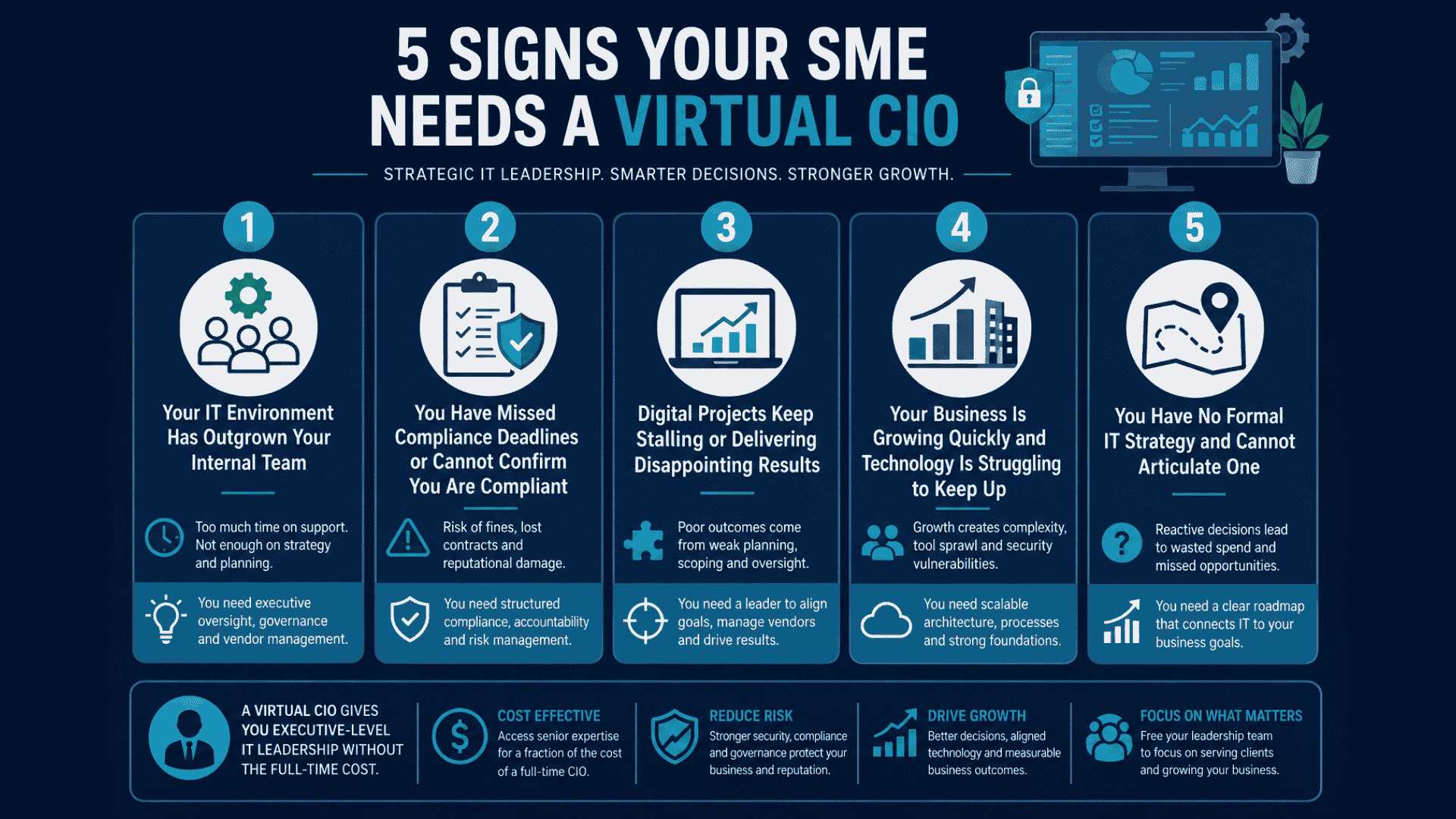
Signal 1: Your IT Environment Has Outgrown Your Internal Team
Every growing business hits a predictable ceiling. The person managing IT, whether a capable internal hire, a part-time technician, or you yourself, can no longer cover both day-to-day demands and the strategic planning your environment now requires. According to IBS Intelligence, 28% of Australian SMEs reported daily AI usage in January 2026. That is up from just 9% in July 2024. When your team uses AI tools daily across multiple business functions, you have moved beyond simple helpdesk territory. Your environment now requires governance, vendor management, and policy oversight.
The warning signs here are subtle at first. Projects get delayed because nobody has time to scope them properly. Vendors are renewed on autopilot because there was no review process in place. Security patches fall behind because reactive support consumes all available hours. If your internal IT contact spends more than 70% of their time on support tickets and less than 30% on forward planning, a strategic gap already exists. This is one of the clearest virtual CIO decision triggers. It is worth acting on before the gap becomes a crisis.
Signal 2: You Have Missed Compliance Deadlines or Cannot Confirm You Are Compliant
For Brisbane SMEs in professional services, healthcare, finance, or construction, regulatory obligations are not optional. These cover data handling, cyber security, and privacy. The challenge is that compliance frameworks keep evolving. They are becoming more complex, more frequently updated, and more closely scrutinised by regulators and enterprise clients alike. If you recently failed to answer a client’s security questionnaire with confidence, missed a compliance review deadline, or found a data handling gap during an audit, that is a direct signal. IT leadership is absent at the executive level.
A virtual CIO brings the structured accountability that compliance requires. They build a compliance calendar and assign ownership. They also coordinate with your legal and finance teams to ensure your technology stack meets its obligations on time. Businesses that defer this work do not save money. They accumulate risk that eventually materialises in fines, lost contracts, or reputational damage. If compliance keeps you up at night, the timing question for a vCIO has already answered itself.
Signal 3: Digital Projects Keep Stalling or Delivering Disappointing Results
If your business has invested in a new platform, cloud migration, automation tool, or business system in the past 18 months, you may have faced difficulties. Projects that drag on far longer than expected or fail to deliver their promised return are very common. According to the Australian Industry Group, 54% of business leaders cited skills constraints as the greatest barrier to technology uptake. That is more than half. The problem in most of these cases is not the technology itself. The root cause is the absence of someone who can translate business goals into a clear technology brief. They also need to manage vendors to scope and measure outcomes against defined objectives.
A virtual CIO acts as your internal advocate and project lead for every digital initiative. They hold vendors accountable, align stakeholders, set realistic timelines, and course-correct when projects drift. If you rely entirely on a software vendor’s implementation team to define success criteria, your business is ceding strategic control. That is a textbook outsourced CIO timing signal. For a broader overview of this role, see our guide to virtual CIO services for Australian small businesses. It covers how the service is structured and the fundamentals in detail.
Signal 4: Your Business Is Growing Quickly and Technology Is Struggling to Keep Up

Rapid headcount growth, new service lines, interstate expansion, or a surge in client volume all put pressure on your IT environment. That pressure is immediate. Systems that worked well for a team of 12 often buckle under the demands of a team of 30. New staff need onboarding processes, access controls, and device management. Also new revenue streams need supporting infrastructure. New locations need connectivity and security that matches the rest of the business.
According to NAB, 51% of SMEs now use AI in marketing and sales functions. Another 39% are using it in operations and logistics. That level of functional adoption across multiple departments creates tool sprawl almost immediately. Without strategic oversight, you accumulate subscriptions, integrations, and data flows nobody fully understands. These create both security vulnerabilities and operational inefficiencies. A virtual CIO builds architecture that scales with you rather than behind you. They ensure your technology investment grows in proportion to your business, not in spite of it.
The cost argument here is also compelling. Based on Seek Salary Insights 2025 and industry benchmarks, the average Australian full-time CIO salary sits between $220,000 and $280,000 per year. That includes superannuation and benefits. A vCIO engagement typically costs between $2,000 and $5,000 per month. For a growing Brisbane SME that needs executive-level IT leadership, a full-time hire may not yet be justified. In that case, the value proposition of a vCIO is straightforward.
Signal 5: You Have No Formal IT Strategy and Cannot Articulate One
This is the most telling signal of all. If someone asked you today to explain your technology roadmap for the next 12 to 24 months, could you answer with confidence? That roadmap should cover your security posture, cloud strategy, key vendor relationships, and how IT investment connects to your growth objectives. If the honest answer is no, your business is making technology decisions in a reactive vacuum. Research from Deloitte Tech Trends Australia 2024 found that businesses aligning IT investment to a formal strategy are 2.5 times more likely to report revenue growth above 10% year-on-year compared to those operating without an IT roadmap.
According to IBS Intelligence, 43% of Australian AI users reported that AI has contributed directly to higher revenues. That result does not happen by accident. It happens when technology choices are made with clear business goals in mind. The right tools must be selected and integrated properly, and someone must be accountable for measuring the outcome. A virtual CIO is precisely that person. They build your IT strategy, communicate it to stakeholders, and update it as your business evolves. If you do not have that today, you are leaving measurable value on the table.
How to Use These Signals as a Readiness Checklist
Rather than treating these signals as a binary yes or no, use them as a vCIO readiness checklist. For each of the five signals above, ask yourself honestly whether it applies to your business right now. If you identified with two or three of them, you are approaching the threshold where a virtual CIO engagement will start delivering a measurable return. If you identified with four or five, the case for engaging one now is strong. The cost of waiting is likely higher than the cost of acting.
IT leadership for SMEs does not need to mean a full-time executive salary. It means having a qualified, experienced professional who understands your business and takes responsibility for your technology direction. They show up consistently to ensure your systems support your growth rather than slow it down. That is what a virtual CIO delivers. For the majority of Brisbane SMEs whose technology environment has grown faster than their internal capability, the timing is now.
Conclusion
The question of when to hire a virtual CIO rarely has a dramatic answer. In most cases, the right moment is not a single event. It is a cluster of signals that have been quietly accumulating. The five clearest indicators are: internal teams stretched beyond their strategic capacity, compliance obligations not being met with confidence, digital projects that keep underdelivering, technology straining under rapid growth, and the absence of any formal IT roadmap. Together, these signal that IT leadership at the executive level is overdue. If you recognised your business in three or more of those signals, take action. The most useful next step is a conversation with someone who can assess your situation and give you an honest recommendation.
Ready to find out if a virtual CIO is the right move for your Brisbane business? Talk to the Netcomp team today for a no-obligation consultation. Get a clear picture of where your IT strategy stands right now.
Frequently Asked Questions
How is a virtual CIO different from a standard managed IT provider?
A managed IT provider focuses primarily on keeping your systems operational. This covers helpdesk support, monitoring, backups, and security patching. A virtual CIO operates at the strategic layer above that. They set the technology direction for your business, manage vendors and budgets, oversee compliance, and align your IT investment to your commercial goals. Many Brisbane SMEs benefit from having both, with the vCIO providing leadership and the managed services team handling day-to-day execution.
Is a virtual CIO only relevant for businesses above a certain size?
No. A virtual CIO becomes most impactful once a business has 15 or more staff or manages a meaningful technology budget. However, the trigger for engagement is less about headcount and more about complexity. A business with 10 employees running cloud apps and handling sensitive client data may have a stronger case for a vCIO than a 50-person business. It depends on complexity, not headcount. The five signals in this article are a more reliable guide than staff numbers alone.
How quickly does a virtual CIO engagement typically deliver value?
Most businesses see early value within the first 60 to 90 days. The initial phase usually involves an IT audit, a gap analysis, and a vendor review. From there, a 12-month technology roadmap is developed. Compliance improvements, cost savings from rationalised vendor contracts, and clearer project governance often become visible within the first quarter. Strategic outcomes such as revenue-linked digital initiatives tend to become measurable over a six to twelve month horizon.
What should I look for when choosing a virtual CIO provider in Brisbane?
Look for a provider with experience across businesses of a similar size and industry to yours. They should also have a structured onboarding process and a clear framework for measuring and reporting outcomes. They should be able to articulate how they align IT strategy to business objectives, not just how they manage technology. Transparency around engagement terms and regular reporting cadences are important. Local availability for in-person meetings is also a key factor for Brisbane SMEs working with a virtual CIO for the first time.