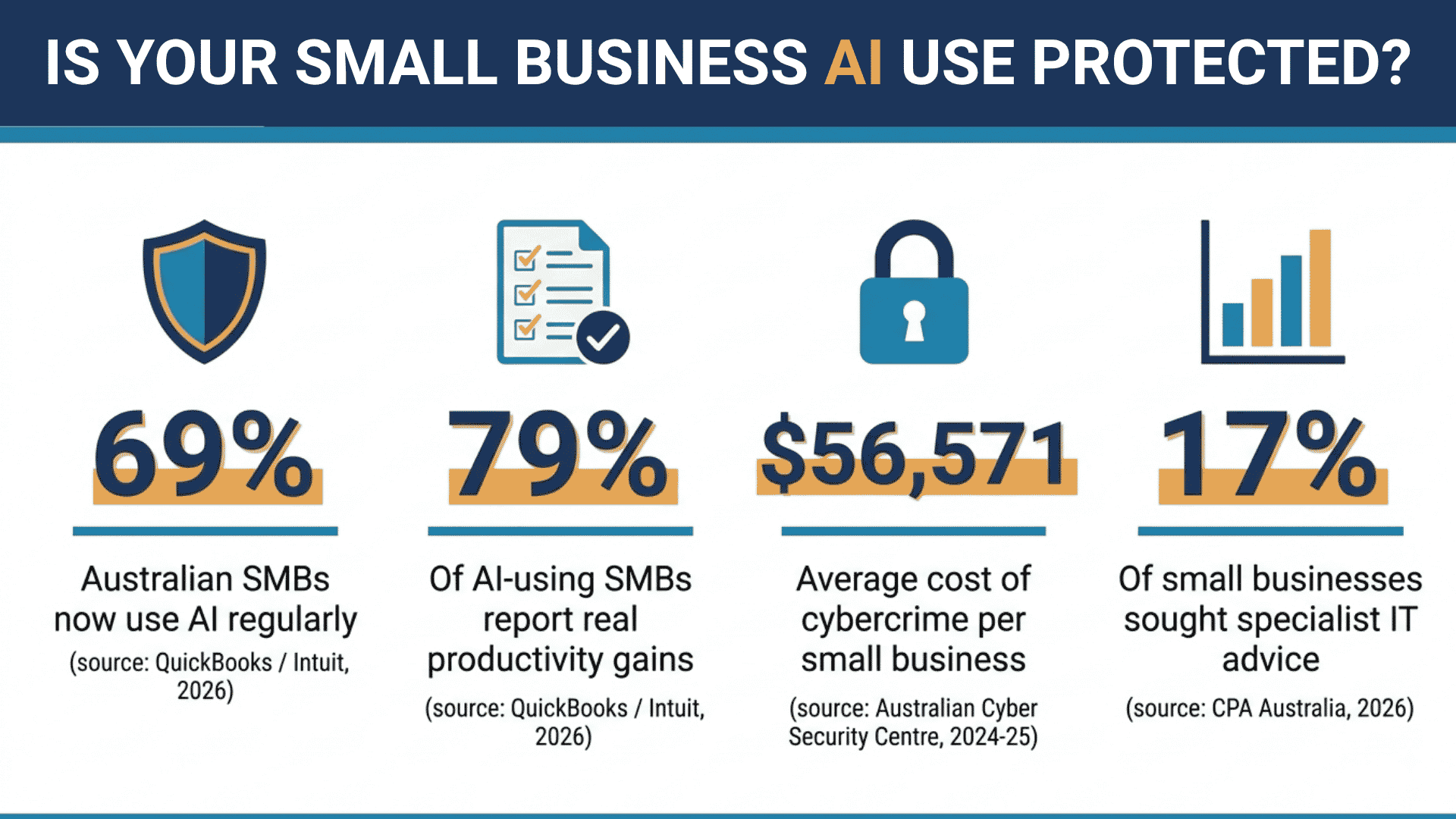
According to the National AI Centre’s AI Adoption Tracker, about 45% of Australian small and medium businesses report active AI adoption in their operations. Moreover, 79% of those businesses report genuine productivity gains. That is a remarkable shift in a short time. But here is the problem. Most Brisbane and Gold Coast small businesses use tools like ChatGPT and Microsoft 365 Copilot. Yet they have no formal rules in place. Staff are pasting client information into prompts, generating documents with unreviewed outputs, and connecting third-party AI apps to business accounts. Without a clear AI policy for small business Australia, this is a data breach waiting to happen. This article explains what you need to lock down now. It also shows how to build a practical AI use policy your team will actually follow.
Why AI Governance Is Suddenly Urgent for Small Business
A few years ago, AI governance was a concern for enterprise IT departments. Back then, it did not worry a Brisbane accounting firm with eight staff. Nor did it trouble a Gold Coast trades business with two admin people. That has changed quickly. In early 2026, 43% of Australian SMEs reported some AI adoption, according to AI.gov.au / National AI Centre. That figure reached 44% in February, the strongest result in several months. Nearly half of small businesses now use these tools in daily operations. As a result, the risks are just as real for small businesses as for larger organisations.
The financial stakes are real. The Australian Cyber Security Centre reports a sharp rise in cybercrime costs. The average self-reported cost for a small business reached $56,571 in 2024-25. That was up from $49,615 the year before. Uncontrolled AI use opens a new category of exposure that sits alongside phishing and ransomware. Staff often paste client names, financial details, or medical information into a public AI tool. The provider may then use that data to train future models. It may also store the data on offshore servers. In some cases, third parties can access it under the provider’s terms of service. None of that is consistent with your obligations under the Privacy Act 1988.
The gap between adoption and governance is the core problem. According to CPA Australia, only 17% of Australian small businesses sought advice from IT consultants or specialists. This means the vast majority adopt AI tools without any structured oversight. An AI policy for small business Australia is the practical tool that closes this gap.
What an AI Use Policy Actually Covers
A common misconception is that an AI policy is a long legal document that nobody reads. In practice, a useful policy is a clear, plain-English document. It answers four questions. First, which AI tools does the business approve? Second, what data can staff enter? Third, who reviews the output? Fourth, what happens when something goes wrong?
Here is what a well-structured AI use policy for a Brisbane or Gold Coast SMB should cover:
- Approved tools list: Specify which AI tools staff may use. This might include Microsoft 365 Copilot within your existing Microsoft tenancy. It could also cover licensed ChatGPT Enterprise or a specific industry tool. Your policy should clearly prohibit unapproved tools, such as free public AI chatbots, for any client or business data.
- Data classification rules: Define what information staff must never enter into any AI tool. This list typically includes client names, contact details, financial records, health information, and tax file numbers. It also covers any information that confidentiality agreements protect.
- Output review requirements: State that a qualified person must review and verify all AI-generated content. This review must happen before anyone sends it to clients, uses it in reports, or publishes it. AI tools can produce confident-sounding but incorrect information, which creates professional and legal risk.
- Incident reporting: Set out a process for staff to report mistakes. They should report whenever they believe they accidentally entered restricted information into an AI tool. Early reporting allows your IT provider or internal team to assess whether a notifiable data breach has occurred.
- Acceptable use boundaries: Clarify the difference between low-risk and higher-risk uses. Low-risk uses include drafting internal meeting notes or summarising public information. Higher-risk uses, such as generating client advice or processing financial data, need additional sign-off.
A policy does not need to be more than two to three pages. The goal is clarity, not comprehensiveness.
ChatGPT and Copilot: Understanding the Privacy Difference
Brisbane small business owners need to understand one important point. Not all AI tools carry the same privacy risk. A ChatGPT policy for business looks different depending on which version your team uses. Likewise, Copilot data privacy small business considerations differ from consumer-grade tools.
The free and basic paid tiers of ChatGPT come from OpenAI’s consumer product. These tiers may use your conversation data to improve their models. That happens unless you specifically opt out in the settings. Most employees using these tools on a personal account have not done this. Imagine a staff member pastes a client’s email into ChatGPT to draft a reply. That content may then leave your control entirely.
ChatGPT Enterprise and Microsoft 365 Copilot have contractual data protection provisions that align more closely with business use. Microsoft 365 Copilot operates within your existing Microsoft tenancy. As a result, it follows the same data residency and compliance controls your organisation has already configured. That is a significant difference. However, you still need to set up those controls correctly. Staff must also understand which data suits Copilot and which does not.
Your AI policy should explicitly name the tools your business uses. It should also link to each provider’s current privacy and data handling terms. These terms change, so you should review your policy at least annually to reflect updates.
Building an Approval Workflow for New AI Tools
AI governance often breaks down fastest in one situation. Individual staff members start using new tools without telling anyone. For example, a team member discovers a useful AI browser extension and adds it to Chrome. Within a day, they start using it for client work. No review, no approval, no awareness from the business owner.
A practical AI governance SMB Australia approach includes a lightweight approval workflow. It does not need to be bureaucratic. For most small businesses, the workflow looks like this:
- A staff member identifies a new AI tool they want to use for work purposes.
- They submit a brief request to the business owner or designated IT contact. The request describes the tool, its purpose, and what data they plan to use.
- The IT contact reviews the tool’s data handling terms. This can happen internally or through your managed IT provider. They then assess whether it conflicts with the business’s privacy obligations.
- Finally, the IT contact approves the tool, approves it with conditions, or declines it. They then record the decision.
This process takes minutes for straightforward tools and may take a day or two for tools that handle sensitive data. That is a reasonable delay compared to the alternative. The alternative is discovering months later that a tool processed your client data. And you never read its terms.
According to Deloitte Australia, just 5% of surveyed SMBs using AI are fully AI-enabled. This means most businesses sit in a transitional phase. In this phase, they trial new tools frequently. An approval workflow is most valuable precisely at this stage.
Training Your Team to Use AI Safely
A written policy only works if your staff understand it. For Brisbane and Gold Coast small businesses with small teams, formal training does not need to be a half-day workshop. A one-hour team session is enough to get started. It should cover the approved tools list, the data restrictions, and the incident reporting process. Follow up with a short reference card that staff can keep at their desk or access in a shared drive.
There are a few practical points that training should emphasise:
- The difference between their personal use of AI tools and their professional use. Some staff use ChatGPT at home for recipes and holiday planning. They may not intuitively understand a key point. The same tool is not appropriate for work tasks involving client data.
- How to recognise when a task involves restricted information. Give concrete examples relevant to your industry. For a Brisbane financial services firm, this means client names, account numbers, and tax information. For a Gold Coast healthcare practice, it means patient names, dates of birth, and clinical notes.
- What to do if they make a mistake. Emphasise that the reporting process is about protecting the business, not punishing the individual. Staff who are afraid to report errors are a bigger risk than the errors themselves.
According to the Australian Bureau of Statistics, 19% of innovation-active small businesses used AI in 2024-25. This suggests something important. The businesses most likely to need a policy already experiment with digital tools across multiple areas. Perhaps your business sits in that group. If so, staff training on AI use naturally extends the digital literacy work you already do.

How Netcomp Helps Brisbane and Gold Coast SMBs Get This Right
Building an AI policy for small business Australia is not something most business owners should attempt alone. Several factors require specialist input. These include the privacy implications and the tool-specific data handling terms. They also include the link between AI governance and your existing cyber security controls. That is where Netcomp Solutions comes in.
Netcomp is a Brisbane-based managed IT and cyber security provider focused on small businesses. We help clients across Brisbane and the Gold Coast assess which AI tools suit their environment. We also configure Microsoft 365 Copilot with the right privacy controls. In addition, we develop practical AI use policies for your industry and team size. We do not deliver generic templates. We work with your business to understand what your staff are actually doing and build governance that fits your reality.
According to CPA Australia, 15% of Australian small businesses named AI as their heaviest technology investment in 2025. Clearly, AI is no longer a peripheral experiment. It is a core part of how small businesses operate. The governance needs to match that reality.
Conclusion
Your team is very likely already using AI tools at work, whether you have formally approved them or not. The productivity benefits are genuine and worth capturing. But without a clear AI policy for small business Australia, you also carry real risk. That risk includes client data exposure, privacy breaches, and potential regulatory consequences under Australian law. A practical AI use policy does not require months of legal work. It requires honest answers to a few key questions. Which tools do you approve? What data is off limits? Who reviews the output? And how do staff report incidents? So document those answers and communicate them to your team. This is one of the most useful things a Brisbane or Gold Coast small business owner can do in 2026.
If you are ready to put the right framework in place, Netcomp Solutions can help. Get in touch with our team today to discuss an AI governance review for your business.
Frequently Asked Questions
Does my small business legally need an AI use policy?
There is currently no Australian law that specifically requires a written AI use policy. However, your existing obligations still apply. The Privacy Act 1988 and the Australian Privacy Principles govern how you handle personal information. This includes any information you process through AI tools. Suppose your business shares client data with an AI provider. This may conflict with your privacy policy or client expectations. In that case, you may have a notifiable data breach on your hands. A written AI use policy is the practical safeguard that keeps your team compliant with obligations that already exist.
Is Microsoft 365 Copilot safe to use with client data?
Microsoft designed Copilot for business use, and it operates within your existing Microsoft tenancy. This gives it stronger data protection controls than consumer-grade AI tools. However, “safer” does not mean unrestricted. First, you need to configure your Microsoft environment correctly. Second, your data classification settings need to reflect the sensitivity of client information. Third, your staff still need clear guidance on which data suits Copilot. Netcomp can assess your Microsoft 365 environment and confirm whether Copilot meets your privacy requirements.
What should a small business do if a staff member accidentally puts client data into an AI tool?
The first step is to report it internally as quickly as possible. Your IT provider or managed IT service can then help you assess the incident. Together, you can decide whether it meets the threshold for a notifiable data breach under the Privacy Act. If you suspect an eligible breach, you must assess it within 30 days. Once you confirm an eligible breach, you must notify the Office of the Australian Information Commissioner. You must also notify the affected individuals as soon as practicable. Early internal reporting is critical. It starts that 30-day clock from a position of awareness rather than discovery. Your AI use policy should include a clear, no-blame process for staff to report these situations.
How often should we update our AI use policy?
At minimum, you should review your AI use policy annually. In practice, you should also review it at three other moments. Review it whenever you adopt a significant new AI tool. Review it when a provider updates its data handling terms. Finally, review it when Australian privacy law or guidance changes. The AI landscape is shifting quickly. As a result, a policy from early 2025 may not reflect the tools or risks your business faces in 2026. Building an annual review into your IT governance calendar is the most practical approach for a small business team.